Supervisors hear DPH, hospitals and first responders on strain at psychiatric emergency services
July 28, 2022 | San Francisco County, California
This article was created by AI summarizing key points discussed. AI makes mistakes, so for full details and context, please refer to the video of the full meeting. Please report any errors so we can fix them. Report an error »
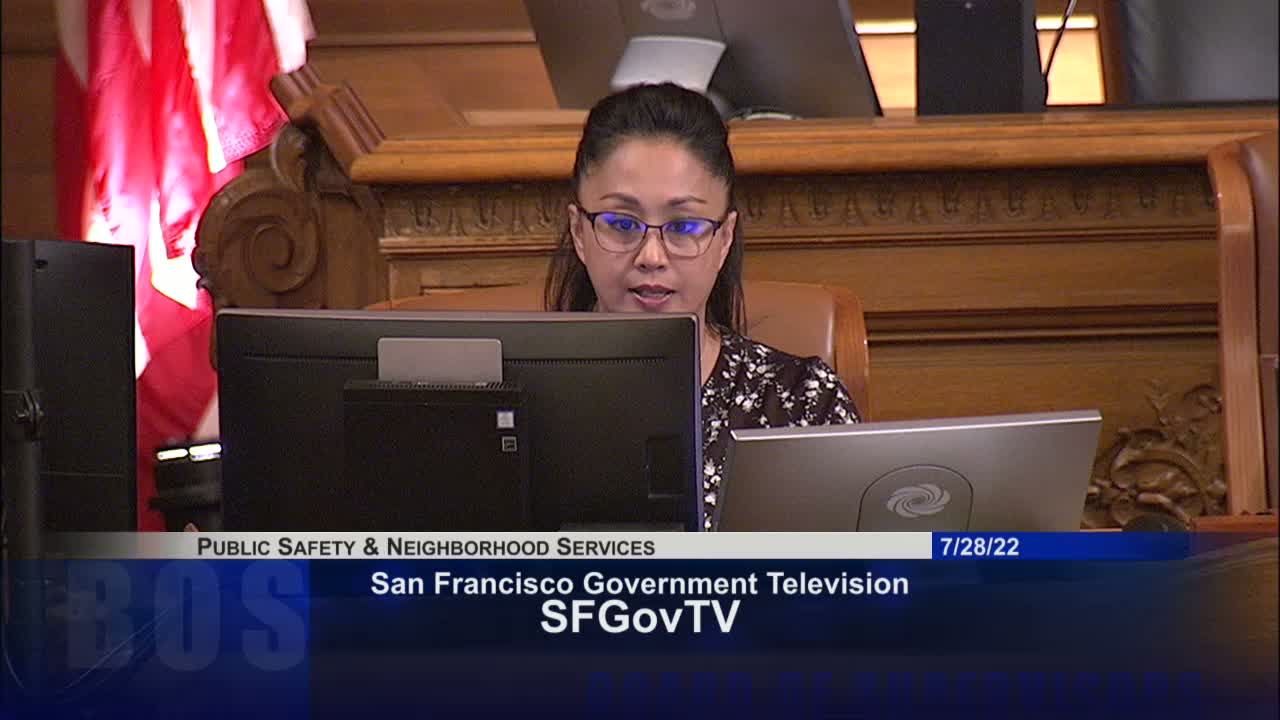
The Public Safety and Neighborhood Services Committee on July 28 heard detailed testimony about persistent capacity and staffing strains at the psychiatric emergency services (PES) unit at Zuckerberg San Francisco General Hospital (ZSFG).
Supervisor Rafael Mandelmann, who requested the hearing, said the city has long known PES is under pressure and asked DPH and partners to clarify staffing, diversion options and discharge practices. "Concerned about the state of PES is not ... new at the board of supervisors," Mandelmann said, opening the discussion.
DPH psychiatrist Mark Leary described PES as "the only dedicated psychiatric emergency service in the city and county of San Francisco," operating 24/7 with psychiatrists on duty and a multidisciplinary clinical team. Leary said DPH changed its COVID-era intake process to route psychiatric patients through the hospital emergency department (ED) for screening; about 82% of the time in 2022 PES accepted immediate transfers from the ED after medical clearance, while 18% of the time transfers had to wait until a PES space opened. Leary said roughly 18% of PES presentations result in acute inpatient admission, about 5% go to psychiatric respite or urgent‑care clinics and roughly 65% are discharged with outpatient referrals.
Dr. Hilary Cunnens (DPH) outlined community programs intended to relieve PES demand: Street Crisis Response Teams (SCRT) (reported to have engaged >5,000 clients from Nov 2020–June 2022), Door urgent care (about 1,600 admissions last fiscal year), Hummingbird respite beds and a newly opened sobering center ramping up to 24/7. She said the city is planning a crisis diversion unit expected to open in late 2023 with capacity for ~16 clients and up to 23 hours of medically supervised stabilization, operated under an RFP to a nonprofit provider.
Committee members pressed DPH on the character and effectiveness of referrals from PES: how many patients receive a warm handoff to a named case manager versus a paper referral, and whether a small subset of "frequent utilizers" drive repeated visits. DPH said data systems are being built (including Epic conversion) and that new bridge and coordinated‑care teams will provide more robust follow‑up; officials said they plan to publish dashboards and begin releasing more timely data this year.
Nursing and clinical staff and union leaders gave a different view of on‑the‑ground capacity. SEIU RN chapter president Heather Bolin read nursing staff reports describing high acuity, chronic understaffing, long boarding times (she cited multiple staff reports that patients have boarded 60–100+ hours in the ED or PES), lack of ancillary staff and insufficient security. "Acuity is high. We're short staffed. Patients have been here for over 100 hours," Bolin said, urging the city to address staffing, ancillary support and retention incentives.
UCSF emergency‑medicine faculty and ED clinicians described long ED hold times and the use of Door by private hospitals to create safe discharges. SFFD and SFPD representatives described on‑street response: SCRT transports commonly go to Door, Hummingbird or other diversion sites when appropriate, and SFPD emphasized legal thresholds for 5150 detentions and the need for clearer, HIPAA‑compliant data exchanges when patients are released.
Department officials acknowledged gaps and pledged follow‑up: DPH said it would provide additional data on the 72 occasions raised in committee when staff recommended against release but a patient left, supply further details about the planned crisis‑diversion unit and produce more timely transfer/boarding metrics.
Procedural outcome: after three hours of testimony and public comment, the committee voted to continue Item 1 to the call of the chair so DPH can return with details on the crisis diversion timeline, placement counts and staffing plans. The roll call recorded two ayes and the item was continued.
What’s next: DPH will supply requested data on transfers, conservatorship outcomes and the planned diversion unit; the committee scheduled further follow‑up when staff and data are available.
Supervisor Rafael Mandelmann, who requested the hearing, said the city has long known PES is under pressure and asked DPH and partners to clarify staffing, diversion options and discharge practices. "Concerned about the state of PES is not ... new at the board of supervisors," Mandelmann said, opening the discussion.
DPH psychiatrist Mark Leary described PES as "the only dedicated psychiatric emergency service in the city and county of San Francisco," operating 24/7 with psychiatrists on duty and a multidisciplinary clinical team. Leary said DPH changed its COVID-era intake process to route psychiatric patients through the hospital emergency department (ED) for screening; about 82% of the time in 2022 PES accepted immediate transfers from the ED after medical clearance, while 18% of the time transfers had to wait until a PES space opened. Leary said roughly 18% of PES presentations result in acute inpatient admission, about 5% go to psychiatric respite or urgent‑care clinics and roughly 65% are discharged with outpatient referrals.
Dr. Hilary Cunnens (DPH) outlined community programs intended to relieve PES demand: Street Crisis Response Teams (SCRT) (reported to have engaged >5,000 clients from Nov 2020–June 2022), Door urgent care (about 1,600 admissions last fiscal year), Hummingbird respite beds and a newly opened sobering center ramping up to 24/7. She said the city is planning a crisis diversion unit expected to open in late 2023 with capacity for ~16 clients and up to 23 hours of medically supervised stabilization, operated under an RFP to a nonprofit provider.
Committee members pressed DPH on the character and effectiveness of referrals from PES: how many patients receive a warm handoff to a named case manager versus a paper referral, and whether a small subset of "frequent utilizers" drive repeated visits. DPH said data systems are being built (including Epic conversion) and that new bridge and coordinated‑care teams will provide more robust follow‑up; officials said they plan to publish dashboards and begin releasing more timely data this year.
Nursing and clinical staff and union leaders gave a different view of on‑the‑ground capacity. SEIU RN chapter president Heather Bolin read nursing staff reports describing high acuity, chronic understaffing, long boarding times (she cited multiple staff reports that patients have boarded 60–100+ hours in the ED or PES), lack of ancillary staff and insufficient security. "Acuity is high. We're short staffed. Patients have been here for over 100 hours," Bolin said, urging the city to address staffing, ancillary support and retention incentives.
UCSF emergency‑medicine faculty and ED clinicians described long ED hold times and the use of Door by private hospitals to create safe discharges. SFFD and SFPD representatives described on‑street response: SCRT transports commonly go to Door, Hummingbird or other diversion sites when appropriate, and SFPD emphasized legal thresholds for 5150 detentions and the need for clearer, HIPAA‑compliant data exchanges when patients are released.
Department officials acknowledged gaps and pledged follow‑up: DPH said it would provide additional data on the 72 occasions raised in committee when staff recommended against release but a patient left, supply further details about the planned crisis‑diversion unit and produce more timely transfer/boarding metrics.
Procedural outcome: after three hours of testimony and public comment, the committee voted to continue Item 1 to the call of the chair so DPH can return with details on the crisis diversion timeline, placement counts and staffing plans. The roll call recorded two ayes and the item was continued.
What’s next: DPH will supply requested data on transfers, conservatorship outcomes and the planned diversion unit; the committee scheduled further follow‑up when staff and data are available.
View the Full Meeting & All Its Details
This article offers just a summary. Unlock complete video, transcripts, and insights as a Founder Member.
✓
Watch full, unedited meeting videos
✓
Search every word spoken in unlimited transcripts
✓
AI summaries & real-time alerts (all government levels)
✓
Permanent access to expanding government content
30-day money-back guarantee
