Committee recommends ordinance to limit ‘phantom’ GO bond pass-throughs to tenants
April 15, 2024 | San Francisco County, California
This article was created by AI summarizing key points discussed. AI makes mistakes, so for full details and context, please refer to the video of the full meeting. Please report any errors so we can fix them. Report an error »
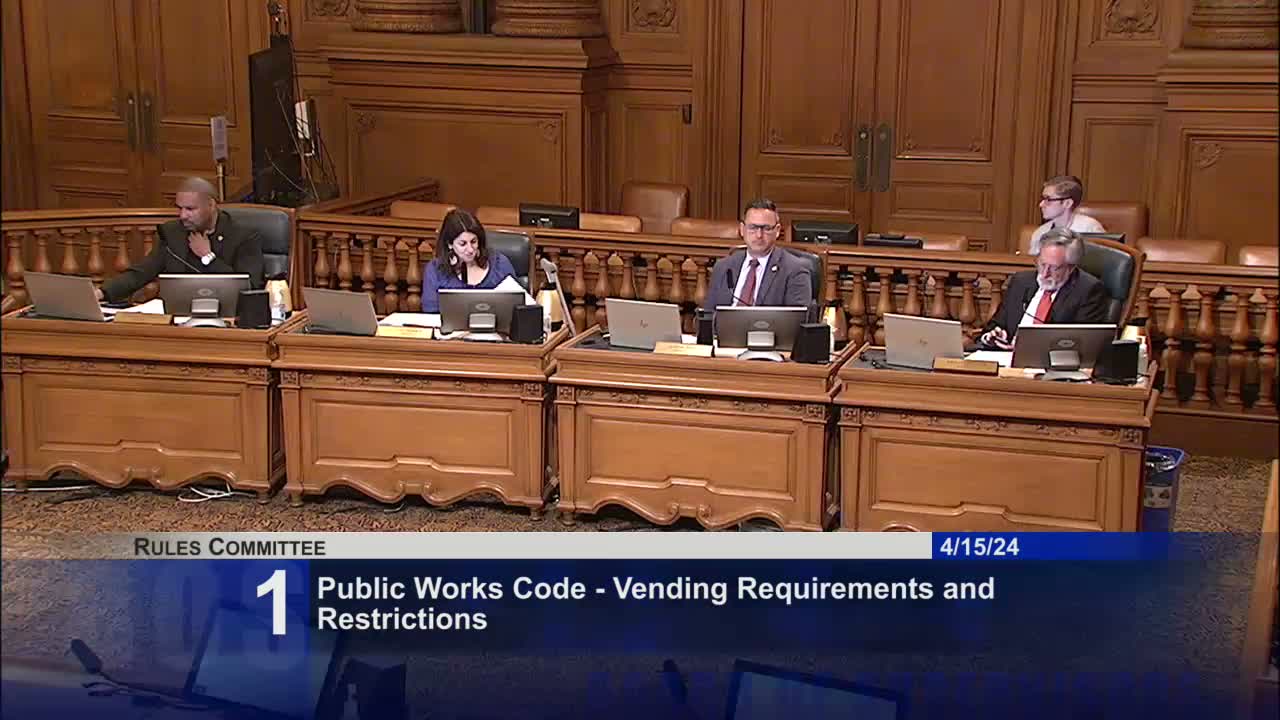
The Rules Committee on April 15 recommended an ordinance that would change how landlords calculate tenant pass-throughs for general obligation (GO) bonds, with sponsors and tenant advocates saying the rule will stop some landlords from charging tenants for bond-related costs that have not actually raised property tax rates.
President Aaron Peskin, a cosponsor, said the ordinance uses the tenant’s move-in date (or 2005, whichever is later) and the specific issuing entity’s tax-rate change to compute a tenant-level pass-through. "This ordinance...catches us up," Peskin said, citing the city’s capital-plan practice, adopted in 2005, that has generally kept the city’s GO bond-related marginal tax rate flat.
Deepa Varner of the Rent Board described existing hardship relief: tenants receiving means-tested public assistance, tenants whose rent exceeds 33% of household income with assets under $60,000, or tenants with exceptional circumstances can seek deferral of pass-throughs. Varner said the rent board had processed 107 applications with 56 granted, about 32 pending, and noted an average landlord charge of approximately $20.66 per month for GO bond pass-throughs and average deferred amounts near $2.12.
Jamie Whitaker from the budget office explained how the controller’s office currently computes aggregate pass-through rates and how the ordinance would change calculations to account for move-in date and the eligible bonds by issuance entity. Whitaker said the proposed change would reduce the pass-through in many cases by isolating increases attributable to bond issuances after a tenant moved in.
Public comment included long lines of tenants and tenant advocates who called the practice a loophole used by some corporate landlords to extract additional rent; several tenant advocates urged the committee to act. Representatives of landlord groups and some property managers urged caution, citing administrability concerns for small owners and the long-standing compromise embedded in the current law. President Peskin offered a minor "approved-as-to-form" amendment and the committee voted to send the ordinance to the full Board with a positive recommendation.
President Aaron Peskin, a cosponsor, said the ordinance uses the tenant’s move-in date (or 2005, whichever is later) and the specific issuing entity’s tax-rate change to compute a tenant-level pass-through. "This ordinance...catches us up," Peskin said, citing the city’s capital-plan practice, adopted in 2005, that has generally kept the city’s GO bond-related marginal tax rate flat.
Deepa Varner of the Rent Board described existing hardship relief: tenants receiving means-tested public assistance, tenants whose rent exceeds 33% of household income with assets under $60,000, or tenants with exceptional circumstances can seek deferral of pass-throughs. Varner said the rent board had processed 107 applications with 56 granted, about 32 pending, and noted an average landlord charge of approximately $20.66 per month for GO bond pass-throughs and average deferred amounts near $2.12.
Jamie Whitaker from the budget office explained how the controller’s office currently computes aggregate pass-through rates and how the ordinance would change calculations to account for move-in date and the eligible bonds by issuance entity. Whitaker said the proposed change would reduce the pass-through in many cases by isolating increases attributable to bond issuances after a tenant moved in.
Public comment included long lines of tenants and tenant advocates who called the practice a loophole used by some corporate landlords to extract additional rent; several tenant advocates urged the committee to act. Representatives of landlord groups and some property managers urged caution, citing administrability concerns for small owners and the long-standing compromise embedded in the current law. President Peskin offered a minor "approved-as-to-form" amendment and the committee voted to send the ordinance to the full Board with a positive recommendation.
Don't Miss a Word: See the Full Meeting!
Go beyond summaries. Unlock every video, transcript, and key insight with a Founder Membership.
✓
Get instant access to full meeting videos
✓
Search and clip any phrase from complete transcripts
✓
Receive AI-powered summaries & custom alerts
✓
Enjoy lifetime, unrestricted access to government data
30-day money-back guarantee
