Supervisors hear pleas as newcomer families sleep on San Francisco streets; departments point to limited capacity and short-term vouchers
April 22, 2024 | San Francisco County, California
This article was created by AI summarizing key points discussed. AI makes mistakes, so for full details and context, please refer to the video of the full meeting. Please report any errors so we can fix them. Report an error »
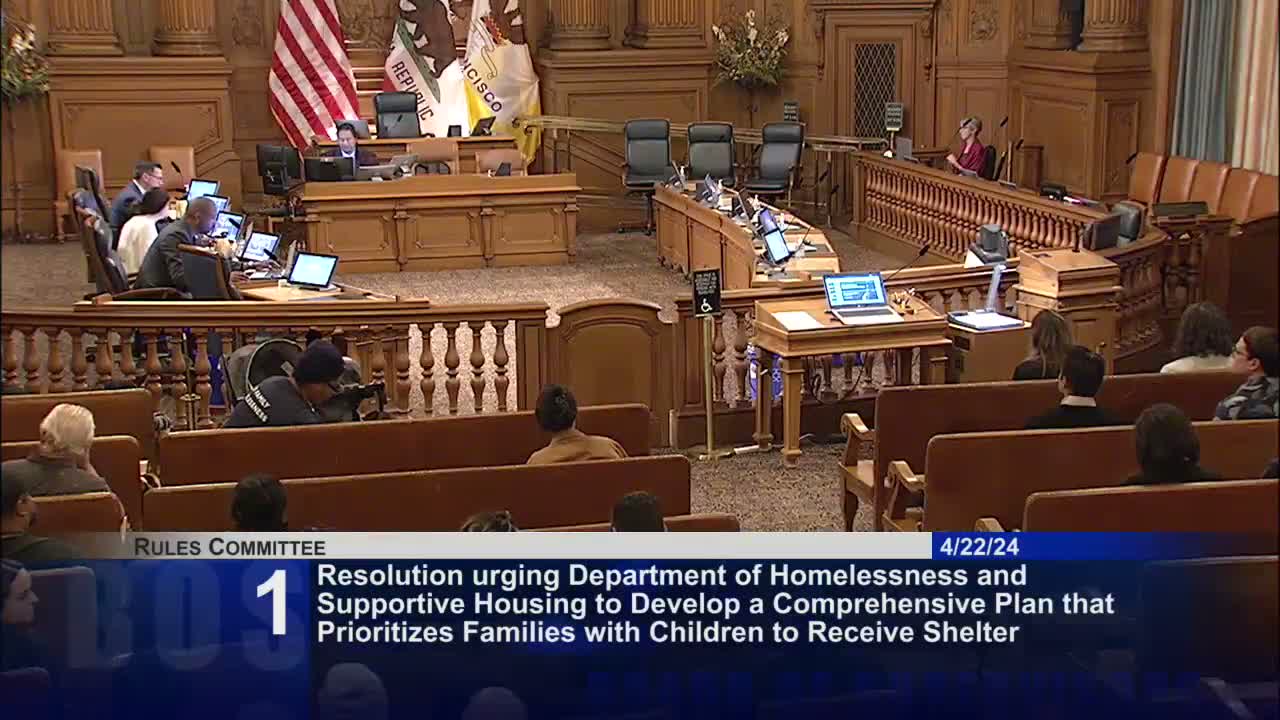
San Francisco supervisors pressed city departments Tuesday over rising family homelessness among newcomers, receiving firsthand testimony from families and faith groups and hearing agency officials outline limited immediate capacity and planned programmatic changes.
The hearing, called by Supervisor Asha Safai, focused on what she described as a ‘‘growing crisis’’ of newcomer families ‘‘sleeping on the streets’’ and the need for better data and coordination. ‘‘We need real solutions, not band aids,’’ Safai said as she opened the meeting and urged departments to provide metrics and clear pathways out of homelessness.
Jorge Rivas, director of the Office of Civic Engagement and Immigrant Affairs (OSEA), told the committee that while partner organizations such as the school district and legal providers show rising newcomer enrollments, ‘‘there's very limited quantitative data to support this trend due to the city data collection processes.’’ He described OSEA’s Immigrant Support Hub as an online resource list and said OSEA is piloting hosted housing programs and has an agreement in development with the University of San Francisco to use some vacant dorm space over the summer for up to 12 people for limited stays.
Emily Cohen, deputy director of the Department of Homelessness and Supportive Housing (HSH), laid out the family homelessness system’s current inventory and reforms. She said she pulled a recent snapshot showing ‘‘375 families on the family shelter waiting list’’ with about 60 of those families in temporary emergency shelter such as Buena Vista Horace Mann or through short hotel vouchers. Cohen described system changes — removing a prior verification requirement for unsheltered families and moving to same‑day shelter offers — that have increased shelter utilization but said the system still lacks the housing exits to shorten shelter stays.
Cohen and other officials described a mix of immediate and near‑term actions: HSH said it is deploying funds to expand family hotel vouchers by roughly 35 slots and proposed using $20 million from Proposition C to fund a five‑year rapid‑rehousing subsidy after the budget process. Cohen also described a flex subsidy pool of 165 locally funded slots for families, with 130 households matched and 77 moved into housing to date; she said those vouchers are being released on a staggered basis to ensure providers can support lease‑up and stabilization.
Supervisors repeatedly questioned whether the current situation qualifies as an ‘‘emergency’’ under existing interagency protocols. Rivas said the city’s emergency plan was designed to respond to a ‘‘mass arrival’’ event and not to a steady, daily stream of newcomers. Kim Bowman of the Department of Emergency Management explained that DEM does not solely determine whether a local emergency proclamation is warranted; instead, subject‑matter departments (OSEA, HSA, HSH, DPH and others) would evaluate capacity and advise the mayor’s office. "We don't determine if something is an emergency or warrants a local emergency proclamation," Bowman told the committee.
Public comment filled the committee room with dozens of families and advocates who said families arrive without support networks, face long waits for legal services, and sometimes sleep on sidewalks and under awnings. Margarita Solito, a mother who identified herself as a newcomer from El Salvador, urged the city to ‘‘respect our kids' integrity’’ and called for transparency and humanitarian action. Faith groups, non‑profit providers and educators urged a supplemental budget and faster deployment of resources.
Committee members asked for clearer data, better coordination across access points, and faster release of vouchers. Supervisor Safai moved to continue the matter to the call of the chair so departments could return with more detailed answers on emergency declaration thresholds, voucher availability, non‑congregate shelter options and waiting‑list coordination; the motion passed without objection.
What happens next: supervisors directed staff to return with follow‑up information and to hold departments accountable for progress. Departments said they are structuring near-term voucher expansions and longer-term subsidy proposals but emphasized that scaling exits to permanent housing remains the systemic constraint.
Officials and advocates agreed on urgency but differed on tools: some argued for immediate supplemental funding and rapid voucher release; departments said provider capacity, prioritization rules and funding constraints will shape how quickly families can move from shelter to housing.
The committee continued the item to the call of the chair; no final policy was adopted at the hearing.
The hearing, called by Supervisor Asha Safai, focused on what she described as a ‘‘growing crisis’’ of newcomer families ‘‘sleeping on the streets’’ and the need for better data and coordination. ‘‘We need real solutions, not band aids,’’ Safai said as she opened the meeting and urged departments to provide metrics and clear pathways out of homelessness.
Jorge Rivas, director of the Office of Civic Engagement and Immigrant Affairs (OSEA), told the committee that while partner organizations such as the school district and legal providers show rising newcomer enrollments, ‘‘there's very limited quantitative data to support this trend due to the city data collection processes.’’ He described OSEA’s Immigrant Support Hub as an online resource list and said OSEA is piloting hosted housing programs and has an agreement in development with the University of San Francisco to use some vacant dorm space over the summer for up to 12 people for limited stays.
Emily Cohen, deputy director of the Department of Homelessness and Supportive Housing (HSH), laid out the family homelessness system’s current inventory and reforms. She said she pulled a recent snapshot showing ‘‘375 families on the family shelter waiting list’’ with about 60 of those families in temporary emergency shelter such as Buena Vista Horace Mann or through short hotel vouchers. Cohen described system changes — removing a prior verification requirement for unsheltered families and moving to same‑day shelter offers — that have increased shelter utilization but said the system still lacks the housing exits to shorten shelter stays.
Cohen and other officials described a mix of immediate and near‑term actions: HSH said it is deploying funds to expand family hotel vouchers by roughly 35 slots and proposed using $20 million from Proposition C to fund a five‑year rapid‑rehousing subsidy after the budget process. Cohen also described a flex subsidy pool of 165 locally funded slots for families, with 130 households matched and 77 moved into housing to date; she said those vouchers are being released on a staggered basis to ensure providers can support lease‑up and stabilization.
Supervisors repeatedly questioned whether the current situation qualifies as an ‘‘emergency’’ under existing interagency protocols. Rivas said the city’s emergency plan was designed to respond to a ‘‘mass arrival’’ event and not to a steady, daily stream of newcomers. Kim Bowman of the Department of Emergency Management explained that DEM does not solely determine whether a local emergency proclamation is warranted; instead, subject‑matter departments (OSEA, HSA, HSH, DPH and others) would evaluate capacity and advise the mayor’s office. "We don't determine if something is an emergency or warrants a local emergency proclamation," Bowman told the committee.
Public comment filled the committee room with dozens of families and advocates who said families arrive without support networks, face long waits for legal services, and sometimes sleep on sidewalks and under awnings. Margarita Solito, a mother who identified herself as a newcomer from El Salvador, urged the city to ‘‘respect our kids' integrity’’ and called for transparency and humanitarian action. Faith groups, non‑profit providers and educators urged a supplemental budget and faster deployment of resources.
Committee members asked for clearer data, better coordination across access points, and faster release of vouchers. Supervisor Safai moved to continue the matter to the call of the chair so departments could return with more detailed answers on emergency declaration thresholds, voucher availability, non‑congregate shelter options and waiting‑list coordination; the motion passed without objection.
What happens next: supervisors directed staff to return with follow‑up information and to hold departments accountable for progress. Departments said they are structuring near-term voucher expansions and longer-term subsidy proposals but emphasized that scaling exits to permanent housing remains the systemic constraint.
Officials and advocates agreed on urgency but differed on tools: some argued for immediate supplemental funding and rapid voucher release; departments said provider capacity, prioritization rules and funding constraints will shape how quickly families can move from shelter to housing.
The committee continued the item to the call of the chair; no final policy was adopted at the hearing.
Don't Miss a Word: See the Full Meeting!
Go beyond summaries. Unlock every video, transcript, and key insight with a Founder Membership.
✓
Get instant access to full meeting videos
✓
Search and clip any phrase from complete transcripts
✓
Receive AI-powered summaries & custom alerts
✓
Enjoy lifetime, unrestricted access to government data
30-day money-back guarantee
