Rules Committee advances revisions to San Francisco's Language Access Ordinance after 2024 compliance report
May 06, 2024 | San Francisco County, California
This article was created by AI summarizing key points discussed. AI makes mistakes, so for full details and context, please refer to the video of the full meeting. Please report any errors so we can fix them. Report an error »
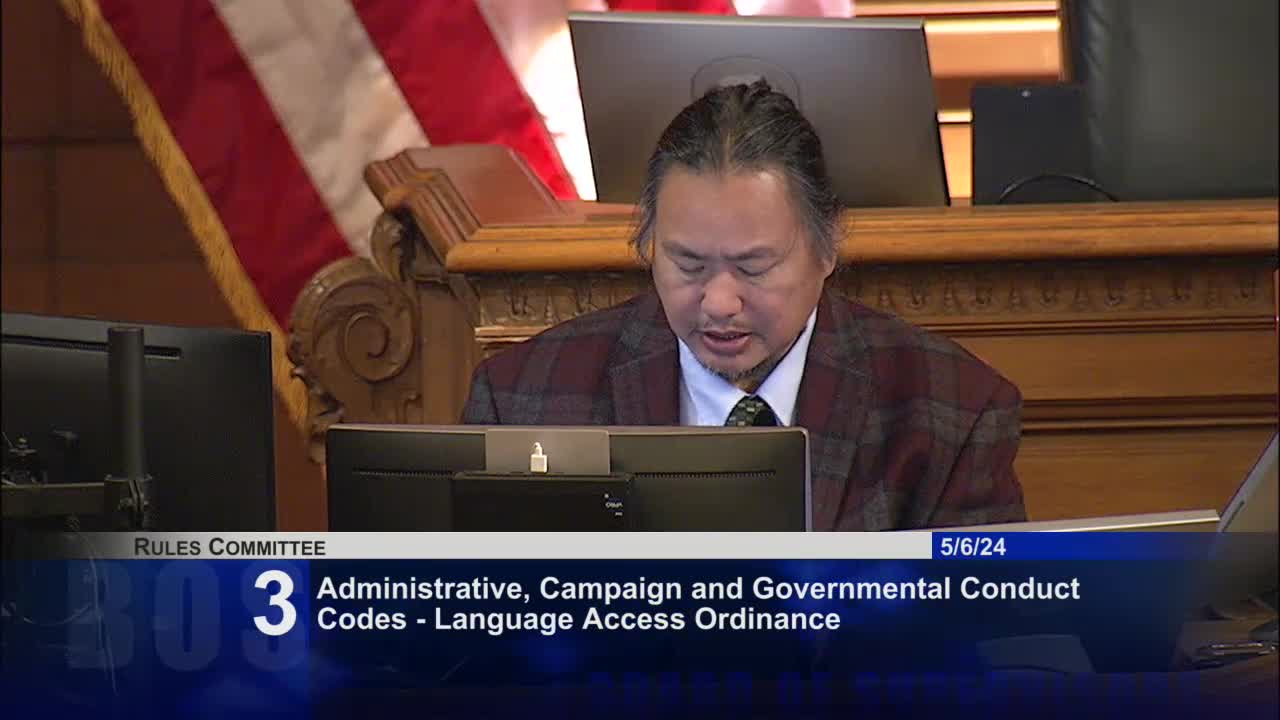
San Francisco's Rules Committee on May 6 accepted a package of amendments intended to strengthen the city's Language Access Ordinance (Administrative Code 91) after hearing a presentation of the 2024 compliance summary report and more than an hour of public comment.
Supervisor Shimon Walton, the legislation's author in committee, said the changes add findings, clarify the difference between interpretation (spoken) and translation (written), strengthen the Office of Civic Engagement and Immigrant Affairs's (OSEA) role in guiding departments, expand language access for health-related emergencies and digital services, require departments to post signage and "know your rights" materials, and require departments to plan and budget for language services. Walton told the committee the measure would memorialize Chinese (Cantonese), Spanish and Filipino as required languages and lower the threshold that triggers a required language from 10,000 to 6,000 residents, adding Vietnamese as a required language two years after passage.
OSEA Director Jorge Rivas described the office's language access unit (seven full-time equivalent positions) and said implementing the proposed amendments would require upgrading two existing classifications and adding two new positions including a training officer and at least one additional language specialist. "These amendments will expand and deepen the unit's responsibilities and activities," Rivas said, noting the office is coordinating with the City Administrator's and Mayor's offices about resource needs.
Chloe Noonan, OSEA's policy and civic engagement officer, presented key findings from the 2024 compliance summary: roughly 18.9% of San Francisco residents identify as limited-English proficient (LEP); District 11 has the highest LEP share at about 35%; the report shows increases in intake-method data collection, total LEP interactions, translated materials and in-person interpretation, but declines in telephonic interpretation, certified bilingual staff counts, and overall language services budgets. Noonan's presentation attributed some declines to operational adjustments (for example, the Department of Public Health consolidating interpreter services and the Port's pandemic-related drop in public interactions) and to variable election-year spending for the Department of Elections.
Community speakers and advocacy organizations urged stronger implementation and funding. Marlene Tran, a retired bilingual teacher and former Immigrant Rights Commissioner, asked for translated supervisors' newsletters and subtitles on City Hall TV. Advocates from Chinese for Affirmative Action and the Language Access Network of San Francisco cited data in the report and recommended increased hiring, improved data collection, translated complaint forms, and public reporting of complaints and investigations. Anisha Hingorani (policy manager, Chinese for Affirmative Action) cited figures in the presentation, including an asserted reduction in combined department language-services budgets "from $20,000,000 down to $15,000,000," and spot-check findings that 22% of respondents experienced 10'to'20 minute wait times; those figures were offered during public comment and attributed to the compliance report and community spot checks.
Deputy City Attorney Anne Pearson told the committee that several substantive amendments (for example, clarifying definitions of "vital information") were not yet in the circulated draft and that those edits would be prepared for the committee's next meeting.
After public comment, Walton moved to accept the amendments. The committee voted to approve the amendments as introduced and then voted to continue item 3, as amended, to the May 13 Rules Committee meeting so the office and city attorneys could integrate substantive edits (the continuation motion passed without objection). The committee also moved to file item 4, the departmental compliance hearing.
Next steps: the committee continued the ordinance as amended to the May 13 meeting for further drafting; Walton said a companion resolution with programmatic details will be introduced to the full Board later this month.
Supervisor Shimon Walton, the legislation's author in committee, said the changes add findings, clarify the difference between interpretation (spoken) and translation (written), strengthen the Office of Civic Engagement and Immigrant Affairs's (OSEA) role in guiding departments, expand language access for health-related emergencies and digital services, require departments to post signage and "know your rights" materials, and require departments to plan and budget for language services. Walton told the committee the measure would memorialize Chinese (Cantonese), Spanish and Filipino as required languages and lower the threshold that triggers a required language from 10,000 to 6,000 residents, adding Vietnamese as a required language two years after passage.
OSEA Director Jorge Rivas described the office's language access unit (seven full-time equivalent positions) and said implementing the proposed amendments would require upgrading two existing classifications and adding two new positions including a training officer and at least one additional language specialist. "These amendments will expand and deepen the unit's responsibilities and activities," Rivas said, noting the office is coordinating with the City Administrator's and Mayor's offices about resource needs.
Chloe Noonan, OSEA's policy and civic engagement officer, presented key findings from the 2024 compliance summary: roughly 18.9% of San Francisco residents identify as limited-English proficient (LEP); District 11 has the highest LEP share at about 35%; the report shows increases in intake-method data collection, total LEP interactions, translated materials and in-person interpretation, but declines in telephonic interpretation, certified bilingual staff counts, and overall language services budgets. Noonan's presentation attributed some declines to operational adjustments (for example, the Department of Public Health consolidating interpreter services and the Port's pandemic-related drop in public interactions) and to variable election-year spending for the Department of Elections.
Community speakers and advocacy organizations urged stronger implementation and funding. Marlene Tran, a retired bilingual teacher and former Immigrant Rights Commissioner, asked for translated supervisors' newsletters and subtitles on City Hall TV. Advocates from Chinese for Affirmative Action and the Language Access Network of San Francisco cited data in the report and recommended increased hiring, improved data collection, translated complaint forms, and public reporting of complaints and investigations. Anisha Hingorani (policy manager, Chinese for Affirmative Action) cited figures in the presentation, including an asserted reduction in combined department language-services budgets "from $20,000,000 down to $15,000,000," and spot-check findings that 22% of respondents experienced 10'to'20 minute wait times; those figures were offered during public comment and attributed to the compliance report and community spot checks.
Deputy City Attorney Anne Pearson told the committee that several substantive amendments (for example, clarifying definitions of "vital information") were not yet in the circulated draft and that those edits would be prepared for the committee's next meeting.
After public comment, Walton moved to accept the amendments. The committee voted to approve the amendments as introduced and then voted to continue item 3, as amended, to the May 13 Rules Committee meeting so the office and city attorneys could integrate substantive edits (the continuation motion passed without objection). The committee also moved to file item 4, the departmental compliance hearing.
Next steps: the committee continued the ordinance as amended to the May 13 meeting for further drafting; Walton said a companion resolution with programmatic details will be introduced to the full Board later this month.
View the Full Meeting & All Its Details
This article offers just a summary. Unlock complete video, transcripts, and insights as a Founder Member.
✓
Watch full, unedited meeting videos
✓
Search every word spoken in unlimited transcripts
✓
AI summaries & real-time alerts (all government levels)
✓
Permanent access to expanding government content
30-day money-back guarantee
