Rules committee hears experts on AI threats to local elections and files the hearing
May 13, 2024 | San Francisco County, California
This article was created by AI summarizing key points discussed. AI makes mistakes, so for full details and context, please refer to the video of the full meeting. Please report any errors so we can fix them. Report an error »
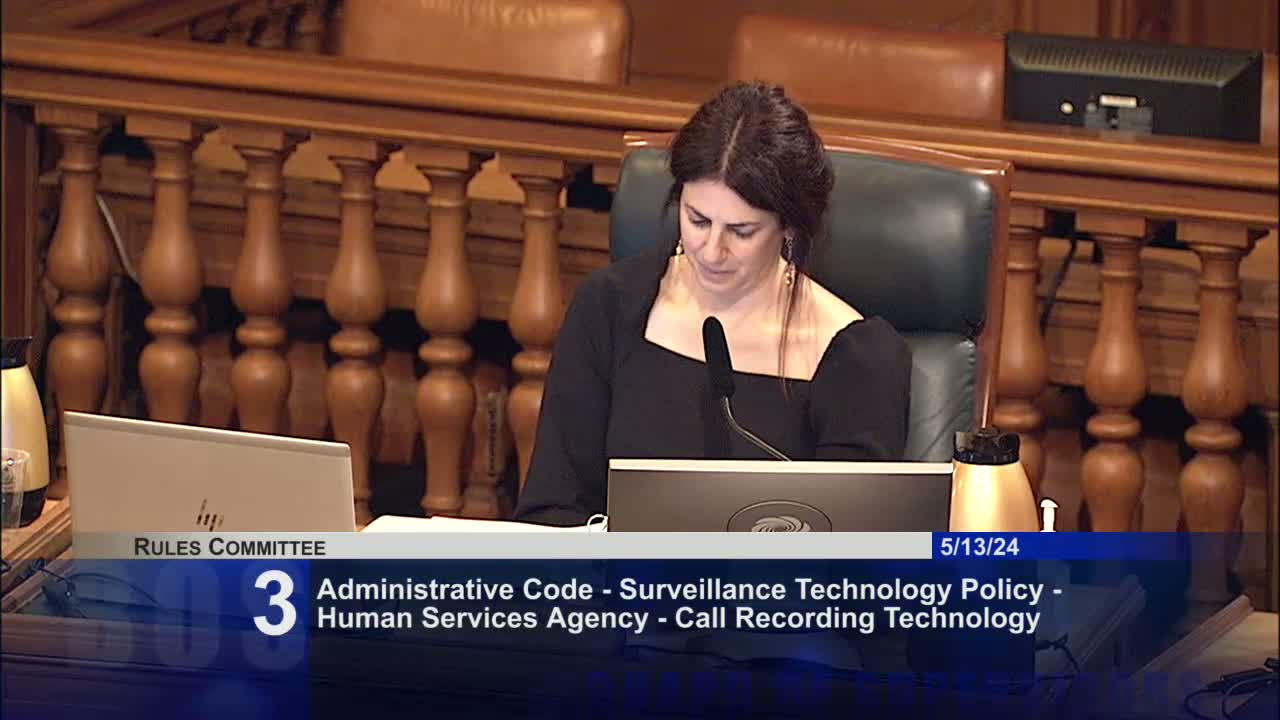
The San Francisco Board of Supervisors Rules Committee held a public hearing May 13, 2024 on the risks posed by artificial intelligence to local elections and voted to file the hearing after presentations from academics and city officials.
Supervisor Dean Preston opened the hearing noting concerns about AI-generated images, audio and videos that can mislead voters. Professor David Harris, a faculty member at UC Berkeley and an advisor to the California Initiative for Technology and Democracy, described several state bills and demonstrated examples of AI-generated fakes, including a widely circulated social-media video that used an AI-generated voice to mimic President Barack Obama. Harris summarized a package of state bills that would require provenance labeling, deep-fake disclosures, limits on certain deep-fake uses in elections, and platform 'know your customer' measures (he referenced AB3211, AB2655, a deep-fake campaigning close-to-election bill and SB1228 in the transcript).
John Arndt, Director of Elections, told the committee that San Francisco’s voting infrastructure is safeguarded—equipment is not connected to the internet, system software is reinstalled from the Secretary of State before each election, equipment is tested before voting, and the department conducts risk-limiting audits and manual tallies (including sampling manual counts) to verify machine results. Arndt said the department’s role is to be a trusted source on election processes and results and that it cannot regulate campaign speech, though it can alert and coordinate with enforcement partners.
Patrick Ford and Michael Canning of the Ethics Commission explained the commission’s administrative enforcement process, staffing constraints and the limits of local jurisdiction over some state election rules, including AB730 (the state law addressing materially deceptive audio/visual media distributed within 60 days of an election). Committee members expressed concern that no city entity currently has clear rapid-response enforcement authority for some deceptive AI-generated content and discussed strategies including awaiting state action, exploring vesting enforcement power at the Ethics Commission, and coordinating more robust planning with city attorney and other partners.
After the presentations and discussion, Supervisor Preston moved to file the hearing for the record; the committee voted unanimously to file it.
Supervisor Dean Preston opened the hearing noting concerns about AI-generated images, audio and videos that can mislead voters. Professor David Harris, a faculty member at UC Berkeley and an advisor to the California Initiative for Technology and Democracy, described several state bills and demonstrated examples of AI-generated fakes, including a widely circulated social-media video that used an AI-generated voice to mimic President Barack Obama. Harris summarized a package of state bills that would require provenance labeling, deep-fake disclosures, limits on certain deep-fake uses in elections, and platform 'know your customer' measures (he referenced AB3211, AB2655, a deep-fake campaigning close-to-election bill and SB1228 in the transcript).
John Arndt, Director of Elections, told the committee that San Francisco’s voting infrastructure is safeguarded—equipment is not connected to the internet, system software is reinstalled from the Secretary of State before each election, equipment is tested before voting, and the department conducts risk-limiting audits and manual tallies (including sampling manual counts) to verify machine results. Arndt said the department’s role is to be a trusted source on election processes and results and that it cannot regulate campaign speech, though it can alert and coordinate with enforcement partners.
Patrick Ford and Michael Canning of the Ethics Commission explained the commission’s administrative enforcement process, staffing constraints and the limits of local jurisdiction over some state election rules, including AB730 (the state law addressing materially deceptive audio/visual media distributed within 60 days of an election). Committee members expressed concern that no city entity currently has clear rapid-response enforcement authority for some deceptive AI-generated content and discussed strategies including awaiting state action, exploring vesting enforcement power at the Ethics Commission, and coordinating more robust planning with city attorney and other partners.
After the presentations and discussion, Supervisor Preston moved to file the hearing for the record; the committee voted unanimously to file it.
View the Full Meeting & All Its Details
This article offers just a summary. Unlock complete video, transcripts, and insights as a Founder Member.
✓
Watch full, unedited meeting videos
✓
Search every word spoken in unlimited transcripts
✓
AI summaries & real-time alerts (all government levels)
✓
Permanent access to expanding government content
30-day money-back guarantee
