Supervisors hear program updates showing low recidivism and call for expansion of stabilization and housing supports
April 27, 2023 | San Francisco County, California
This article was created by AI summarizing key points discussed. AI makes mistakes, so for full details and context, please refer to the video of the full meeting. Please report any errors so we can fix them. Report an error »
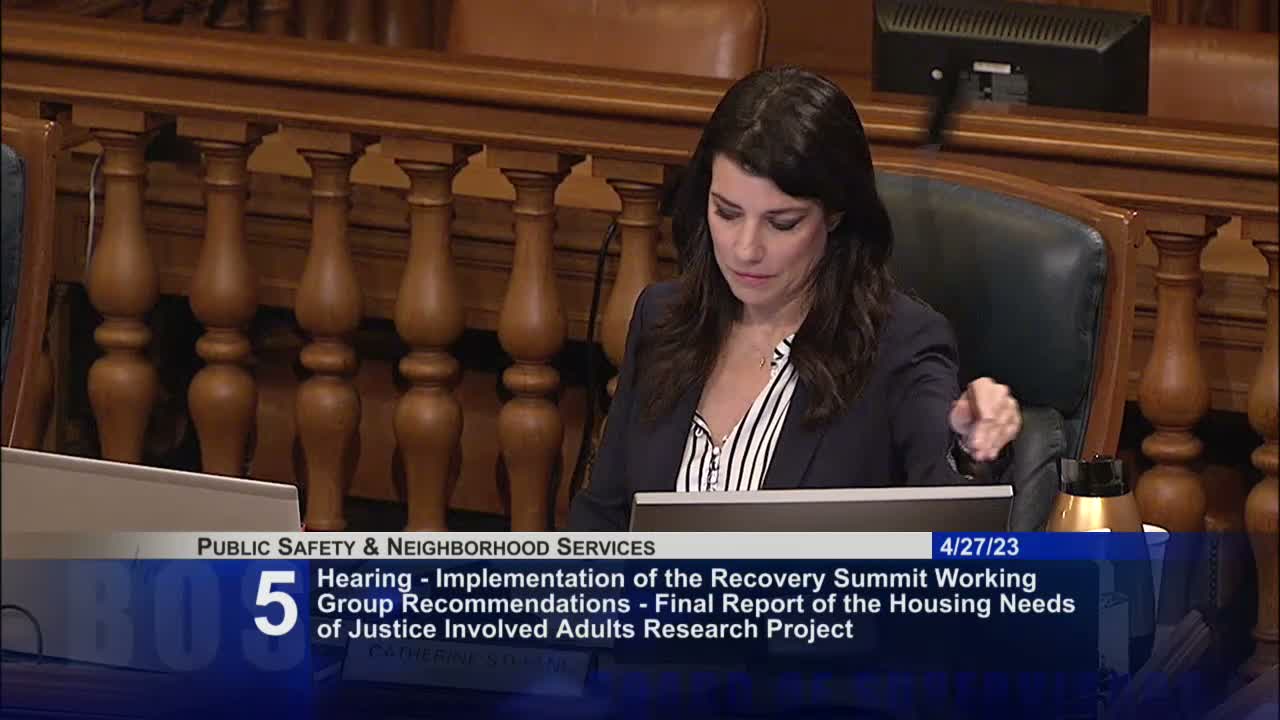
Members of the Reentry Division and the Recovery Summit working group updated the committee on program development and research into the housing needs of justice‑involved adults.
Steve Adame, director of the Reentry Division at the San Francisco Adult Probation Department, said four programs launched or expanded after earlier hearings: Her House (an abstinence‑focused therapeutic community for women and children), Positive Directions TRP Academy (a culturally responsive therapeutic residential program), the Billie Holiday Center (a stabilization center), and the MENA Project (a program with culturally specific outreach). Presenters supplied utilization and outcome figures: Her House (capacity 10 women and 4 children; served 40 participants with 19 successful completions), TRP Academy (capacity 65; served over 208 people in one year with 59 completions), Billie Holiday Center (30 capacity; reported serving 606 people in a year with 321 completions), and the MENA Project (75 capacity; initial moves into permanent housing reported).
Adame said the combined recidivism rate for program participants in Her House, TRP Academy and the MENA Project since each program's inception is 1 percent, a statistic the presenters cited as evidence of program effectiveness. Presenters also shared two years of mixed-methods research on housing needs (12 focus groups and a survey with 284 responses) and emphasized three themes: addiction’s impact linked to incarceration and homelessness, financial instability, and gaps in reentry planning.
Recommendations from the working group included creating a citywide shared housing goal for justice‑involved adults, expanding the continuum of options beyond a single model (including both harm-reduction and abstinence‑based programs), building a coordinated recovery system of care, increasing transitional housing capacity with 1–3 year stays, and standing up more stabilization centers (presenters identified a 75‑unit candidate building already under remodel at no cost to the city).
Dozens of current and former program participants, staff and advocates gave two‑minute public comments, testifying to personal recovery, urging expansion of beds, requesting low‑threshold entry (on‑site TB/COVID testing and simplified intake), and asking the Board to prioritize operating subsidies and funding for elevator repairs in SROs to make existing housing accessible. Chair Stephanie moved to file the hearing; Member Dorsey and Chair Stephanie voted aye and the hearing was filed.
Next steps: the committee filed the hearing record; supervisors agreed to carry community testimony into budget deliberations and monitor implementation of the recommendations.
Steve Adame, director of the Reentry Division at the San Francisco Adult Probation Department, said four programs launched or expanded after earlier hearings: Her House (an abstinence‑focused therapeutic community for women and children), Positive Directions TRP Academy (a culturally responsive therapeutic residential program), the Billie Holiday Center (a stabilization center), and the MENA Project (a program with culturally specific outreach). Presenters supplied utilization and outcome figures: Her House (capacity 10 women and 4 children; served 40 participants with 19 successful completions), TRP Academy (capacity 65; served over 208 people in one year with 59 completions), Billie Holiday Center (30 capacity; reported serving 606 people in a year with 321 completions), and the MENA Project (75 capacity; initial moves into permanent housing reported).
Adame said the combined recidivism rate for program participants in Her House, TRP Academy and the MENA Project since each program's inception is 1 percent, a statistic the presenters cited as evidence of program effectiveness. Presenters also shared two years of mixed-methods research on housing needs (12 focus groups and a survey with 284 responses) and emphasized three themes: addiction’s impact linked to incarceration and homelessness, financial instability, and gaps in reentry planning.
Recommendations from the working group included creating a citywide shared housing goal for justice‑involved adults, expanding the continuum of options beyond a single model (including both harm-reduction and abstinence‑based programs), building a coordinated recovery system of care, increasing transitional housing capacity with 1–3 year stays, and standing up more stabilization centers (presenters identified a 75‑unit candidate building already under remodel at no cost to the city).
Dozens of current and former program participants, staff and advocates gave two‑minute public comments, testifying to personal recovery, urging expansion of beds, requesting low‑threshold entry (on‑site TB/COVID testing and simplified intake), and asking the Board to prioritize operating subsidies and funding for elevator repairs in SROs to make existing housing accessible. Chair Stephanie moved to file the hearing; Member Dorsey and Chair Stephanie voted aye and the hearing was filed.
Next steps: the committee filed the hearing record; supervisors agreed to carry community testimony into budget deliberations and monitor implementation of the recommendations.
Don't Miss a Word: See the Full Meeting!
Go beyond summaries. Unlock every video, transcript, and key insight with a Founder Membership.
✓
Get instant access to full meeting videos
✓
Search and clip any phrase from complete transcripts
✓
Receive AI-powered summaries & custom alerts
✓
Enjoy lifetime, unrestricted access to government data
30-day money-back guarantee
