Committee hears BLA estimates and city departments on costs, equity and next steps for building electrification
July 26, 2021 | San Francisco County, California
This article was created by AI summarizing key points discussed. AI makes mistakes, so for full details and context, please refer to the video of the full meeting. Please report any errors so we can fix them. Report an error »
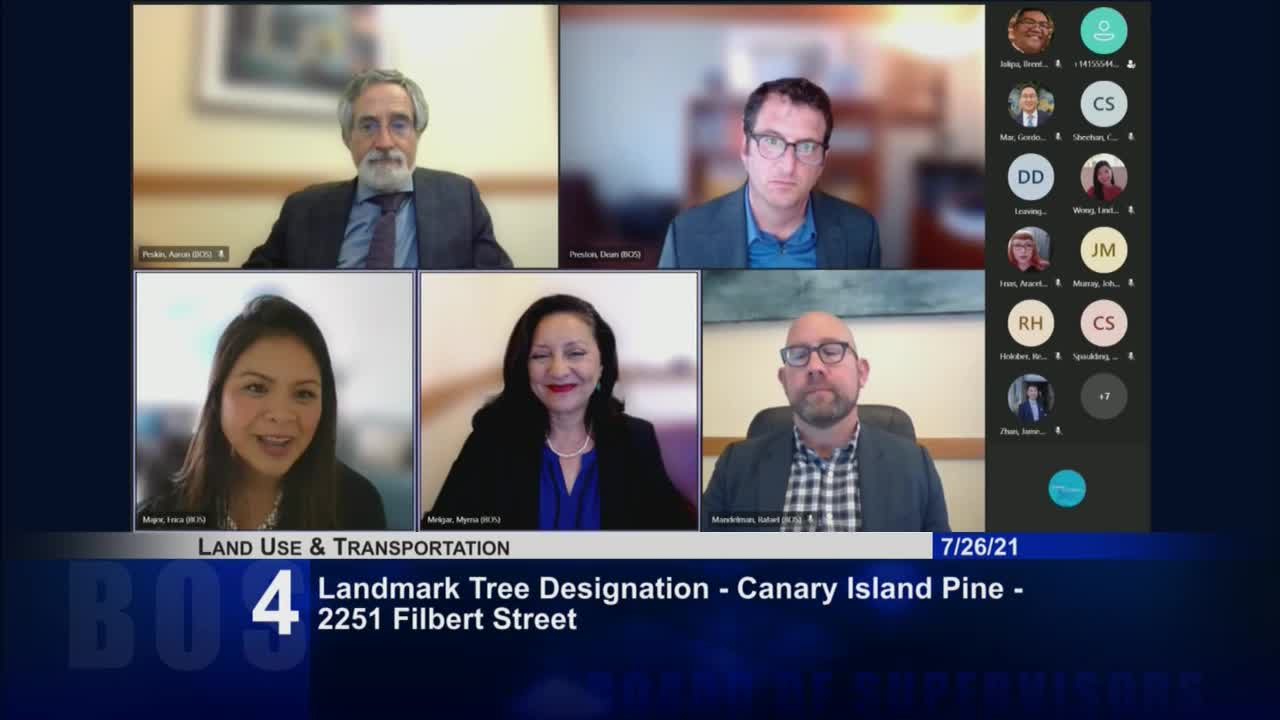
The Land Use and Transportation Committee held a multi-agency hearing on a Budget and Legislative Analyst (BLA) report analyzing what it would take to decarbonize residential buildings by eliminating natural gas usage.
Supervisor Matt/Mark Marr (sponsor) said electrifying existing buildings is essential to meet San Francisco’s net-zero goals and introduced BLA authors Fred Brusseau and Reuben Holleber, who summarized the report’s findings. The BLA used two external consultant studies to generate low- and high-cost scenarios: using Navigant-derived low-end averages, retrofitting roughly 240,231 housing units was estimated near $3.5 billion; a higher-scenario estimate using E3 consulting produced a figure near $5.9 billion. Per-unit averages varied substantially by building type and methodology.
BLA presenters emphasized policy options the city could consider to manage cost and equity: (a) a wholesale retrofit program funded at scale (highest cost, greatest emissions reduction); (b) incremental rules such as requiring electric appliances at the end of life or at time of sale (lower near-term cost but slower emissions reductions); (c) targeted incentive programs modelled on Sacramento Municipal Utility District’s $13,750-per-household approach; and (d) financing structures including bonds combined with rebates and phased implementation. The BLA noted key uncertainties: appliance accessibility in older buildings, panel and distribution upgrades, and the long-term trajectory of gas and electricity prices.
Charles Sheehan from the Department of the Environment described public-health and resilience rationales for eliminating gas (indoor air quality, methane hazards, and faster electricity restoration after major earthquakes) and pushed for equity-centered planning (tenant protections, anti-displacement measures and workforce investments). Catherine Spalding of the SFPUC said Clean Power SF and Hetch Hetchy already supply most city electricity and expect to reach 100% renewable supply by 2025, but flagged distribution upgrades handled by PG&E, potential rate impacts and customer-side upgrades (transformer or panel work) as constraints. SFPUC described planned heat-pump water-heater incentives and municipal pilot projects for municipal buildings and multifamily housing.
Advocates from Emerald Cities Collaborative, the Climate Emergency Coalition and community groups emphasized a just-transition approach with targeted funding for low-income households, job-training pathways, and anti-displacement protections. Public callers — including contractors and energy-affordability organizations — urged smaller-scale pilots targeted to low-income households and streamlined permitting.
Committee members asked for more details about funding, comparisons with other cities’ incentive programs, workforce pipeline requirements and a feasible timeline. Speakers recommended the Board consider appointing a working group or convening a multi-stakeholder process to design a roadmap, funding study and pilot programs. Supervisor Marr moved to file the hearing for the record; the committee approved the motion and the hearing was filed.
Supervisor Matt/Mark Marr (sponsor) said electrifying existing buildings is essential to meet San Francisco’s net-zero goals and introduced BLA authors Fred Brusseau and Reuben Holleber, who summarized the report’s findings. The BLA used two external consultant studies to generate low- and high-cost scenarios: using Navigant-derived low-end averages, retrofitting roughly 240,231 housing units was estimated near $3.5 billion; a higher-scenario estimate using E3 consulting produced a figure near $5.9 billion. Per-unit averages varied substantially by building type and methodology.
BLA presenters emphasized policy options the city could consider to manage cost and equity: (a) a wholesale retrofit program funded at scale (highest cost, greatest emissions reduction); (b) incremental rules such as requiring electric appliances at the end of life or at time of sale (lower near-term cost but slower emissions reductions); (c) targeted incentive programs modelled on Sacramento Municipal Utility District’s $13,750-per-household approach; and (d) financing structures including bonds combined with rebates and phased implementation. The BLA noted key uncertainties: appliance accessibility in older buildings, panel and distribution upgrades, and the long-term trajectory of gas and electricity prices.
Charles Sheehan from the Department of the Environment described public-health and resilience rationales for eliminating gas (indoor air quality, methane hazards, and faster electricity restoration after major earthquakes) and pushed for equity-centered planning (tenant protections, anti-displacement measures and workforce investments). Catherine Spalding of the SFPUC said Clean Power SF and Hetch Hetchy already supply most city electricity and expect to reach 100% renewable supply by 2025, but flagged distribution upgrades handled by PG&E, potential rate impacts and customer-side upgrades (transformer or panel work) as constraints. SFPUC described planned heat-pump water-heater incentives and municipal pilot projects for municipal buildings and multifamily housing.
Advocates from Emerald Cities Collaborative, the Climate Emergency Coalition and community groups emphasized a just-transition approach with targeted funding for low-income households, job-training pathways, and anti-displacement protections. Public callers — including contractors and energy-affordability organizations — urged smaller-scale pilots targeted to low-income households and streamlined permitting.
Committee members asked for more details about funding, comparisons with other cities’ incentive programs, workforce pipeline requirements and a feasible timeline. Speakers recommended the Board consider appointing a working group or convening a multi-stakeholder process to design a roadmap, funding study and pilot programs. Supervisor Marr moved to file the hearing for the record; the committee approved the motion and the hearing was filed.
View the Full Meeting & All Its Details
This article offers just a summary. Unlock complete video, transcripts, and insights as a Founder Member.
✓
Watch full, unedited meeting videos
✓
Search every word spoken in unlimited transcripts
✓
AI summaries & real-time alerts (all government levels)
✓
Permanent access to expanding government content
30-day money-back guarantee
