Oversight hearing: DA and city agencies outline gaps as San Francisco faces rising fentanyl deaths
September 28, 2023 | San Francisco County, California
This article was created by AI summarizing key points discussed. AI makes mistakes, so for full details and context, please refer to the video of the full meeting. Please report any errors so we can fix them. Report an error »
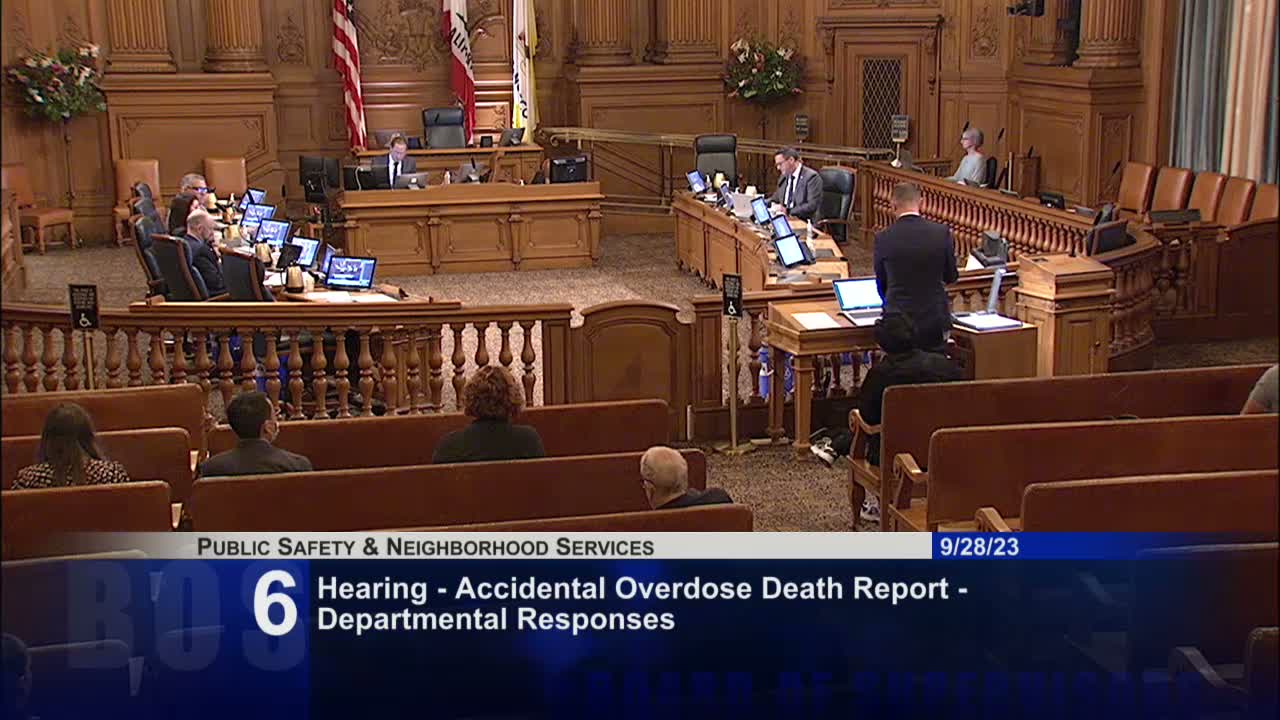
The Public Safety and Neighborhood Services Committee held a multi‑department hearing on January’s Office of the Chief Medical Examiner report and departmental responses to accidental overdose deaths.
Dr. Luke Rutter of the Office of the Chief Medical Examiner told the committee that opioid and polysubstance overdose deaths have risen sharply and that fentanyl was involved in roughly 70–80% of accidental overdose deaths. "Fentanyl accounts for about 70 to 80 percent of these accidental overdose deaths," he said, and described OCME's monthly reporting that informs demographic and drug‑profile trends.
District Attorney Chesa Boudin (appearing as DA Jenkins in the transcript) said his office has filed more than 1,000 drug‑dealing cases since July of the prior year with a 90% filing rate and has pursued 248 motions to detain repeat dealers while cases are pending. She said the court has granted only a small fraction of those motions (19), limiting the prosecution’s ability to remove repeat sellers from the streets. "We have to be looking into who the sellers are that can be tied to these specific and individual deaths," she said, urging more thorough death investigations with OCME and SFPD to provide the evidence necessary for more serious charges.
Commander Derek Lewis described SFPD’s Drug Market Agency Coordination Center (DMACC) and an increase in arrests and fentanyl seizures (218 pounds year to date in SFPD figures cited at the hearing). Hilary Conins of the Department of Public Health described DPH's 'whole‑city' overdose prevention approach, neighborhood behavioral teams, a newly launched overdose response office, and harm‑reduction work. Conins said DPH and partners distributed more than 72,000 naloxone doses in 2023 to date and are expanding medications for addiction treatment, contingency management pilots and post‑overdose outreach teams.
Deputy Director Emily Cohen of the Department of Homelessness and Supportive Housing said HSH is tracking overdoses inside shelter and housing programs with incident dashboards and that older data show lower fatality rates in congregate shelters with higher staff presence and good reversal rates.
Public comment was extensive and sharply divided: some advocates urged a public‑health, low‑threshold approach (overdose prevention sites, expanded naloxone, treatment on demand) and others called for more aggressive prosecution of dealers and stronger judicial responses. Committee members asked departments to return with measures that would clarify implementation and to explore better coordination for overdose investigations that could tie sellers to deaths.
Supervisor Safaie moved to continue the item to the call of the chair for follow‑up; the committee agreed and directed departments to return with specific plans for better coordination, expanded treatment capacity and provider/auditing information. The hearing produced multiple follow‑up tasks rather than immediate policy votes.
Dr. Luke Rutter of the Office of the Chief Medical Examiner told the committee that opioid and polysubstance overdose deaths have risen sharply and that fentanyl was involved in roughly 70–80% of accidental overdose deaths. "Fentanyl accounts for about 70 to 80 percent of these accidental overdose deaths," he said, and described OCME's monthly reporting that informs demographic and drug‑profile trends.
District Attorney Chesa Boudin (appearing as DA Jenkins in the transcript) said his office has filed more than 1,000 drug‑dealing cases since July of the prior year with a 90% filing rate and has pursued 248 motions to detain repeat dealers while cases are pending. She said the court has granted only a small fraction of those motions (19), limiting the prosecution’s ability to remove repeat sellers from the streets. "We have to be looking into who the sellers are that can be tied to these specific and individual deaths," she said, urging more thorough death investigations with OCME and SFPD to provide the evidence necessary for more serious charges.
Commander Derek Lewis described SFPD’s Drug Market Agency Coordination Center (DMACC) and an increase in arrests and fentanyl seizures (218 pounds year to date in SFPD figures cited at the hearing). Hilary Conins of the Department of Public Health described DPH's 'whole‑city' overdose prevention approach, neighborhood behavioral teams, a newly launched overdose response office, and harm‑reduction work. Conins said DPH and partners distributed more than 72,000 naloxone doses in 2023 to date and are expanding medications for addiction treatment, contingency management pilots and post‑overdose outreach teams.
Deputy Director Emily Cohen of the Department of Homelessness and Supportive Housing said HSH is tracking overdoses inside shelter and housing programs with incident dashboards and that older data show lower fatality rates in congregate shelters with higher staff presence and good reversal rates.
Public comment was extensive and sharply divided: some advocates urged a public‑health, low‑threshold approach (overdose prevention sites, expanded naloxone, treatment on demand) and others called for more aggressive prosecution of dealers and stronger judicial responses. Committee members asked departments to return with measures that would clarify implementation and to explore better coordination for overdose investigations that could tie sellers to deaths.
Supervisor Safaie moved to continue the item to the call of the chair for follow‑up; the committee agreed and directed departments to return with specific plans for better coordination, expanded treatment capacity and provider/auditing information. The hearing produced multiple follow‑up tasks rather than immediate policy votes.
Don't Miss a Word: See the Full Meeting!
Go beyond summaries. Unlock every video, transcript, and key insight with a Founder Membership.
✓
Get instant access to full meeting videos
✓
Search and clip any phrase from complete transcripts
✓
Receive AI-powered summaries & custom alerts
✓
Enjoy lifetime, unrestricted access to government data
30-day money-back guarantee
