Supervisors press for richer, anonymized crime dashboards; committee votes to broaden hearing and continue
October 12, 2023 | San Francisco County, California
This article was created by AI summarizing key points discussed. AI makes mistakes, so for full details and context, please refer to the video of the full meeting. Please report any errors so we can fix them. Report an error »
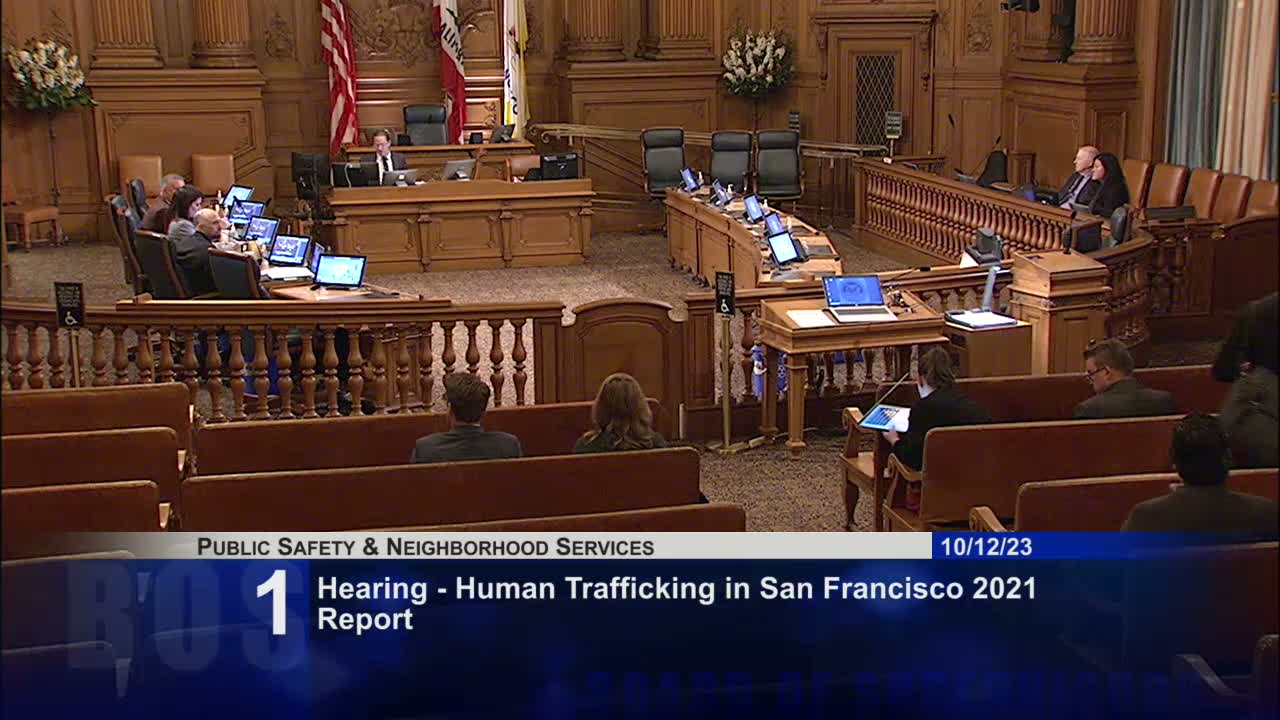
San Francisco's Public Safety and Neighborhood Services Committee heard on Oct. 12 that the city's public-facing criminal-justice dashboards provide useful summaries but lack the demographic, geographic and disposition detail reporters and researchers say they need to follow cases from arrest to outcome. Vice Chair Engadio convened the hearing and presenters from the Budget and Legislative Analyst's Office, the District Attorney's Office and the San Francisco Police Department described current capabilities, data sources, and barriers to expanding the dashboards.
The committee's Budget and Legislative Analyst (BLA), Fred Brousseau, said comparative research found stronger dashboards in jurisdictions including Yolo County, Cook County and Manhattan. "Our estimate is about $134,400" in initial enhancement costs for staffing and one-time technical support, Brousseau said, adding ongoing annual costs would be in the mid-hundreds of thousands to maintain expanded features. The BLA recommended stakeholder input and seeking outside grants where possible.
Journalists told the panel they want the ability to "follow the lifetime of an arrest," including downloadable raw datasets, demographic filters, and an easy way to link incident reports to charging and court documents. Joe Fitzgerald Rodriguez, president of the Northern California chapter of the Society of Professional Journalists, said, "Solutions depend on good data, transparent and accessible crime data residents can trust." He urged unique tracking numbers and better exportable data to reduce reliance on individual records requests.
Representatives from the District Attorney's Office, including Chief of Policy Edward McCaffrey and Data Director Nora Gregory, described seven dashboards the office publishes and said the DA now integrates data from its case-management system and feeds from courts, SFPD and the sheriff. Gregory said the office has improved access to defendant demographics since receiving sheriff booking data in 2020'21 and that some datasets are already available on DataSF. She cautioned that historic data quality problems require careful choices about how to present demographic fields across multi-year series.
SFPD's Catherine Maguire, executive director of the Strategic Management Bureau, described the department's incident, use-of-force and stops datasets and the agency's redaction process under department general order 3.16 to protect victims, juveniles and investigative techniques. On practical fixes, Maguire endorsed low-cost measures such as clearer instructions on the crime dashboard and simple linking guidance; "I love that idea," she said when supervisors proposed linking incident numbers to DA or court records to help members of the public follow a case.
The hearing produced no immediate policy changes. The committee did take two formal actions: it unanimously approved continuing agenda item 1 (a human trafficking report hearing) to the call of the chair after staff at the Department on the Status of Women reported a COVID outbreak, and it voted unanimously to amend the long title of agenda item 2 to remove the Mayor's Office of Innovation and add the Superior Court of California, County of San Francisco, and the Sheriff's Department. Vice Chair Engadio subsequently moved, and the committee approved, continuing the amended item to the call of the chair for follow-up with the sheriff and the courts.
The committee and presenters emphasized resource and staffing limits as the principal constraints on rapid expansion. The BLA noted that some jurisdictions maintain richer dashboards with only modest staff levels and initial grant funding. The DA's Office said it is exploring grants and partnerships; SFPD and DA staff discussed incremental solutions such as linking and automated redaction to speed record access while protecting sensitive information.
Committee members signaled interest in a separate follow-up hearing focused on Justice (the city's internal multi-agency data-sharing program) and on coordination with the superior court and the sheriff's office. The hearing closed with public comment reported as none or unattended by remote callers, and Chair Catherine Stephanie adjourned the meeting after the committee votes concluded.
The committee's Budget and Legislative Analyst (BLA), Fred Brousseau, said comparative research found stronger dashboards in jurisdictions including Yolo County, Cook County and Manhattan. "Our estimate is about $134,400" in initial enhancement costs for staffing and one-time technical support, Brousseau said, adding ongoing annual costs would be in the mid-hundreds of thousands to maintain expanded features. The BLA recommended stakeholder input and seeking outside grants where possible.
Journalists told the panel they want the ability to "follow the lifetime of an arrest," including downloadable raw datasets, demographic filters, and an easy way to link incident reports to charging and court documents. Joe Fitzgerald Rodriguez, president of the Northern California chapter of the Society of Professional Journalists, said, "Solutions depend on good data, transparent and accessible crime data residents can trust." He urged unique tracking numbers and better exportable data to reduce reliance on individual records requests.
Representatives from the District Attorney's Office, including Chief of Policy Edward McCaffrey and Data Director Nora Gregory, described seven dashboards the office publishes and said the DA now integrates data from its case-management system and feeds from courts, SFPD and the sheriff. Gregory said the office has improved access to defendant demographics since receiving sheriff booking data in 2020'21 and that some datasets are already available on DataSF. She cautioned that historic data quality problems require careful choices about how to present demographic fields across multi-year series.
SFPD's Catherine Maguire, executive director of the Strategic Management Bureau, described the department's incident, use-of-force and stops datasets and the agency's redaction process under department general order 3.16 to protect victims, juveniles and investigative techniques. On practical fixes, Maguire endorsed low-cost measures such as clearer instructions on the crime dashboard and simple linking guidance; "I love that idea," she said when supervisors proposed linking incident numbers to DA or court records to help members of the public follow a case.
The hearing produced no immediate policy changes. The committee did take two formal actions: it unanimously approved continuing agenda item 1 (a human trafficking report hearing) to the call of the chair after staff at the Department on the Status of Women reported a COVID outbreak, and it voted unanimously to amend the long title of agenda item 2 to remove the Mayor's Office of Innovation and add the Superior Court of California, County of San Francisco, and the Sheriff's Department. Vice Chair Engadio subsequently moved, and the committee approved, continuing the amended item to the call of the chair for follow-up with the sheriff and the courts.
The committee and presenters emphasized resource and staffing limits as the principal constraints on rapid expansion. The BLA noted that some jurisdictions maintain richer dashboards with only modest staff levels and initial grant funding. The DA's Office said it is exploring grants and partnerships; SFPD and DA staff discussed incremental solutions such as linking and automated redaction to speed record access while protecting sensitive information.
Committee members signaled interest in a separate follow-up hearing focused on Justice (the city's internal multi-agency data-sharing program) and on coordination with the superior court and the sheriff's office. The hearing closed with public comment reported as none or unattended by remote callers, and Chair Catherine Stephanie adjourned the meeting after the committee votes concluded.
Don't Miss a Word: See the Full Meeting!
Go beyond summaries. Unlock every video, transcript, and key insight with a Founder Membership.
✓
Get instant access to full meeting videos
✓
Search and clip any phrase from complete transcripts
✓
Receive AI-powered summaries & custom alerts
✓
Enjoy lifetime, unrestricted access to government data
30-day money-back guarantee
