SFUSD officials outline lockdown rules, communications and PA upgrades after December campus incidents
February 01, 2024 | San Francisco County, California
This article was created by AI summarizing key points discussed. AI makes mistakes, so for full details and context, please refer to the video of the full meeting. Please report any errors so we can fix them. Report an error »
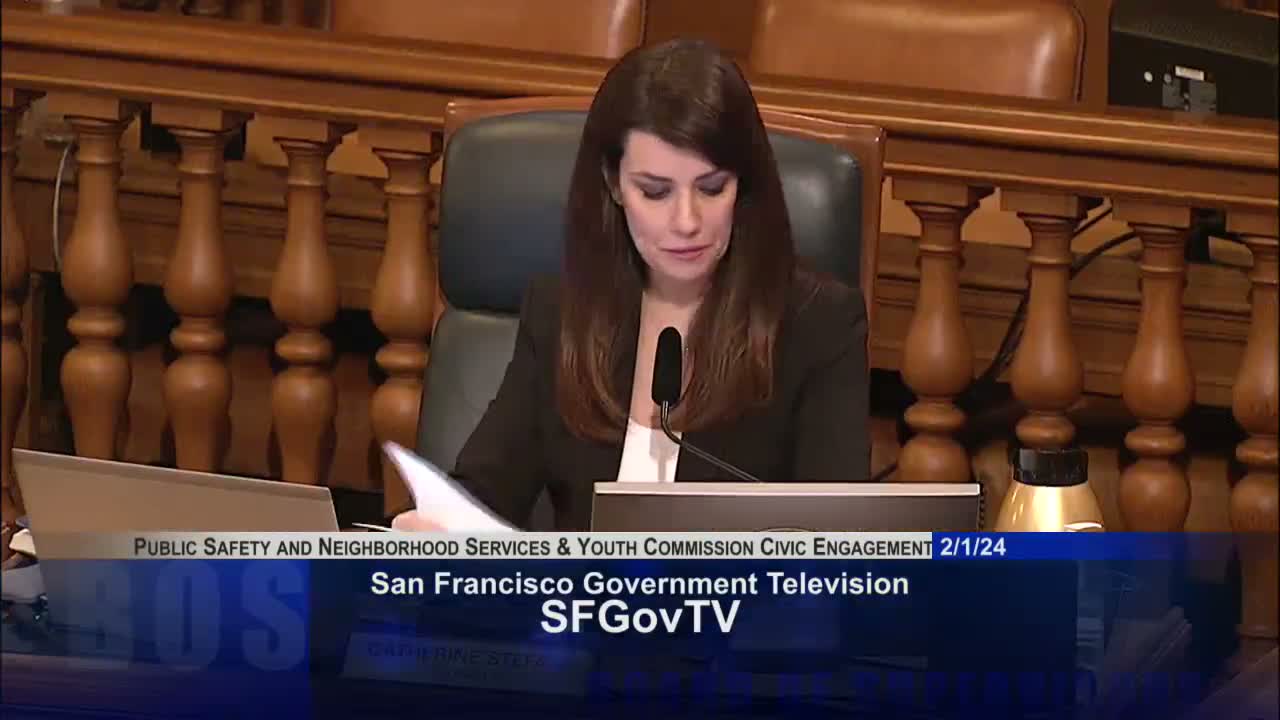
Supervisor Catherine Stephanie, chair of the Public Safety and Neighborhood Services Committee, convened a Feb. 1 joint hearing with the San Francisco Youth Commission to examine San Francisco Unified School District lockdown and emergency procedures after incidents at George Washington and Galileo high schools on Dec. 8, 2023.
Greg Markwith, SFUSD director of emergency planning and preparedness, told the panel the district is prioritizing physical security and communications upgrades. He said the Board of Education reallocated $10,000,000 in bond funds in late 2021 for safety and security work; an assessment identified under 40 sites with insufficient door hardware and, according to Markwith, "90% of our classrooms have secure hardware installed" with the district aiming to finish installations by summer 2024. He said remote door access (buzzers with integrated cameras) and most PA system modernization work are planned for completion by summer 2024 if funding is available, and that the district estimates an additional $2–5 million beyond the $10 million will be required to meet district PA standards across roughly 30 priority campuses.
On communications, Markwith described a three‑tiered crisis communications framework (low, medium, high impact) and said SFUSD will tailor notifications to the incident level: low‑impact incidents may prompt targeted parent contact; medium incidents will generate an end‑of‑day message; high‑impact events (gas leaks, evacuations or a lockdown) prompt immediate school messenger texts and possibly press releases or social media posts. He said the district reserves judgment until facts are confirmed because third‑party apps such as Citizen frequently post inaccurate alerts that can undermine emergency responses.
Markwith also described operational coordination with SFPD. "I meet with Captain Samuel Christ of [SFPD's] community engagement division once per week," he said, and he noted the district and SFPD public information officers coordinate messaging so communications do not compromise investigations.
Assistant Superintendent Eric Guthard (introduced in the hearing) and other SFUSD staff emphasized prevention, climate and student supports: coordinated care teams at every school, wellness centers at every high school and planned middle‑school expansion, social workers or nurses at sites that lack wellness centers, and the district's Say Something anonymous reporting system run by Sandy Hook Promise. SFUSD said it has trained "over 8,000 students" in recent sessions and that roughly 45% of the relevant cohort has completed training to date; the district said it will continue outreach and monitoring with the Sandy Hook Promise team.
Youth commissioners and public commenters pressed the district on gaps students and families described on the ground. Student speakers said lockdown drills had not been consistently performed at some campuses, that PA systems sometimes failed or were not at district standard, and that See Something/Say Something signage and awareness were lacking. "We don't do the drills twice a year. We haven't had lockdown drills," a student from Washington High School said, and another student added that wellness centers were understaffed and wait times for therapy were long.
Parents and advocates also asked what contingency funding SFUSD would use if a November bond measure fails; Markwith said facilities staff would reprioritize projects and seek other funding if necessary but described the bond as the most thorough option. SFUSD staff acknowledged staffing shortages in counseling and social work positions and said wellness centers and coordinated care teams are part of the district's response to provide supports after alarming incidents.
During public comment, parents urged printed take‑home materials about safe firearm storage and clearer, more accessible communication; student speakers and parents asked the district to make Say Something more visible and to ensure consistent training and drills. Community commenters also encouraged local engagement on social media regulation and youth digital literacy.
The committees closed with commitments to follow up. The chair offered praise for student leadership and advocacy and a motion to "hear and file" the hearing was offered and approved (three ayes). The hearing record will be filed and used to inform follow‑up oversight and potential further hearings or requests for information from SFUSD.
Ending: The committee filed the hearing record by motion and adjourned; staff said they will remain in contact with the district to track progress on PA upgrades, Say Something roll‑out and wellness staffing.
Greg Markwith, SFUSD director of emergency planning and preparedness, told the panel the district is prioritizing physical security and communications upgrades. He said the Board of Education reallocated $10,000,000 in bond funds in late 2021 for safety and security work; an assessment identified under 40 sites with insufficient door hardware and, according to Markwith, "90% of our classrooms have secure hardware installed" with the district aiming to finish installations by summer 2024. He said remote door access (buzzers with integrated cameras) and most PA system modernization work are planned for completion by summer 2024 if funding is available, and that the district estimates an additional $2–5 million beyond the $10 million will be required to meet district PA standards across roughly 30 priority campuses.
On communications, Markwith described a three‑tiered crisis communications framework (low, medium, high impact) and said SFUSD will tailor notifications to the incident level: low‑impact incidents may prompt targeted parent contact; medium incidents will generate an end‑of‑day message; high‑impact events (gas leaks, evacuations or a lockdown) prompt immediate school messenger texts and possibly press releases or social media posts. He said the district reserves judgment until facts are confirmed because third‑party apps such as Citizen frequently post inaccurate alerts that can undermine emergency responses.
Markwith also described operational coordination with SFPD. "I meet with Captain Samuel Christ of [SFPD's] community engagement division once per week," he said, and he noted the district and SFPD public information officers coordinate messaging so communications do not compromise investigations.
Assistant Superintendent Eric Guthard (introduced in the hearing) and other SFUSD staff emphasized prevention, climate and student supports: coordinated care teams at every school, wellness centers at every high school and planned middle‑school expansion, social workers or nurses at sites that lack wellness centers, and the district's Say Something anonymous reporting system run by Sandy Hook Promise. SFUSD said it has trained "over 8,000 students" in recent sessions and that roughly 45% of the relevant cohort has completed training to date; the district said it will continue outreach and monitoring with the Sandy Hook Promise team.
Youth commissioners and public commenters pressed the district on gaps students and families described on the ground. Student speakers said lockdown drills had not been consistently performed at some campuses, that PA systems sometimes failed or were not at district standard, and that See Something/Say Something signage and awareness were lacking. "We don't do the drills twice a year. We haven't had lockdown drills," a student from Washington High School said, and another student added that wellness centers were understaffed and wait times for therapy were long.
Parents and advocates also asked what contingency funding SFUSD would use if a November bond measure fails; Markwith said facilities staff would reprioritize projects and seek other funding if necessary but described the bond as the most thorough option. SFUSD staff acknowledged staffing shortages in counseling and social work positions and said wellness centers and coordinated care teams are part of the district's response to provide supports after alarming incidents.
During public comment, parents urged printed take‑home materials about safe firearm storage and clearer, more accessible communication; student speakers and parents asked the district to make Say Something more visible and to ensure consistent training and drills. Community commenters also encouraged local engagement on social media regulation and youth digital literacy.
The committees closed with commitments to follow up. The chair offered praise for student leadership and advocacy and a motion to "hear and file" the hearing was offered and approved (three ayes). The hearing record will be filed and used to inform follow‑up oversight and potential further hearings or requests for information from SFUSD.
Ending: The committee filed the hearing record by motion and adjourned; staff said they will remain in contact with the district to track progress on PA upgrades, Say Something roll‑out and wellness staffing.
Don't Miss a Word: See the Full Meeting!
Go beyond summaries. Unlock every video, transcript, and key insight with a Founder Membership.
✓
Get instant access to full meeting videos
✓
Search and clip any phrase from complete transcripts
✓
Receive AI-powered summaries & custom alerts
✓
Enjoy lifetime, unrestricted access to government data
30-day money-back guarantee
