Supervisors press SFPD on lactation facilities, childcare and recruiting more women officers
February 08, 2024 | San Francisco County, California
This article was created by AI summarizing key points discussed. AI makes mistakes, so for full details and context, please refer to the video of the full meeting. Please report any errors so we can fix them. Report an error »
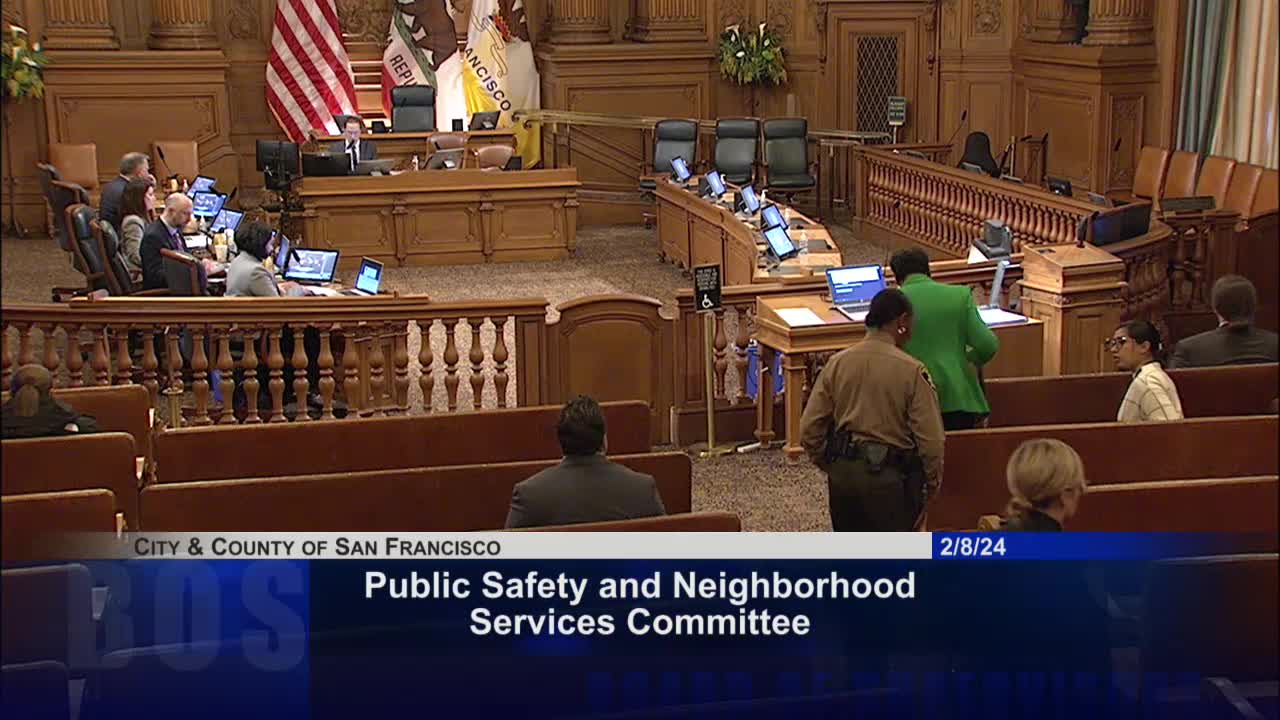
San Francisco supervisors on Feb. 8 pressed the San Francisco Police Department and city human‑resources leaders to make lactation facilities, child care and recruitment infrastructure a higher priority as part of efforts to recruit and retain more women sworn officers.
Supervisor Melgar opened the item by noting an approximately 500‑officer shortage and that women represent roughly 15 percent of the department’s sworn officers. "Women make up half of our population in San Francisco…and only 1 in 6 police officers in San Francisco is a woman," she said, urging the city to make the workplace family‑friendly.
Deputy Director Mawili Tubenio (DHR) summarized the city’s lactation policy and said DHR tracks 96 lactation rooms citywide, provides guidance for departments entering leases or renovations, and facilitated procurement of pods and pumps. Penny Tsai, SFPD’s ADA coordinator, said SFPD has 24 worksites and monthly inspections for designated lactation spaces; several smaller or older worksites currently use multipurpose rooms or temporary privacy screens. Tsai described a phased improvement plan: modular walls ordered for 11 worksites, with a six‑worksite Phase I on a roughly 7‑week installation timeline and shipments already arriving.
Deputy Chief Walsh and SFPD recruiting staff acknowledged recruiting and retention challenges and described changes to application tracking (SmartRecruiter) to reduce drop‑off between application and testing stages and to target outreach. Walsh said the department has not yet met the 30x30 recruitment milestone but is piloting outreach, mentorship, and physical‑preparation supports for underrepresented groups and exploring childcare options, including partnerships and possible site‑based childcare.
Director Kimberly Ellis (Department on the Status of Women) and the Department of Early Childhood joined the conversation with recommendations: citywide mandatory lactation amenities (pods) rather than encouraged checklists; expanded childcare slots, subsidies and facility master planning; a female‑officer recruitment and retention task force; and annual public reporting on progress. Ellis argued these structural changes would both advance equity and help address the staffing deficit.
Public commenters included SFPD officers, commanding officers and union representatives who described past gaps in accommodations, concerns about workplace culture and fear of retaliation for speaking up, and support for childcare and housing incentives to retain officers.
Committee action: the committee voted to file the hearing record so work can continue across departments, and supervisors urged DHR, SFPD and the Department of Early Childhood to coordinate feasible pilot programs for childcare, firm timelines for lactation‑room improvements and ongoing reporting on recruitment metrics.
What’s next: the committee asked staff to monitor SFPD’s phased lactation upgrades and to report back on recruitment outreach, childcare pilot options and progress toward a more family‑friendly workforce.
Supervisor Melgar opened the item by noting an approximately 500‑officer shortage and that women represent roughly 15 percent of the department’s sworn officers. "Women make up half of our population in San Francisco…and only 1 in 6 police officers in San Francisco is a woman," she said, urging the city to make the workplace family‑friendly.
Deputy Director Mawili Tubenio (DHR) summarized the city’s lactation policy and said DHR tracks 96 lactation rooms citywide, provides guidance for departments entering leases or renovations, and facilitated procurement of pods and pumps. Penny Tsai, SFPD’s ADA coordinator, said SFPD has 24 worksites and monthly inspections for designated lactation spaces; several smaller or older worksites currently use multipurpose rooms or temporary privacy screens. Tsai described a phased improvement plan: modular walls ordered for 11 worksites, with a six‑worksite Phase I on a roughly 7‑week installation timeline and shipments already arriving.
Deputy Chief Walsh and SFPD recruiting staff acknowledged recruiting and retention challenges and described changes to application tracking (SmartRecruiter) to reduce drop‑off between application and testing stages and to target outreach. Walsh said the department has not yet met the 30x30 recruitment milestone but is piloting outreach, mentorship, and physical‑preparation supports for underrepresented groups and exploring childcare options, including partnerships and possible site‑based childcare.
Director Kimberly Ellis (Department on the Status of Women) and the Department of Early Childhood joined the conversation with recommendations: citywide mandatory lactation amenities (pods) rather than encouraged checklists; expanded childcare slots, subsidies and facility master planning; a female‑officer recruitment and retention task force; and annual public reporting on progress. Ellis argued these structural changes would both advance equity and help address the staffing deficit.
Public commenters included SFPD officers, commanding officers and union representatives who described past gaps in accommodations, concerns about workplace culture and fear of retaliation for speaking up, and support for childcare and housing incentives to retain officers.
Committee action: the committee voted to file the hearing record so work can continue across departments, and supervisors urged DHR, SFPD and the Department of Early Childhood to coordinate feasible pilot programs for childcare, firm timelines for lactation‑room improvements and ongoing reporting on recruitment metrics.
What’s next: the committee asked staff to monitor SFPD’s phased lactation upgrades and to report back on recruitment outreach, childcare pilot options and progress toward a more family‑friendly workforce.
View the Full Meeting & All Its Details
This article offers just a summary. Unlock complete video, transcripts, and insights as a Founder Member.
✓
Watch full, unedited meeting videos
✓
Search every word spoken in unlimited transcripts
✓
AI summaries & real-time alerts (all government levels)
✓
Permanent access to expanding government content
30-day money-back guarantee
