Report to supervisors: most surveyed union workers cannot afford median San Francisco rents; committee plans follow-up
November 08, 2021 | San Francisco County, California
This article was created by AI summarizing key points discussed. AI makes mistakes, so for full details and context, please refer to the video of the full meeting. Please report any errors so we can fix them. Report an error »
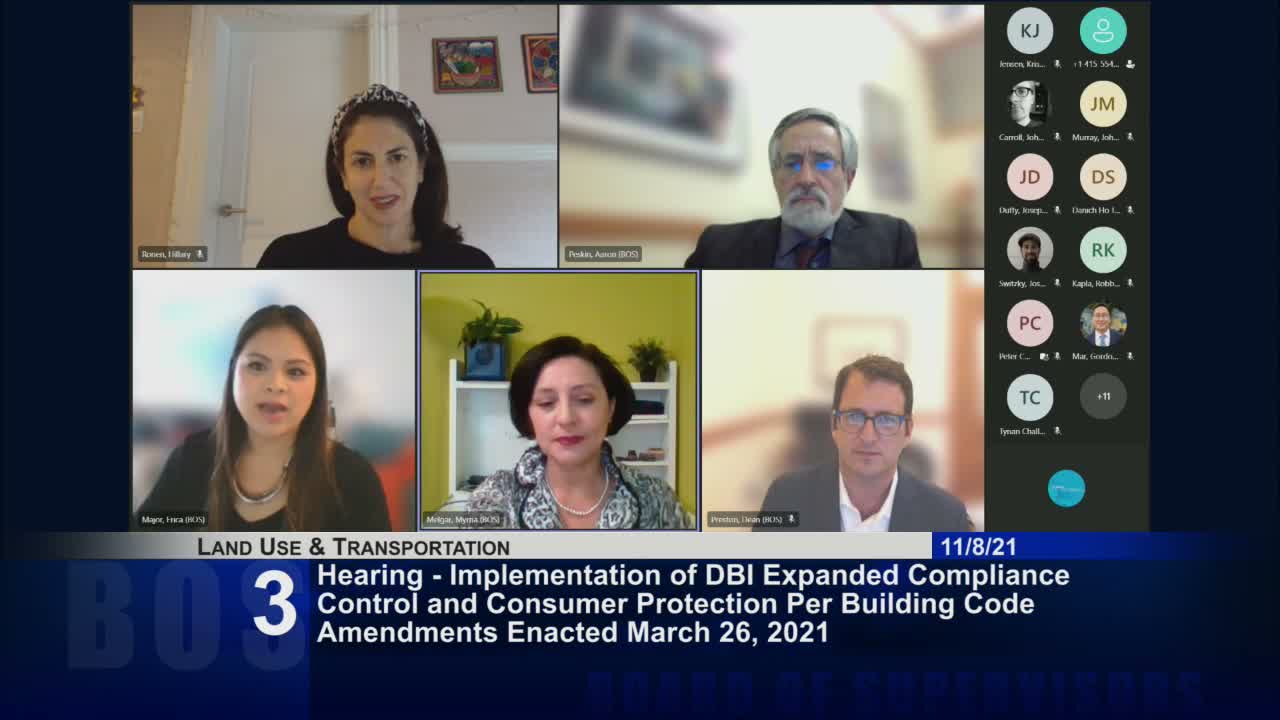
A coalition report presented to the Land Use and Transportation Committee on Nov. 8 said San Francisco must expand affordable housing that serves the full range of working households to keep essential personnel in the city.
"This report emphasizes land, funding and programs," sponsor Supervisor Gordon Marr said as he introduced the "Housing Our Workers" study, produced by labor groups, community housing organizations and the UC Berkeley Labor Center. The report links income and occupation data for roughly 50,000 union members to ZIP codes and finds a substantial affordability gap for many mid‑ and lower‑wage workers.
Tynan Chaloner of the UC Berkeley Labor Center summarized the data: the report used median market rents from Zumper averaged 2019–2021 and found a median one‑bedroom rent of $3,289 and a median two‑bedroom rent of $4,298. Chaloner said only a small share of workers in the dataset could afford those medians under a 30%‑of‑income standard; the report estimates roughly 7% of surveyed workers could afford the median rent.
Report presenters framed policy recommendations around three priorities: protect residents from displacement, preserve existing affordable stock through targeted acquisition and funding, and produce more housing (including family‑sized units, cooperative models and proactive land acquisition). Peter Cohen of the Council of Community Housing Organizations stressed that securing land and flexible financing are central to any scalable solution.
Public callers and union representatives urged immediate action: labor groups highlighted long commutes, family housing shortages and the need for worker‑focused affordability levels, while housing developers and preservation advocates called for funding to acquire at‑risk properties. Several callers said roughly 40% of the workforce now lives outside the city, increasing commute times and environmental damage.
Supervisors commended the analysis and asked staff for follow‑up hearings with Planning and the Mayor's Office of Community Development to incorporate the report's recommendations into the housing element update. The committee voted unanimously to continue the hearing to the call of the chair for further policy work and staff coordination.
"This report emphasizes land, funding and programs," sponsor Supervisor Gordon Marr said as he introduced the "Housing Our Workers" study, produced by labor groups, community housing organizations and the UC Berkeley Labor Center. The report links income and occupation data for roughly 50,000 union members to ZIP codes and finds a substantial affordability gap for many mid‑ and lower‑wage workers.
Tynan Chaloner of the UC Berkeley Labor Center summarized the data: the report used median market rents from Zumper averaged 2019–2021 and found a median one‑bedroom rent of $3,289 and a median two‑bedroom rent of $4,298. Chaloner said only a small share of workers in the dataset could afford those medians under a 30%‑of‑income standard; the report estimates roughly 7% of surveyed workers could afford the median rent.
Report presenters framed policy recommendations around three priorities: protect residents from displacement, preserve existing affordable stock through targeted acquisition and funding, and produce more housing (including family‑sized units, cooperative models and proactive land acquisition). Peter Cohen of the Council of Community Housing Organizations stressed that securing land and flexible financing are central to any scalable solution.
Public callers and union representatives urged immediate action: labor groups highlighted long commutes, family housing shortages and the need for worker‑focused affordability levels, while housing developers and preservation advocates called for funding to acquire at‑risk properties. Several callers said roughly 40% of the workforce now lives outside the city, increasing commute times and environmental damage.
Supervisors commended the analysis and asked staff for follow‑up hearings with Planning and the Mayor's Office of Community Development to incorporate the report's recommendations into the housing element update. The committee voted unanimously to continue the hearing to the call of the chair for further policy work and staff coordination.
Don't Miss a Word: See the Full Meeting!
Go beyond summaries. Unlock every video, transcript, and key insight with a Founder Membership.
✓
Get instant access to full meeting videos
✓
Search and clip any phrase from complete transcripts
✓
Receive AI-powered summaries & custom alerts
✓
Enjoy lifetime, unrestricted access to government data
30-day money-back guarantee
