Planning department finds a large jobs-housing mismatch; committee asks for follow-up and funding discussion
December 13, 2021 | San Francisco County, California
This article was created by AI summarizing key points discussed. AI makes mistakes, so for full details and context, please refer to the video of the full meeting. Please report any errors so we can fix them. Report an error »
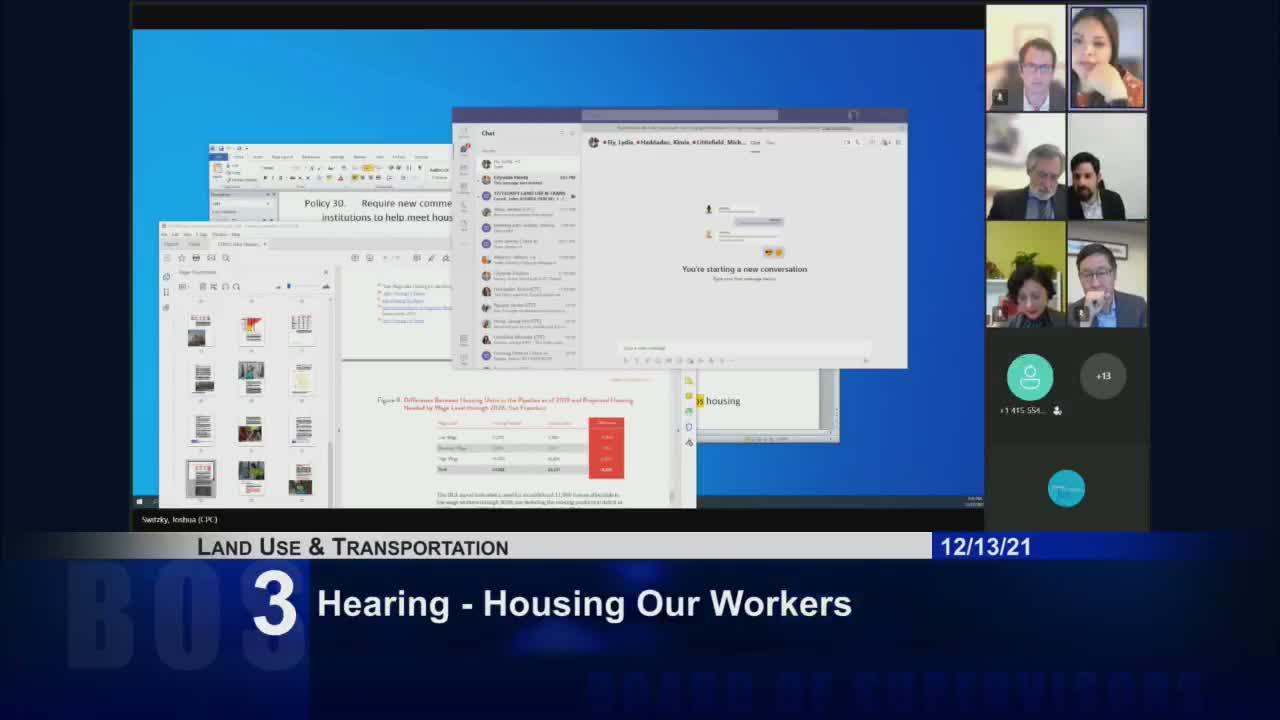
The Land Use & Transportation Committee on Dec. 13 heard the Planning Department’s first Jobs-Housing Fit report, a data-driven look at whether housing production in San Francisco matched the city’s job growth.
Joshua Slutsky of the Planning Department summarized the retrospective analysis covering 2009–2019: the city added roughly 211,000 jobs during that decade, which the department estimates generated demand for about 154,000 housing units. Planning found the city met substantially less than that demand — less than 20% of need was met over the period — leaving an estimated unmet need of about 124,000 housing units, including roughly 54,000 affordable units.
The department’s forward-looking assessment — based on the development pipeline and supplemented by regional job projections — produced a cumulative deficit of roughly 106,000 units when past and anticipated development are combined. Planning reported that the largest shortfalls by absolute numbers are in above-moderate and moderate affordability bands and that, to close the affordable-unit deficit alone, local subsidy needs could be on the order of tens of billions of dollars: using an illustrative average subsidy of $350,000 per affordable unit, the report placed a local funding-price tag in excess of $20 billion and identified the need for acquisition of hundreds of sites to meet the deficit.
Michelle Littlefield, Planning’s data and analytics manager, said the department is undertaking substantial data-system improvements — integrating permit data, cleaning pipeline records, and building dashboards — so future reports can be more timely and granular. Planning noted the first report uses data through calendar year 2019 and that pandemic-era disruptions affected data workflows.
Stakeholders at the hearing praised the report and urged action. Fernando Marti of the Council of Community Housing Organizations and labor and community advocates framed the findings as evidence that the city must prioritize funding, land acquisition and new policy tools such as cooperative housing and small-site preservation. Public commenters representing Jobs with Justice, the San Francisco Labor Council and multiple community groups said the report reflects lived experience of long commutes and displacement and called for expanded public investment and creative housing production strategies.
Supervisors pressed Planning on methodology and scope. Committee members asked for breakdowns within the broad “above-moderate” category, additional geographic analysis of where housing has been built versus where working households live, and how gig and non-office jobs are captured by pipeline-based projections. Planning said it used BLS job data, matched worker profiles to household incomes via the Census PUMS dataset, and followed the administrative code’s pipeline-based requirements; staff said they can calculate finer-grained income and geographic breakdowns for future reports and suggested the Board might consider amending methodology constraints in the administrative code.
After discussion and public comment the committee voted to continue the item to the call of the chair and requested Planning return in roughly three months with an update on how the jobs-housing fit analysis is being incorporated into ongoing housing-element work and pipeline reporting. No binding budget or policy decision was taken at the hearing.
Joshua Slutsky of the Planning Department summarized the retrospective analysis covering 2009–2019: the city added roughly 211,000 jobs during that decade, which the department estimates generated demand for about 154,000 housing units. Planning found the city met substantially less than that demand — less than 20% of need was met over the period — leaving an estimated unmet need of about 124,000 housing units, including roughly 54,000 affordable units.
The department’s forward-looking assessment — based on the development pipeline and supplemented by regional job projections — produced a cumulative deficit of roughly 106,000 units when past and anticipated development are combined. Planning reported that the largest shortfalls by absolute numbers are in above-moderate and moderate affordability bands and that, to close the affordable-unit deficit alone, local subsidy needs could be on the order of tens of billions of dollars: using an illustrative average subsidy of $350,000 per affordable unit, the report placed a local funding-price tag in excess of $20 billion and identified the need for acquisition of hundreds of sites to meet the deficit.
Michelle Littlefield, Planning’s data and analytics manager, said the department is undertaking substantial data-system improvements — integrating permit data, cleaning pipeline records, and building dashboards — so future reports can be more timely and granular. Planning noted the first report uses data through calendar year 2019 and that pandemic-era disruptions affected data workflows.
Stakeholders at the hearing praised the report and urged action. Fernando Marti of the Council of Community Housing Organizations and labor and community advocates framed the findings as evidence that the city must prioritize funding, land acquisition and new policy tools such as cooperative housing and small-site preservation. Public commenters representing Jobs with Justice, the San Francisco Labor Council and multiple community groups said the report reflects lived experience of long commutes and displacement and called for expanded public investment and creative housing production strategies.
Supervisors pressed Planning on methodology and scope. Committee members asked for breakdowns within the broad “above-moderate” category, additional geographic analysis of where housing has been built versus where working households live, and how gig and non-office jobs are captured by pipeline-based projections. Planning said it used BLS job data, matched worker profiles to household incomes via the Census PUMS dataset, and followed the administrative code’s pipeline-based requirements; staff said they can calculate finer-grained income and geographic breakdowns for future reports and suggested the Board might consider amending methodology constraints in the administrative code.
After discussion and public comment the committee voted to continue the item to the call of the chair and requested Planning return in roughly three months with an update on how the jobs-housing fit analysis is being incorporated into ongoing housing-element work and pipeline reporting. No binding budget or policy decision was taken at the hearing.
View the Full Meeting & All Its Details
This article offers just a summary. Unlock complete video, transcripts, and insights as a Founder Member.
✓
Watch full, unedited meeting videos
✓
Search every word spoken in unlimited transcripts
✓
AI summaries & real-time alerts (all government levels)
✓
Permanent access to expanding government content
30-day money-back guarantee
