Mission Bay neighbors and providers clash over safety at HomeRise PSH; supervisors press HSH for fixes
March 28, 2024 | San Francisco County, California
This article was created by AI summarizing key points discussed. AI makes mistakes, so for full details and context, please refer to the video of the full meeting. Please report any errors so we can fix them. Report an error »
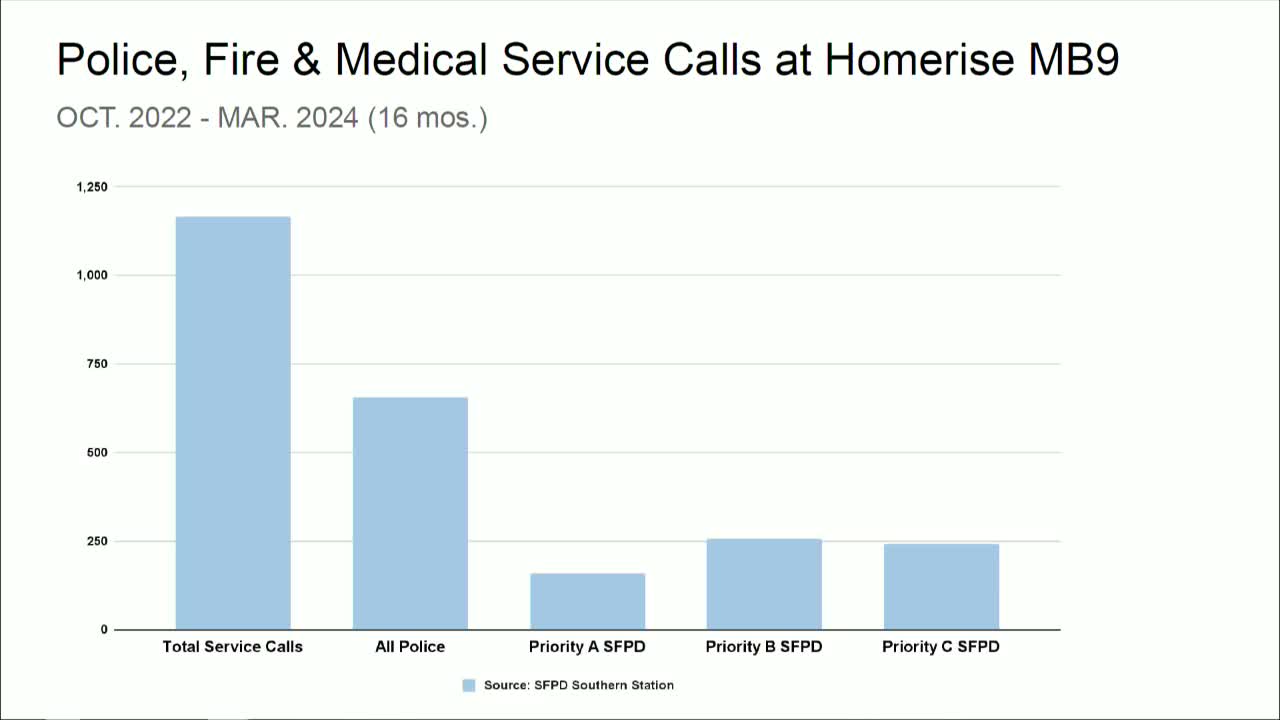
Supervisor Matt Dorsey convened a March 27 committee hearing to air neighborhood concerns about permanent supportive housing operations after the city opened Mission Bay 9 (MB9) in early 2022.
Neighbors told the Public Safety and Neighborhood Services Committee that MB9 generated what they described as a sustained surge in emergency responses. “In the past 14 months there have been more than a thousand calls to the city, including more than 600 police calls,” said resident Deanna Terzian, who urged HomeRise and the Department of Homelessness and Supportive Housing to provide 24/7 security, expedited relocation for repeat offenders and clearer tenant-screening information.
Supervisor Dorsey framed the hearing as pro-housing but focused on the city’s responsibility to operate PSH so it works for tenants and neighbors. He cited SFPD data showing 1,166 calls for city service at a single Mission Bay building between late October 2022 and March 2024, including 656 police-related calls with 159 classified as “priority A.”
Emily Cohen, deputy director at the Department of Homelessness and Supportive Housing, said most PSH sites are working and stressed that PSH is “not a medical facility” but a housing model with on-site services. Cohen said HSH has invested $32,400,000 over two years to lower case-manager workloads and raise frontline wages and pointed to other steps including a Permanent Housing Advanced Clinical Services (PACS/FACS) team and a stronger good-neighbor policy. She told the committee that the city’s PSH portfolio includes roughly 13,000 units, about 70% site-based (approximately 9,000 units), and that the systemwide vacancy rate is near 7%.
HomeRise, the nonprofit operator at MB9, said most residents are stable and that a small share of tenants — the agency estimated roughly 3–5% — are high-acuity and driving disproportionate calls for service. Marcel Davis, HomeRise director of resident services, described monthly meetings with neighbors and law enforcement and said the operator has installed no-loitering signage, adjusted access to community space and used case management to resolve some incidents.
But neighbors said meetings and incremental steps have not produced enough change. “Families are afraid to enter their own building,” Terzian said, describing repeated fights, open drug dealing and episodes she said included a tenant exposing himself to neighbors. Residents and several neighborhood organizations reiterated requests for greater on-site staffing, quicker relocation or eviction processes for repeat violent offenders, and funds to support neighborhood ambassadors who could help manage block-level behavior.
Provider and tenant speakers urged a balanced response. Lauren Hall, co-chair of the Supportive Housing Provider Network, warned against “othering” PSH tenants and said many 100% PSH sites are functioning well; Mercy Housing, Episcopal Community Services and other providers urged additional investments in clinical staffing and a funding model that recognizes intense needs during a building’s first 18–24 months of operation.
HSH officials told supervisors time-limited private security at an individual site is possible but said citywide, 24/7 private security across the entire PSH portfolio would cost an estimated $60–70 million annually and may not deliver the clinical de-escalation that trained social-service staff provide. Cohen and others recommended a mix of strategies — more clinical staff on site, time-limited security in crisis situations, community ambassadors, and an enhanced pathway for high-acuity tenants to receive intensive care.
The committee did not adopt new rules at the hearing. Supervisor Dorsey moved to continue the item to the call of the chair to allow follow-up with HSH, HomeRise and neighbors; the motion passed. Committee members asked HSH to supply more operational data, screening criteria for the MB9 placements, and a clear timetable for follow-up meetings.
What happens next: the committee continued the matter to the call of the chair so supervisors and city agencies can monitor progress, track outcomes of neighborhood working groups, and consider targeted investments (clinical staff, ambassadors or limited security) for sites with persistent problems.
Neighbors told the Public Safety and Neighborhood Services Committee that MB9 generated what they described as a sustained surge in emergency responses. “In the past 14 months there have been more than a thousand calls to the city, including more than 600 police calls,” said resident Deanna Terzian, who urged HomeRise and the Department of Homelessness and Supportive Housing to provide 24/7 security, expedited relocation for repeat offenders and clearer tenant-screening information.
Supervisor Dorsey framed the hearing as pro-housing but focused on the city’s responsibility to operate PSH so it works for tenants and neighbors. He cited SFPD data showing 1,166 calls for city service at a single Mission Bay building between late October 2022 and March 2024, including 656 police-related calls with 159 classified as “priority A.”
Emily Cohen, deputy director at the Department of Homelessness and Supportive Housing, said most PSH sites are working and stressed that PSH is “not a medical facility” but a housing model with on-site services. Cohen said HSH has invested $32,400,000 over two years to lower case-manager workloads and raise frontline wages and pointed to other steps including a Permanent Housing Advanced Clinical Services (PACS/FACS) team and a stronger good-neighbor policy. She told the committee that the city’s PSH portfolio includes roughly 13,000 units, about 70% site-based (approximately 9,000 units), and that the systemwide vacancy rate is near 7%.
HomeRise, the nonprofit operator at MB9, said most residents are stable and that a small share of tenants — the agency estimated roughly 3–5% — are high-acuity and driving disproportionate calls for service. Marcel Davis, HomeRise director of resident services, described monthly meetings with neighbors and law enforcement and said the operator has installed no-loitering signage, adjusted access to community space and used case management to resolve some incidents.
But neighbors said meetings and incremental steps have not produced enough change. “Families are afraid to enter their own building,” Terzian said, describing repeated fights, open drug dealing and episodes she said included a tenant exposing himself to neighbors. Residents and several neighborhood organizations reiterated requests for greater on-site staffing, quicker relocation or eviction processes for repeat violent offenders, and funds to support neighborhood ambassadors who could help manage block-level behavior.
Provider and tenant speakers urged a balanced response. Lauren Hall, co-chair of the Supportive Housing Provider Network, warned against “othering” PSH tenants and said many 100% PSH sites are functioning well; Mercy Housing, Episcopal Community Services and other providers urged additional investments in clinical staffing and a funding model that recognizes intense needs during a building’s first 18–24 months of operation.
HSH officials told supervisors time-limited private security at an individual site is possible but said citywide, 24/7 private security across the entire PSH portfolio would cost an estimated $60–70 million annually and may not deliver the clinical de-escalation that trained social-service staff provide. Cohen and others recommended a mix of strategies — more clinical staff on site, time-limited security in crisis situations, community ambassadors, and an enhanced pathway for high-acuity tenants to receive intensive care.
The committee did not adopt new rules at the hearing. Supervisor Dorsey moved to continue the item to the call of the chair to allow follow-up with HSH, HomeRise and neighbors; the motion passed. Committee members asked HSH to supply more operational data, screening criteria for the MB9 placements, and a clear timetable for follow-up meetings.
What happens next: the committee continued the matter to the call of the chair so supervisors and city agencies can monitor progress, track outcomes of neighborhood working groups, and consider targeted investments (clinical staff, ambassadors or limited security) for sites with persistent problems.
View the Full Meeting & All Its Details
This article offers just a summary. Unlock complete video, transcripts, and insights as a Founder Member.
✓
Watch full, unedited meeting videos
✓
Search every word spoken in unlimited transcripts
✓
AI summaries & real-time alerts (all government levels)
✓
Permanent access to expanding government content
30-day money-back guarantee
