Budget analysts: San Francisco had roughly 40,000 vacant housing units in 2019; vacancy tax and buyback models presented
January 31, 2022 | San Francisco County, California
This article was created by AI summarizing key points discussed. AI makes mistakes, so for full details and context, please refer to the video of the full meeting. Please report any errors so we can fix them. Report an error »
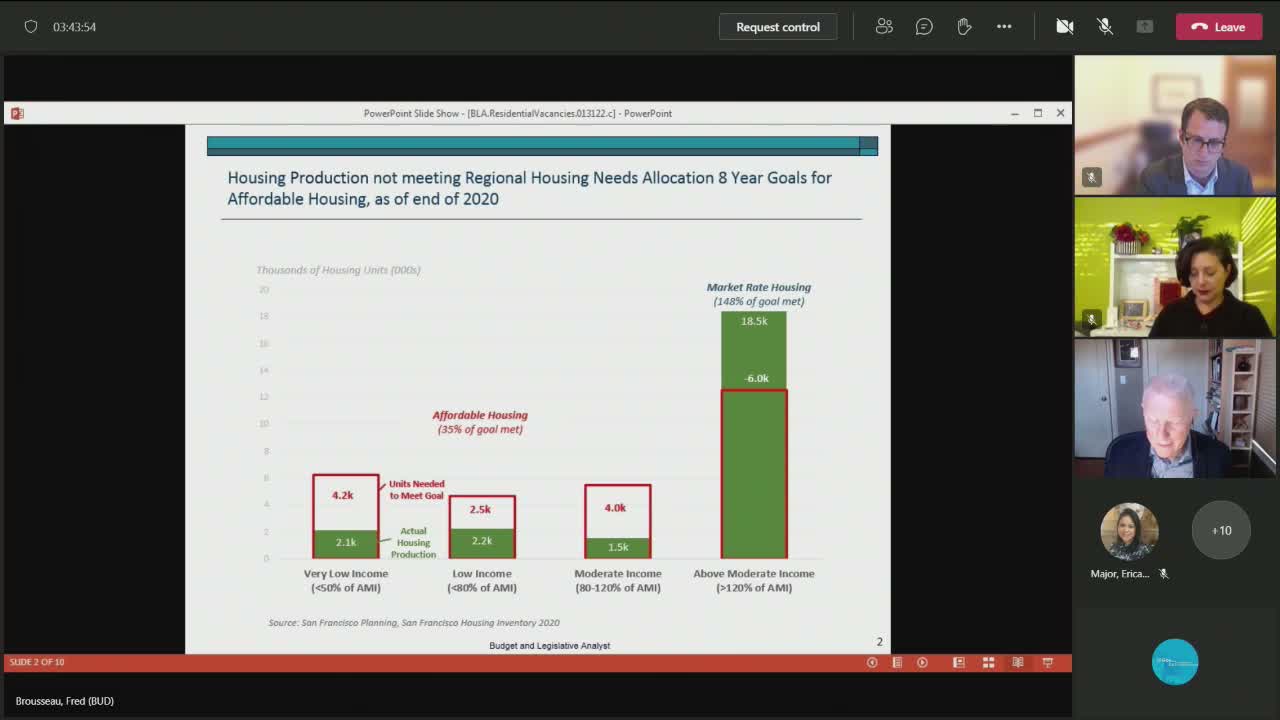
The Budget and Legislative Analyst (BLA) presented a comprehensive report showing an estimated 40,458 vacant housing units in San Francisco as of the 2019 American Community Survey, up from roughly 26,400 in 2013. Vice Chair Supervisor Dean Preston said the numbers suggest that activating vacant housing must be part of the citys strategy alongside new production.
Fred Russo of the BLA said the fastest-growing vacancy classification is "sold but not occupied," which accounted for roughly 20% of vacant units and can include investment properties held off the market. The largest single grouping was "other vacant" (including units out of service for repairs, legal proceedings, or personal/family reasons) and a sizable number of units were listed as "seasonal, recreational, or occasional use."
The BLA compared international and U.S. approaches to vacancy taxes. Vancouver, British Columbia, reported a 25.4% reduction in reported vacant units two years after imposing a tax that charges an additional levy tied to assessed value for units occupied less than six months a year. Oaklands flat-fee vacancy tax produces modest revenue (estimates shared at the hearing). Barcelonas model allows temporary municipal possession of long-term vacant properties for use as affordable housing in limited circumstances.
The BLA gave revenue scenarios for San Francisco under different structures: a low-end flat-fee model comparable to Oakland could raise roughly $13 million annually (net), a mid-range estimate was about $38.8 million, and a Vancouver-style value-linked approach could yield roughly $61.2 million annually (all subject to exemptions and administrative costs). The BLA recommended building vacancy reporting into the citys new housing registry, seeking city-attorney guidance on legally permissible tools, and considering a vacancy tax combined with acquisition programs to convert long-term vacant properties to affordable housing.
Public commenters described local vacant properties, corporate holdings, and illegal unit mergers; many urged a vacancy tax plus stronger enforcement and better inventory tracking. The committee voted to file the BLA report for the record and directed staff to pursue data collection, legal review and next steps.
Fred Russo of the BLA said the fastest-growing vacancy classification is "sold but not occupied," which accounted for roughly 20% of vacant units and can include investment properties held off the market. The largest single grouping was "other vacant" (including units out of service for repairs, legal proceedings, or personal/family reasons) and a sizable number of units were listed as "seasonal, recreational, or occasional use."
The BLA compared international and U.S. approaches to vacancy taxes. Vancouver, British Columbia, reported a 25.4% reduction in reported vacant units two years after imposing a tax that charges an additional levy tied to assessed value for units occupied less than six months a year. Oaklands flat-fee vacancy tax produces modest revenue (estimates shared at the hearing). Barcelonas model allows temporary municipal possession of long-term vacant properties for use as affordable housing in limited circumstances.
The BLA gave revenue scenarios for San Francisco under different structures: a low-end flat-fee model comparable to Oakland could raise roughly $13 million annually (net), a mid-range estimate was about $38.8 million, and a Vancouver-style value-linked approach could yield roughly $61.2 million annually (all subject to exemptions and administrative costs). The BLA recommended building vacancy reporting into the citys new housing registry, seeking city-attorney guidance on legally permissible tools, and considering a vacancy tax combined with acquisition programs to convert long-term vacant properties to affordable housing.
Public commenters described local vacant properties, corporate holdings, and illegal unit mergers; many urged a vacancy tax plus stronger enforcement and better inventory tracking. The committee voted to file the BLA report for the record and directed staff to pursue data collection, legal review and next steps.
Don't Miss a Word: See the Full Meeting!
Go beyond summaries. Unlock every video, transcript, and key insight with a Founder Membership.
✓
Get instant access to full meeting videos
✓
Search and clip any phrase from complete transcripts
✓
Receive AI-powered summaries & custom alerts
✓
Enjoy lifetime, unrestricted access to government data
30-day money-back guarantee
