Committee debates 'Cars to Casas' plan to convert auto‑oriented sites to housing; continued for further drafting
February 28, 2022 | San Francisco County, California
This article was created by AI summarizing key points discussed. AI makes mistakes, so for full details and context, please refer to the video of the full meeting. Please report any errors so we can fix them. Report an error »
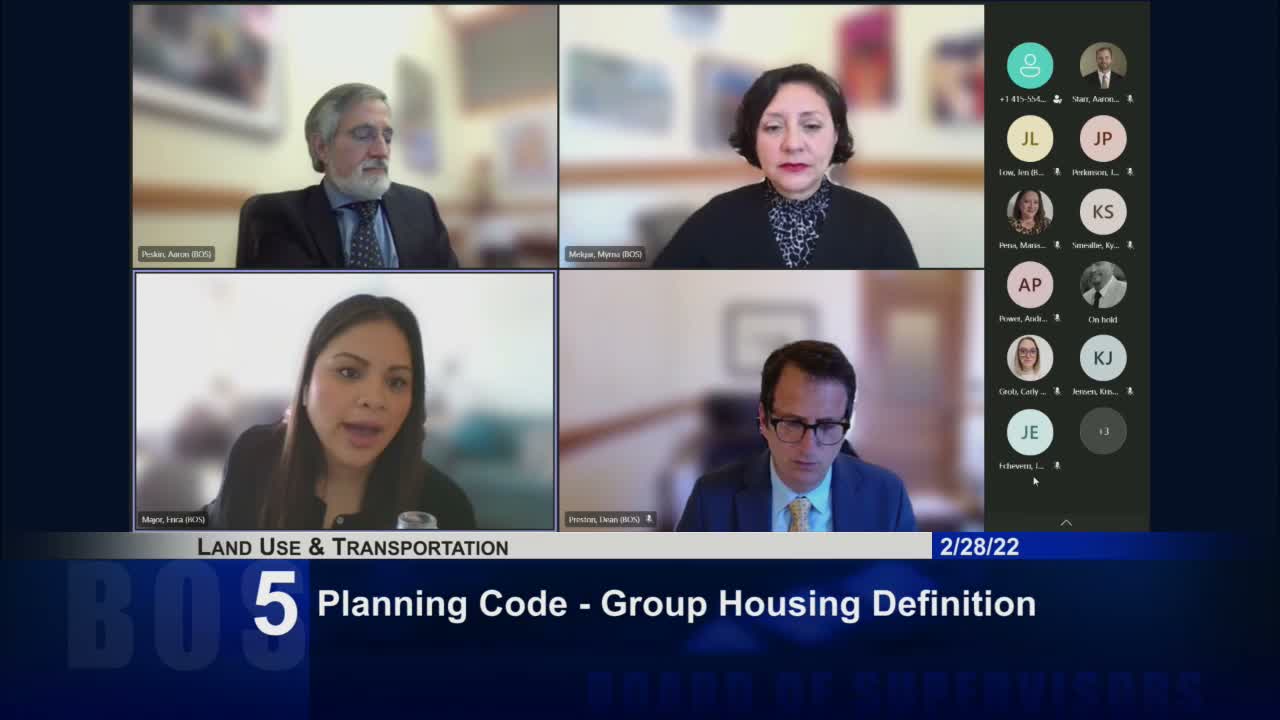
The Mayor’s Office and Planning Department presented an ordinance intended to accelerate housing development on parcels currently used for auto‑oriented purposes by removing certain conditional‑use barriers and enabling form‑based zoning on eligible RH parcels.
Planner Aaron Starr and Mayor’s Office policy staff described key elements: qualifying sites (parking lots, gas stations, accessory parking), a move to form‑based unit counts (up to four units in some RH areas), parking maximums (0.25 spaces/unit default, with conditional use to 0.5) and an exclusion for legacy businesses. The ordinance would also remove an outdated code provision that required conditional use authorization to close a service station.
Supervisors praised the objective of converting vehicle storage to housing but several raised concerns. Supervisor Peskin pressed for stronger affordability commitments and value capture in exchange for streamlined approvals; Supervisor Preston also urged consideration of heightened affordability thresholds tied to additional density. Members discussed labor impacts (loss of blue‑collar automotive jobs) and mapping/feasibility questions.
Public comment was extensive and polarized: housing advocates and YIMBY groups urged quick adoption, saying converting car storage to homes is necessary to address the housing emergency; community organizations and labor/Rep/Equity coalitions urged tabling to ensure protections for blue‑collar jobs, to prioritize 100% affordable development on opportunity sites, and to clarify impacts on sensitive neighborhoods (Chinatown, Tenderloin). After discussion, the committee voted to continue the item to the call of the chair so supervisors, City Attorney and the Mayor’s Office can finalize drafting on affordability triggers, mapping, and other clarifications.
Planner Aaron Starr and Mayor’s Office policy staff described key elements: qualifying sites (parking lots, gas stations, accessory parking), a move to form‑based unit counts (up to four units in some RH areas), parking maximums (0.25 spaces/unit default, with conditional use to 0.5) and an exclusion for legacy businesses. The ordinance would also remove an outdated code provision that required conditional use authorization to close a service station.
Supervisors praised the objective of converting vehicle storage to housing but several raised concerns. Supervisor Peskin pressed for stronger affordability commitments and value capture in exchange for streamlined approvals; Supervisor Preston also urged consideration of heightened affordability thresholds tied to additional density. Members discussed labor impacts (loss of blue‑collar automotive jobs) and mapping/feasibility questions.
Public comment was extensive and polarized: housing advocates and YIMBY groups urged quick adoption, saying converting car storage to homes is necessary to address the housing emergency; community organizations and labor/Rep/Equity coalitions urged tabling to ensure protections for blue‑collar jobs, to prioritize 100% affordable development on opportunity sites, and to clarify impacts on sensitive neighborhoods (Chinatown, Tenderloin). After discussion, the committee voted to continue the item to the call of the chair so supervisors, City Attorney and the Mayor’s Office can finalize drafting on affordability triggers, mapping, and other clarifications.
View the Full Meeting & All Its Details
This article offers just a summary. Unlock complete video, transcripts, and insights as a Founder Member.
✓
Watch full, unedited meeting videos
✓
Search every word spoken in unlimited transcripts
✓
AI summaries & real-time alerts (all government levels)
✓
Permanent access to expanding government content
30-day money-back guarantee
