Supervisors hold hearing linking housing insecurity to poor birth outcomes for BIPOC pregnant people
April 11, 2022 | San Francisco County, California
This article was created by AI summarizing key points discussed. AI makes mistakes, so for full details and context, please refer to the video of the full meeting. Please report any errors so we can fix them. Report an error »
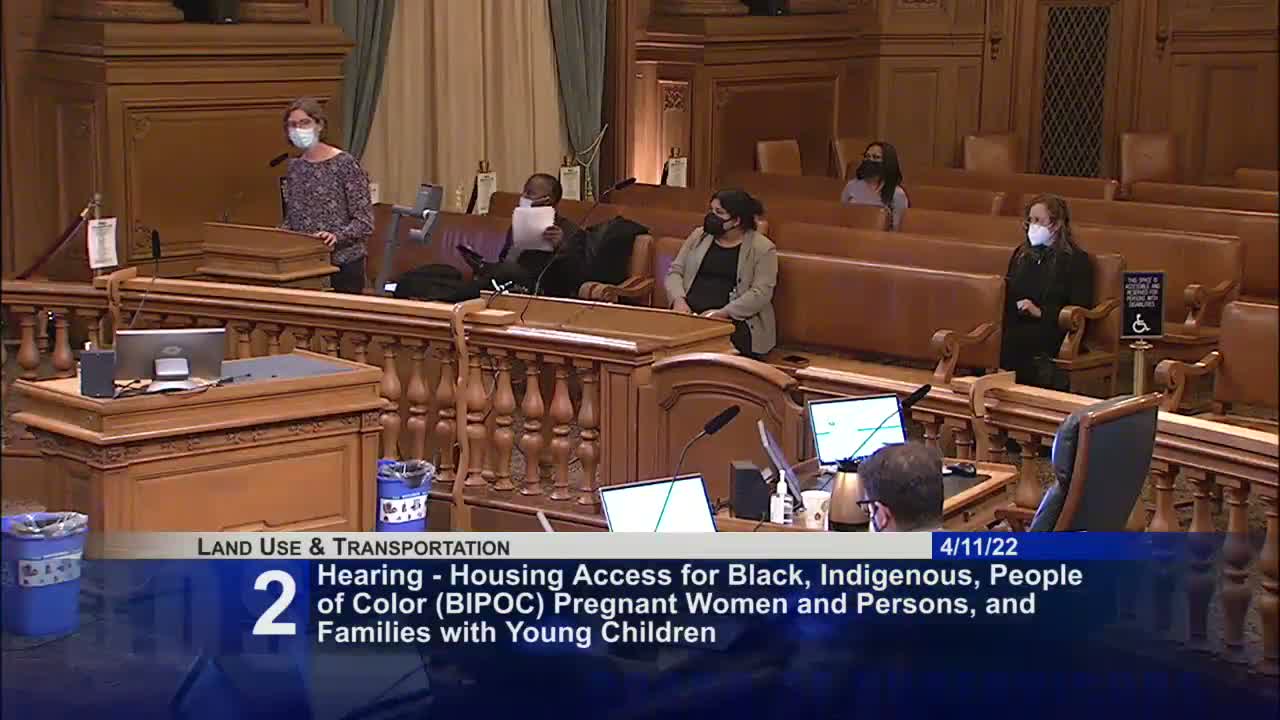
The Land Use and Transportation Committee held a public hearing April 11 examining how housing instability and discrimination contribute to poorer birth outcomes for Black, Indigenous and other people of color in San Francisco.
Chair Mirna Melgaard opened the hearing by citing city data showing stark racial disparities: Black mothers account for a disproportionately large share of maternal deaths and preterm births relative to their share of births. The committee heard clinical testimony, program summaries and community testimony that linked housing insecurity, shelter access and discrimination to elevated risks during pregnancy.
Dr. Nika Seidman, an OB‑GYN with Team Lily at San Francisco General, described daily clinical experience caring for pregnant people who are unsheltered or otherwise housing insecure. Team Lily serves roughly 50 pregnant people a year; staff said over 95% of their patients experience housing insecurity and 30–40% are unsheltered. Seidman said unsheltered pregnant patients face more than double the risk of preterm birth compared with sheltered patients and connected the housing crisis to a rise in congenital syphilis cases, noting San Francisco recorded 5 congenital syphilis cases in 2020 and 6 in the following year.
Matthew (identified in the hearing as Matthew Oglander) of the San Francisco Human Rights Commission outlined fair‑housing concerns, emphasizing source‑of‑income discrimination — landlords refusing Section 8 vouchers — which human‑rights testing shows still occurs in both overt and subtle forms and disproportionately affects Black women with children.
Emily Cohen, Deputy Director at the Department of Homelessness and Supportive Housing, presented coordinated entry data and shelter policy: the 2019 point‑in‑time count found about 208 families with children on a single night; HSH administers coordinated entry assessments and said up to ~1,100 existing family units (with ~428 more coming online) are available to serve pregnant people and families. Cohen described policies that guarantee immediate shelter access for unsheltered pregnant people, while acknowledging that available bed types and program models do not always match clients' needs, which can create gaps between policy and outcomes.
Sheila Nicolaopoulos of the Mayor’s Office of Housing and Community Development outlined MOHCD programs and the DAHLIA housing lottery, noting MOHCD manages ~25,000 affordable units and a pipeline of roughly 11,000 units. She said MOHCD does not currently request pregnancy status in its intake and stressed the challenge of aligning longer lottery timelines with the urgent timing of pregnancy.
Community providers and residents gave multiple personal accounts. Monica Stepto of Homeless Prenatal described Jelani House and PATH hotel programs and urged that community shelters be allowed to serve as coordinated entry access points to reduce referral friction. Witnesses recounted cases where women seeking shelter were turned away and described tragic outcomes including stillbirths and maternal deaths following gaps in access to appropriate housing.
Supervisors questioned officials about the discrepancy between priority policies and on‑the‑ground barriers, the availability and distribution pace of rapid rehousing and hotel vouchers, and the feasibility of better coordinating Section 8 voucher holders with nonprofit owners. HSH and MOHCD acknowledged shortages of specific bed types and program models and said they would follow up on the status of funding allocations and solicitations.
Chair Melgard closed by committing to file the hearing and said the committee will pursue legislative fixes; the committee voted to file the hearing record.
What this means: presenters and community members described a complex system where priority rules exist on paper but resource scarcity, program design limits and discrimination in the private market undermine timely access to stable housing for pregnant BIPOC residents. Committee members asked departments to follow up with data on unspent allocations, program design, and the feasibility of additional access points and targeted subsidies.
Chair Mirna Melgaard opened the hearing by citing city data showing stark racial disparities: Black mothers account for a disproportionately large share of maternal deaths and preterm births relative to their share of births. The committee heard clinical testimony, program summaries and community testimony that linked housing insecurity, shelter access and discrimination to elevated risks during pregnancy.
Dr. Nika Seidman, an OB‑GYN with Team Lily at San Francisco General, described daily clinical experience caring for pregnant people who are unsheltered or otherwise housing insecure. Team Lily serves roughly 50 pregnant people a year; staff said over 95% of their patients experience housing insecurity and 30–40% are unsheltered. Seidman said unsheltered pregnant patients face more than double the risk of preterm birth compared with sheltered patients and connected the housing crisis to a rise in congenital syphilis cases, noting San Francisco recorded 5 congenital syphilis cases in 2020 and 6 in the following year.
Matthew (identified in the hearing as Matthew Oglander) of the San Francisco Human Rights Commission outlined fair‑housing concerns, emphasizing source‑of‑income discrimination — landlords refusing Section 8 vouchers — which human‑rights testing shows still occurs in both overt and subtle forms and disproportionately affects Black women with children.
Emily Cohen, Deputy Director at the Department of Homelessness and Supportive Housing, presented coordinated entry data and shelter policy: the 2019 point‑in‑time count found about 208 families with children on a single night; HSH administers coordinated entry assessments and said up to ~1,100 existing family units (with ~428 more coming online) are available to serve pregnant people and families. Cohen described policies that guarantee immediate shelter access for unsheltered pregnant people, while acknowledging that available bed types and program models do not always match clients' needs, which can create gaps between policy and outcomes.
Sheila Nicolaopoulos of the Mayor’s Office of Housing and Community Development outlined MOHCD programs and the DAHLIA housing lottery, noting MOHCD manages ~25,000 affordable units and a pipeline of roughly 11,000 units. She said MOHCD does not currently request pregnancy status in its intake and stressed the challenge of aligning longer lottery timelines with the urgent timing of pregnancy.
Community providers and residents gave multiple personal accounts. Monica Stepto of Homeless Prenatal described Jelani House and PATH hotel programs and urged that community shelters be allowed to serve as coordinated entry access points to reduce referral friction. Witnesses recounted cases where women seeking shelter were turned away and described tragic outcomes including stillbirths and maternal deaths following gaps in access to appropriate housing.
Supervisors questioned officials about the discrepancy between priority policies and on‑the‑ground barriers, the availability and distribution pace of rapid rehousing and hotel vouchers, and the feasibility of better coordinating Section 8 voucher holders with nonprofit owners. HSH and MOHCD acknowledged shortages of specific bed types and program models and said they would follow up on the status of funding allocations and solicitations.
Chair Melgard closed by committing to file the hearing and said the committee will pursue legislative fixes; the committee voted to file the hearing record.
What this means: presenters and community members described a complex system where priority rules exist on paper but resource scarcity, program design limits and discrimination in the private market undermine timely access to stable housing for pregnant BIPOC residents. Committee members asked departments to follow up with data on unspent allocations, program design, and the feasibility of additional access points and targeted subsidies.
Don't Miss a Word: See the Full Meeting!
Go beyond summaries. Unlock every video, transcript, and key insight with a Founder Membership.
✓
Get instant access to full meeting videos
✓
Search and clip any phrase from complete transcripts
✓
Receive AI-powered summaries & custom alerts
✓
Enjoy lifetime, unrestricted access to government data
30-day money-back guarantee
