Supervisors press OCII and MOHCD on outreach after AB 1584 expands certificate of preference eligibility
April 11, 2022 | San Francisco County, California
This article was created by AI summarizing key points discussed. AI makes mistakes, so for full details and context, please refer to the video of the full meeting. Please report any errors so we can fix them. Report an error »
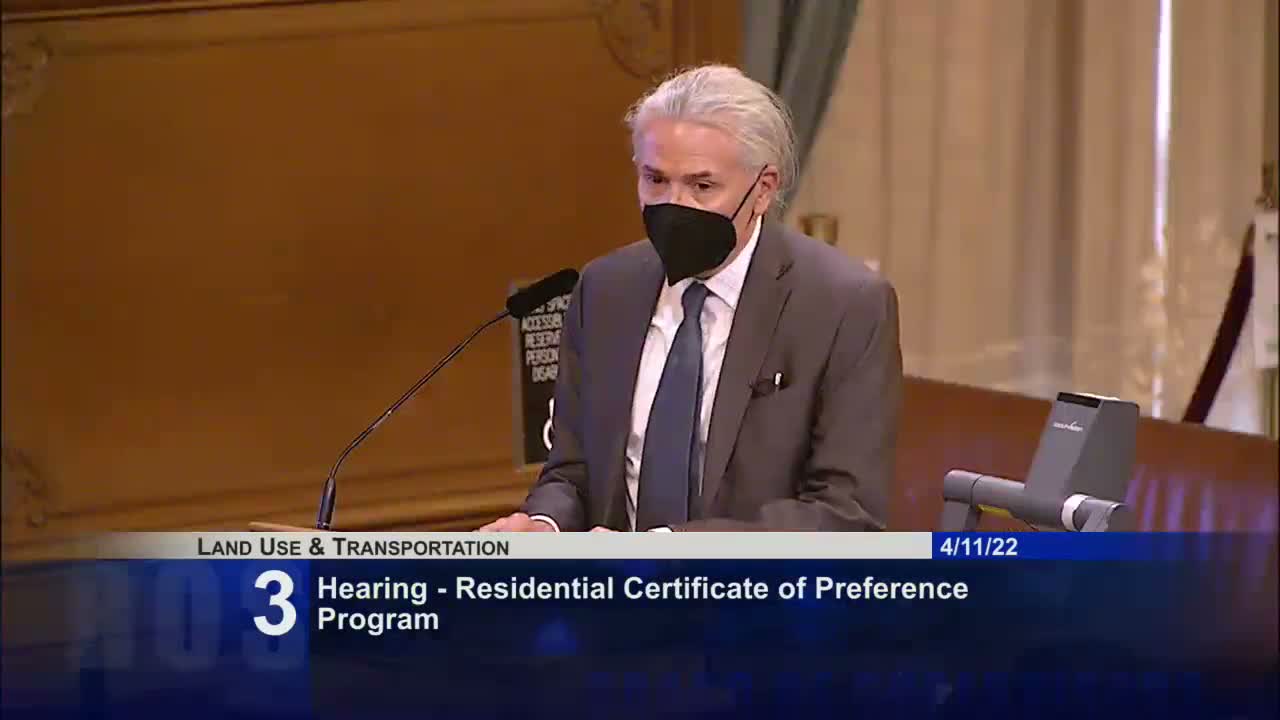
The committee held an extended hearing April 11 on the city’s residential Certificate of Preference (COP) program after the state expanded eligibility to descendants via Assembly Bill 1584. Officials from the Office of Community Investment and Infrastructure (OCII) and the Mayor’s Office of Housing and Community Development (MOHCD) told supervisors the program’s historical records are incomplete and that locating eligible people will require new data work and outreach.
Jim Morales, OCII interim executive director, reviewed the program’s origins in the 1960s and described earlier reforms; OCII and consultants estimate roughly 5,893 households (about 12,188 individuals) were displaced by redevelopment activities historically. OCII said its prior outreach located about 937 verified contact records, and it has about 900 active COP holders on a current list. Morales and OCII staff said the agency has contracted investigators to search for the roughly 10,000 individuals whose contact information could not be confirmed in earlier sweeps.
Eric Shaw of MOHCD described DAHLIA intake and how COP preferences are applied in housing lotteries; MOHCD said it currently applies the preference across its portfolio and is expanding outreach and staffing to process newly eligible claims under AB 1584. MOHCD and OCII acknowledged gaps: they do not currently know the full size of the expanded descendant pool and will need additional research to estimate the number of potentially eligible people who meet income requirements.
Supervisors pressed for concrete counts and methodology. OCII described past contractors (Peel and Kean/Keene teams) and costs for historical data work and said recent contracts will attempt more comprehensive data sweeps using newer methods. Public commenters — including COP holders, community advocates and an OCII subcommittee chair — urged greater urgency, ongoing communication cadence with holders, moving‑assistance stipends, and equity in any outreach strategy.
The committee continued this item to the call of the chair to allow agencies time to report back with outreach plans and research findings.
Jim Morales, OCII interim executive director, reviewed the program’s origins in the 1960s and described earlier reforms; OCII and consultants estimate roughly 5,893 households (about 12,188 individuals) were displaced by redevelopment activities historically. OCII said its prior outreach located about 937 verified contact records, and it has about 900 active COP holders on a current list. Morales and OCII staff said the agency has contracted investigators to search for the roughly 10,000 individuals whose contact information could not be confirmed in earlier sweeps.
Eric Shaw of MOHCD described DAHLIA intake and how COP preferences are applied in housing lotteries; MOHCD said it currently applies the preference across its portfolio and is expanding outreach and staffing to process newly eligible claims under AB 1584. MOHCD and OCII acknowledged gaps: they do not currently know the full size of the expanded descendant pool and will need additional research to estimate the number of potentially eligible people who meet income requirements.
Supervisors pressed for concrete counts and methodology. OCII described past contractors (Peel and Kean/Keene teams) and costs for historical data work and said recent contracts will attempt more comprehensive data sweeps using newer methods. Public commenters — including COP holders, community advocates and an OCII subcommittee chair — urged greater urgency, ongoing communication cadence with holders, moving‑assistance stipends, and equity in any outreach strategy.
The committee continued this item to the call of the chair to allow agencies time to report back with outreach plans and research findings.
Don't Miss a Word: See the Full Meeting!
Go beyond summaries. Unlock every video, transcript, and key insight with a Founder Membership.
✓
Get instant access to full meeting videos
✓
Search and clip any phrase from complete transcripts
✓
Receive AI-powered summaries & custom alerts
✓
Enjoy lifetime, unrestricted access to government data
30-day money-back guarantee
