Committee advances zoning changes to allow adult venues, continues ordinance to April 25
April 18, 2022 | San Francisco County, California
This article was created by AI summarizing key points discussed. AI makes mistakes, so for full details and context, please refer to the video of the full meeting. Please report any errors so we can fix them. Report an error »
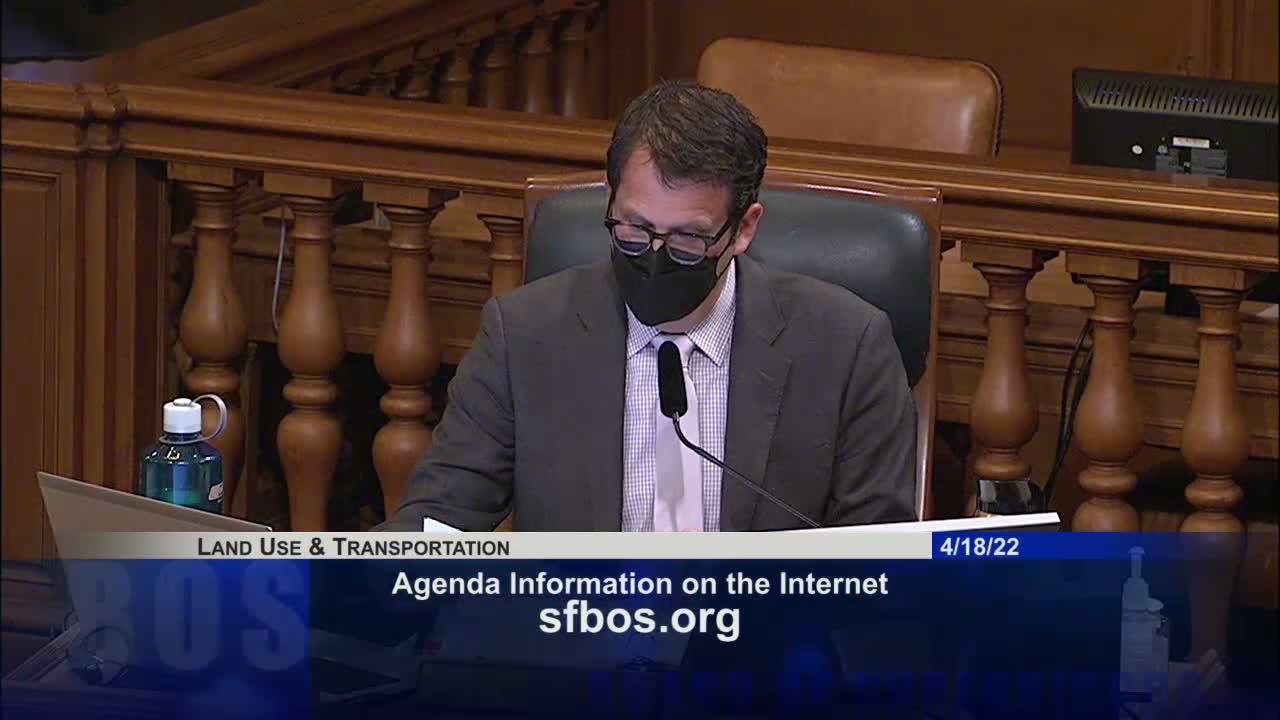
The Land Use and Transportation Committee on April 18 considered an ordinance to add a new "adult venue" use to the San Francisco Planning Code and to change where those businesses may operate, including in neighborhoods historically associated with the city’s LGBTQ community. Supervisor Rafael Mandelman, the item’s sponsor, said the changes respond to conflicts between public-health rules for adult venues and existing zoning that treated them as broadly prohibited "adult businesses."
Mandelman said the proposal would align zoning with the Department of Public Health’s 2021 minimum standards for adult venues — rules that require age verification, prohibit drugs and alcohol on the premises, and require the provision of condoms and sexual-health education. "This is an ordinance to update the city zoning controls for adult venues including those institutions commonly known as gay bathhouses," Mandelman said. He and Planning staff said the ordinance would make adult venues a defined retail-service use that may operate where the Planning Code permits, with specific exceptions and protections in place.
Why it matters: Supporters said the change will clear regulatory obstacles that have prevented entrepreneurs and legacy businesses from operating in queer cultural districts such as the Castro, Upper Market, western SoMa, and parts of the Tenderloin. The sponsor and planning staff said the Planning Commission unanimously recommended the ordinance on April 7 with technical modifications. In committee, Mandelman noted the example of Eros, a longstanding gay- and trans-owned business that lost its longtime lease and has sought relocation options constrained by current zoning.
What the ordinance would do: According to the sponsor and Planning Department testimony, the ordinance would (1) create a new adult-venue use tied to the Department of Public Health’s standards; (2) make adult venues principally permitted in specified LGBTQ cultural districts and corridors; (3) allow for 24-hour operation in areas where the use is principally permitted, subject to controls on noise, lighting and security; and (4) permit extended hours in conditionally permitted areas via conditional-use approval. Planning staff also described technical fixes, including a correction to a table that had incorrectly listed adult businesses as not permitted in a Chinatown district.
Public comment: Three members of the public spoke in favor. Ken Roe, identified as a co-owner of Eros, said his business has been operating since 1992 and supported the code change to allow relocation and continued operation. Cal Callahan (identified in the transcript as manager of the cultural district) and Bob Goldfarb, executive director of the Leather and LGBTQ Cultural District, also urged approval, saying the measure would help remove stigma and revive community-serving queer businesses.
Committee action and next steps: The committee accepted the sponsor’s amendments as read into the record and then, after the city attorney advised that substantive amendments must "sit" for a week before final action, the sponsor withdrew a motion to send the item immediately to the full Board. The committee instead voted to continue the ordinance "as amended" to the Land Use & Transportation Committee meeting on April 25, 2022. The clerk recorded the committee’s votes on both the amendments and the continuance as two ayes and no recorded no votes.
The committee’s action on April 25 will reflect the circulated amendments and any additional revisions required by the one-week rule noted by the city attorney. The Planning Department staff told the committee they are available to answer questions as the item returns to committee.
Mandelman said the proposal would align zoning with the Department of Public Health’s 2021 minimum standards for adult venues — rules that require age verification, prohibit drugs and alcohol on the premises, and require the provision of condoms and sexual-health education. "This is an ordinance to update the city zoning controls for adult venues including those institutions commonly known as gay bathhouses," Mandelman said. He and Planning staff said the ordinance would make adult venues a defined retail-service use that may operate where the Planning Code permits, with specific exceptions and protections in place.
Why it matters: Supporters said the change will clear regulatory obstacles that have prevented entrepreneurs and legacy businesses from operating in queer cultural districts such as the Castro, Upper Market, western SoMa, and parts of the Tenderloin. The sponsor and planning staff said the Planning Commission unanimously recommended the ordinance on April 7 with technical modifications. In committee, Mandelman noted the example of Eros, a longstanding gay- and trans-owned business that lost its longtime lease and has sought relocation options constrained by current zoning.
What the ordinance would do: According to the sponsor and Planning Department testimony, the ordinance would (1) create a new adult-venue use tied to the Department of Public Health’s standards; (2) make adult venues principally permitted in specified LGBTQ cultural districts and corridors; (3) allow for 24-hour operation in areas where the use is principally permitted, subject to controls on noise, lighting and security; and (4) permit extended hours in conditionally permitted areas via conditional-use approval. Planning staff also described technical fixes, including a correction to a table that had incorrectly listed adult businesses as not permitted in a Chinatown district.
Public comment: Three members of the public spoke in favor. Ken Roe, identified as a co-owner of Eros, said his business has been operating since 1992 and supported the code change to allow relocation and continued operation. Cal Callahan (identified in the transcript as manager of the cultural district) and Bob Goldfarb, executive director of the Leather and LGBTQ Cultural District, also urged approval, saying the measure would help remove stigma and revive community-serving queer businesses.
Committee action and next steps: The committee accepted the sponsor’s amendments as read into the record and then, after the city attorney advised that substantive amendments must "sit" for a week before final action, the sponsor withdrew a motion to send the item immediately to the full Board. The committee instead voted to continue the ordinance "as amended" to the Land Use & Transportation Committee meeting on April 25, 2022. The clerk recorded the committee’s votes on both the amendments and the continuance as two ayes and no recorded no votes.
The committee’s action on April 25 will reflect the circulated amendments and any additional revisions required by the one-week rule noted by the city attorney. The Planning Department staff told the committee they are available to answer questions as the item returns to committee.
Don't Miss a Word: See the Full Meeting!
Go beyond summaries. Unlock every video, transcript, and key insight with a Founder Membership.
✓
Get instant access to full meeting videos
✓
Search and clip any phrase from complete transcripts
✓
Receive AI-powered summaries & custom alerts
✓
Enjoy lifetime, unrestricted access to government data
30-day money-back guarantee
