Budget analyst finds 305 vacant below‑market‑rate units; MOHCD outlines lease-up steps and support, committee asks for annual reporting
June 06, 2022 | San Francisco County, California
This article was created by AI summarizing key points discussed. AI makes mistakes, so for full details and context, please refer to the video of the full meeting. Please report any errors so we can fix them. Report an error »
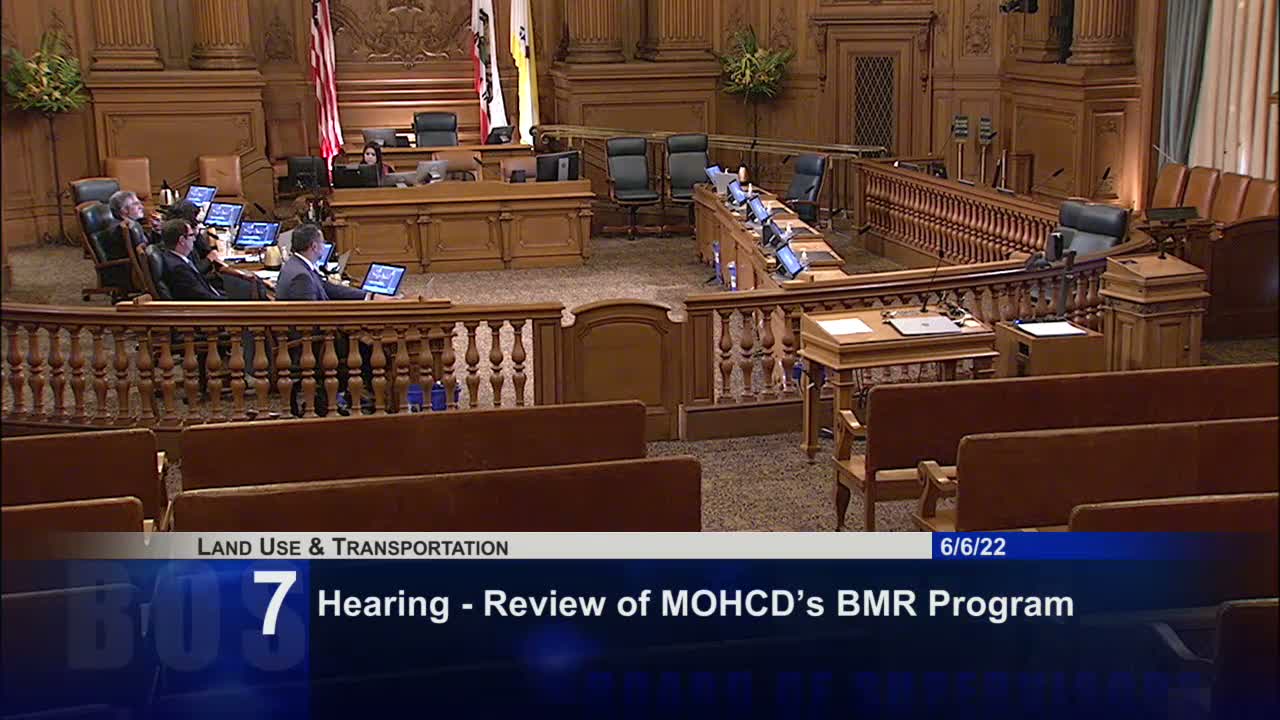
The Land Use & Transportation Committee held an extended hearing June 6 on the Mayor’s Office of Housing & Community Development’s (MOHCD) Below Market Rate (BMR) program after a Budget & Legislative Analyst (BLA) report found 305 vacant BMR rental units citywide out of 1,961 units in 101 buildings (a 15.6% vacancy rate as of the BLA snapshot).
Dan Goncher of the BLA presented the audit: 305 vacancies (69% targeted to households at ≤55% AMI; 30% targeted at 55–100% AMI), with 53% of vacant units being SROs/studios/one-bedrooms; 80% of the vacancies began in 2021–2022. BLA described the enforcement timeline (notice of complaint, notice of enforcement, planning referral, notice of violation and $250/day administrative penalties assessed by Planning if unresolved) and suggested policy options: quarterly MOHCD reporting, Planning Code enforcement adjustments, or market-research on causes of lease-up delays.
MOHCD staff (Sheila Nicholas and Deputy Director Maria Benjamin) said the DAHLIA leasing portal and a suite of technical assistance tools exist to support sponsors and applicants; MOHCD presented an updated status: of the 305 vacancies, 116 were newly advertised (within a normal six‑month lease-up window), 40 leases had been signed, 17 units were transferred to HSH, 5 were under penalty, and 127 were considered delayed lease-ups (95 actively leasing; 31 referred to Planning for enforcement). MOHCD attributed prolonged vacancies to pandemic-era market changes (demand for larger units), applicant non-response (roughly 75% of candidate dropouts in delayed projects), and sponsor staffing or administrative problems; MOHCD said it is improving systems (Salesforce portal, DAHLIA enhancements and community engagement) and will pursue enforcement as a last resort.
Developers and leasing agents who called into the hearing described duplication of income verification, intrusive applicant documentation requirements, and lengthy landlord/MOHCD review; nonprofit and tenant advocates said many families lack alternatives and urged faster placements and oversight. Committee members asked MOHCD for a regular reporting cadence and more granular data (geographic distribution, breakdown of 2021 vs 2022 vacancies and enforcement outcomes). Supervisor Asha Safai said an annual report will be requested; the committee voted to continue the hearing to the call of the chair to allow MOHCD and BLA to provide additional follow-up data and to permit policy work on the inclusionary manual.
Dan Goncher of the BLA presented the audit: 305 vacancies (69% targeted to households at ≤55% AMI; 30% targeted at 55–100% AMI), with 53% of vacant units being SROs/studios/one-bedrooms; 80% of the vacancies began in 2021–2022. BLA described the enforcement timeline (notice of complaint, notice of enforcement, planning referral, notice of violation and $250/day administrative penalties assessed by Planning if unresolved) and suggested policy options: quarterly MOHCD reporting, Planning Code enforcement adjustments, or market-research on causes of lease-up delays.
MOHCD staff (Sheila Nicholas and Deputy Director Maria Benjamin) said the DAHLIA leasing portal and a suite of technical assistance tools exist to support sponsors and applicants; MOHCD presented an updated status: of the 305 vacancies, 116 were newly advertised (within a normal six‑month lease-up window), 40 leases had been signed, 17 units were transferred to HSH, 5 were under penalty, and 127 were considered delayed lease-ups (95 actively leasing; 31 referred to Planning for enforcement). MOHCD attributed prolonged vacancies to pandemic-era market changes (demand for larger units), applicant non-response (roughly 75% of candidate dropouts in delayed projects), and sponsor staffing or administrative problems; MOHCD said it is improving systems (Salesforce portal, DAHLIA enhancements and community engagement) and will pursue enforcement as a last resort.
Developers and leasing agents who called into the hearing described duplication of income verification, intrusive applicant documentation requirements, and lengthy landlord/MOHCD review; nonprofit and tenant advocates said many families lack alternatives and urged faster placements and oversight. Committee members asked MOHCD for a regular reporting cadence and more granular data (geographic distribution, breakdown of 2021 vs 2022 vacancies and enforcement outcomes). Supervisor Asha Safai said an annual report will be requested; the committee voted to continue the hearing to the call of the chair to allow MOHCD and BLA to provide additional follow-up data and to permit policy work on the inclusionary manual.
View the Full Meeting & All Its Details
This article offers just a summary. Unlock complete video, transcripts, and insights as a Founder Member.
✓
Watch full, unedited meeting videos
✓
Search every word spoken in unlimited transcripts
✓
AI summaries & real-time alerts (all government levels)
✓
Permanent access to expanding government content
30-day money-back guarantee
