Committee hears building-decarbonization roadmap; staff outlines equity hub, financing study and a modest near-term staffing plan
July 18, 2022 | San Francisco County, California
This article was created by AI summarizing key points discussed. AI makes mistakes, so for full details and context, please refer to the video of the full meeting. Please report any errors so we can fix them. Report an error »
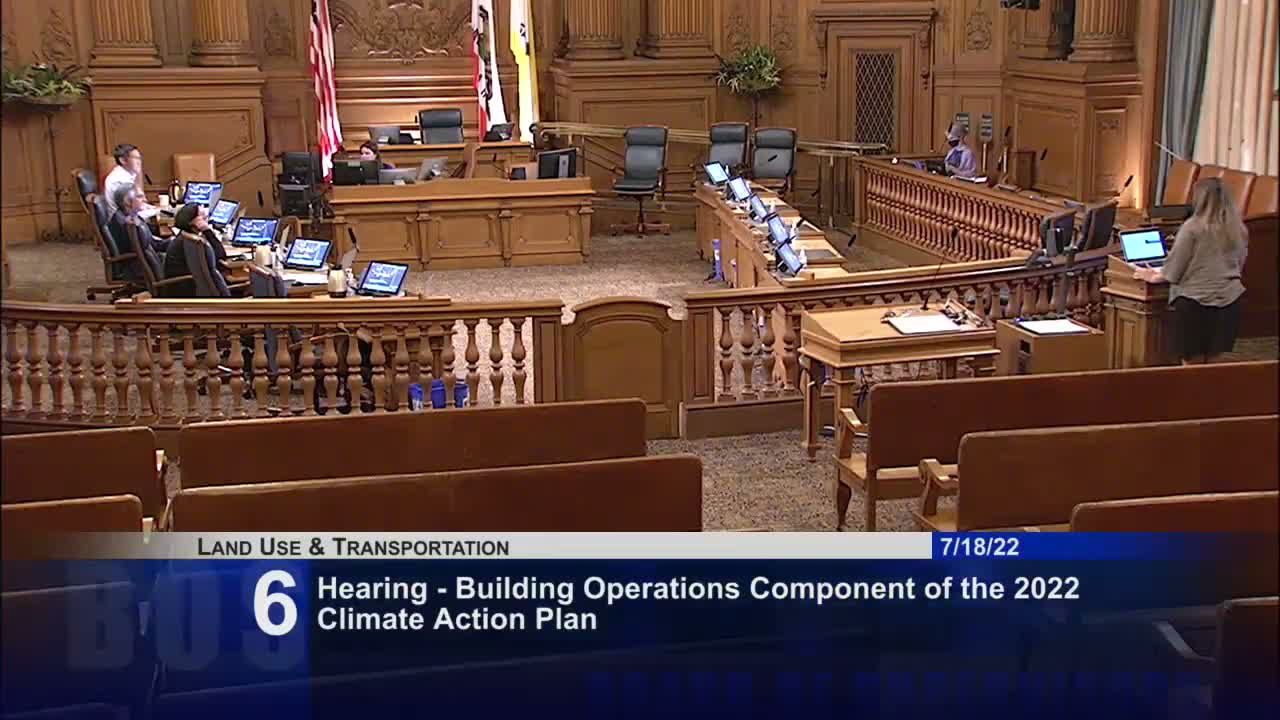
The Land Use & Transportation Committee held an extended hearing on July 18 on the building operations component of San Francisco's 2022 Climate Action Plan, focusing on a roadmap for decarbonizing existing and new buildings.
Cindy Comerford, Climate Program Manager for the Department of the Environment (SFE), summarized the roadmap: buildings account for about 41% of city greenhouse-gas emissions and approximately 87% of building-operation emissions are from natural gas combustion. The roadmap centers on electrification measures, including an established policy that all new construction be all-electric, proposed expansion of that standard to major alterations, and sector-specific approaches: time-of-replacement and time-of-sale policies for residential buildings, building performance standards for large commercial buildings (with a local target of net-zero by 2035 for large commercial), and municipal building electrification coordinated through updated Chapter 7 of the Environment Code.
Comerford emphasized equity and co-benefits: a co-benefit analysis in the plan quantified reduced mortality from electrification (cited in the presentation as $1.9 billion) and predicted thousands of full-time jobs in electrification-related trades. The department described the Climate Equity Hub concept as a one-stop shop for residential electrification assistance and said it was completing stakeholder engagement to set an operational model and potential seed funding this fiscal year.
Public commenters and advocacy groups urged the city to fund the roadmap, accelerate timelines and protect tenants from displacement during upgrades. Speakers included Mothers Out Front, 350.org, the SF Climate Emergency Coalition, Sierra Club local representatives, and others who supported the roadmap but asked for concrete timelines and funding. David Harrison (BOEMO) and others offered technical partnership and cautioned about complexities for large commercial buildings.
Supervisors pressed the department for more specific timelines, metrics and financing; Comerford acknowledged the roadmap is a high-level "shell" and described supporting work: sector-specific work plans, a long-term funding study produced with the UC Berkeley Center for Law, Energy & Environment and CivicMakers with a draft under review and a final report expected in September, and plans for a public dashboard to make progress and metrics transparent. Current building-operations staffing in the department was described as roughly 1-2 full-time equivalent staff dedicated to this sector; Comerford said the department seeks to hire three additional positions with board-added funds for the coming year to focus on residential electrification, workforce development, and community engagement.
On financing, Comerford said the draft long-term funding study has convened community and technical stakeholders; the department will review the draft with its technical advisory committee and expects to publish the final study in September, followed by outreach on financing options.
Supervisor Marr said he will pursue follow-up legislative steps, including forming a building-decarbonization task force, updating Chapter 7 to require all-electric municipal buildings, and advancing policies for commercial building decarbonization.
The committee voted to file the hearing. The committee recorded unanimous "aye" votes (Peskin, Preston, Melgar) on the motion to file.
Quotes
"The decarbonization roadmap is essentially the building operations chapter from our climate action plan," Cindy Comerford said. "We have established a sector-based greenhouse gas reduction of 61% by 2030 and to be a net 0 city by 02/1940." (transcript dates as stated.)
"We need to create more equitable and accessible engagement across the city through capacity building and grant making," Comerford added, describing the Climate Equity Hub process.
Ending
The committee filed the hearing record and supervisors signaled intent to follow up with legislation, task-force formation and budget priorities to support the roadmap's implementation. Staff said more detailed work plans, a funding study report due in September, and planned hires would support next steps.
Cindy Comerford, Climate Program Manager for the Department of the Environment (SFE), summarized the roadmap: buildings account for about 41% of city greenhouse-gas emissions and approximately 87% of building-operation emissions are from natural gas combustion. The roadmap centers on electrification measures, including an established policy that all new construction be all-electric, proposed expansion of that standard to major alterations, and sector-specific approaches: time-of-replacement and time-of-sale policies for residential buildings, building performance standards for large commercial buildings (with a local target of net-zero by 2035 for large commercial), and municipal building electrification coordinated through updated Chapter 7 of the Environment Code.
Comerford emphasized equity and co-benefits: a co-benefit analysis in the plan quantified reduced mortality from electrification (cited in the presentation as $1.9 billion) and predicted thousands of full-time jobs in electrification-related trades. The department described the Climate Equity Hub concept as a one-stop shop for residential electrification assistance and said it was completing stakeholder engagement to set an operational model and potential seed funding this fiscal year.
Public commenters and advocacy groups urged the city to fund the roadmap, accelerate timelines and protect tenants from displacement during upgrades. Speakers included Mothers Out Front, 350.org, the SF Climate Emergency Coalition, Sierra Club local representatives, and others who supported the roadmap but asked for concrete timelines and funding. David Harrison (BOEMO) and others offered technical partnership and cautioned about complexities for large commercial buildings.
Supervisors pressed the department for more specific timelines, metrics and financing; Comerford acknowledged the roadmap is a high-level "shell" and described supporting work: sector-specific work plans, a long-term funding study produced with the UC Berkeley Center for Law, Energy & Environment and CivicMakers with a draft under review and a final report expected in September, and plans for a public dashboard to make progress and metrics transparent. Current building-operations staffing in the department was described as roughly 1-2 full-time equivalent staff dedicated to this sector; Comerford said the department seeks to hire three additional positions with board-added funds for the coming year to focus on residential electrification, workforce development, and community engagement.
On financing, Comerford said the draft long-term funding study has convened community and technical stakeholders; the department will review the draft with its technical advisory committee and expects to publish the final study in September, followed by outreach on financing options.
Supervisor Marr said he will pursue follow-up legislative steps, including forming a building-decarbonization task force, updating Chapter 7 to require all-electric municipal buildings, and advancing policies for commercial building decarbonization.
The committee voted to file the hearing. The committee recorded unanimous "aye" votes (Peskin, Preston, Melgar) on the motion to file.
Quotes
"The decarbonization roadmap is essentially the building operations chapter from our climate action plan," Cindy Comerford said. "We have established a sector-based greenhouse gas reduction of 61% by 2030 and to be a net 0 city by 02/1940." (transcript dates as stated.)
"We need to create more equitable and accessible engagement across the city through capacity building and grant making," Comerford added, describing the Climate Equity Hub process.
Ending
The committee filed the hearing record and supervisors signaled intent to follow up with legislation, task-force formation and budget priorities to support the roadmap's implementation. Staff said more detailed work plans, a funding study report due in September, and planned hires would support next steps.
Don't Miss a Word: See the Full Meeting!
Go beyond summaries. Unlock every video, transcript, and key insight with a Founder Membership.
✓
Get instant access to full meeting videos
✓
Search and clip any phrase from complete transcripts
✓
Receive AI-powered summaries & custom alerts
✓
Enjoy lifetime, unrestricted access to government data
30-day money-back guarantee
