San Francisco supervisors press SFMTA for stronger scooter sidewalk enforcement and anti‑sidewalk technology
October 03, 2022 | San Francisco County, California
This article was created by AI summarizing key points discussed. AI makes mistakes, so for full details and context, please refer to the video of the full meeting. Please report any errors so we can fix them. Report an error »
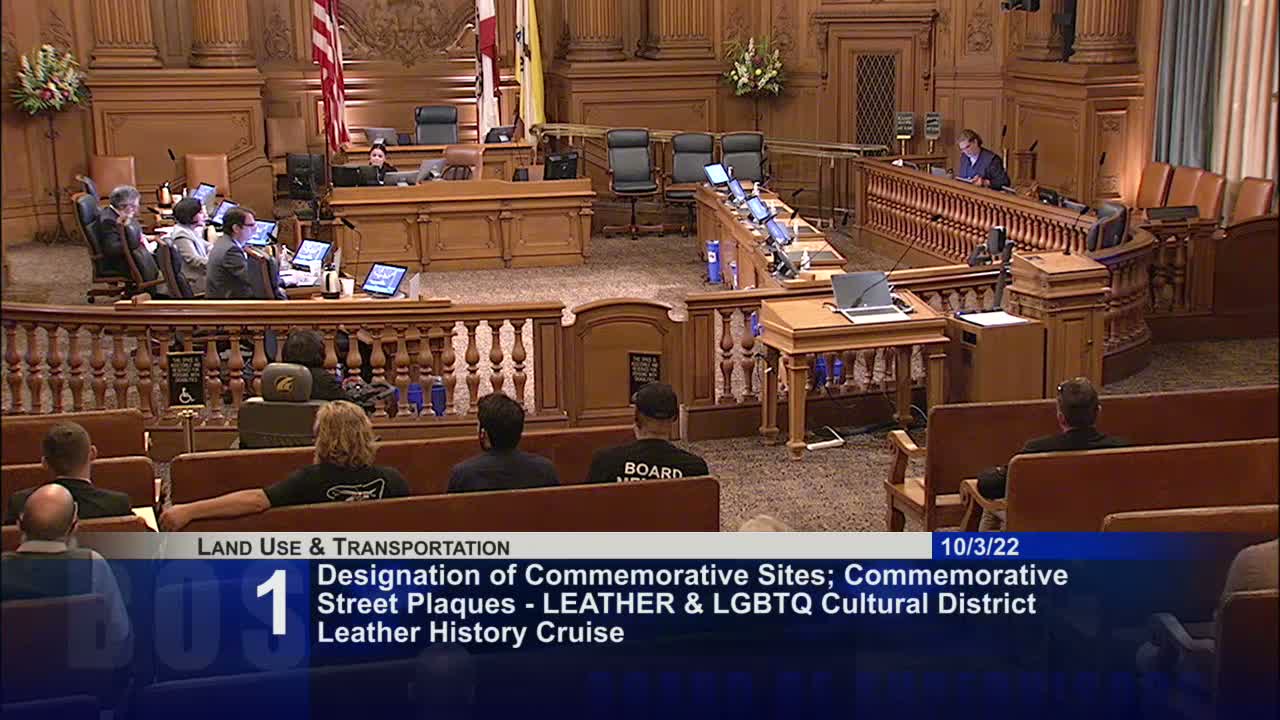
Supervisors on the San Francisco Board of Supervisors’ Land Use & Transportation Committee on Oct. 3 signaled urgency in tightening rules for shared electric scooters, unanimously forwarding an amended resolution that asks the SFMTA to accelerate technology rollouts and enforcement to keep devices off sidewalks.
The resolution, introduced by Supervisor Aaron Peskin and amended by him at the hearing, urges the San Francisco Municipal Transportation Agency to require city‑approved anti‑sidewalk‑riding technology on permitted scooters, to empower parking control officers to issue administrative citations for sidewalk riding and improper parking, and to consider device caps and steeper fines in high‑use areas such as the Embarcadero.
Peskin told the committee the city has endured “scooter geddon” and rising complaints, and proposed three concrete actions: allow only devices with approved sidewalk‑detection tech to operate, expand enforcement (including parking control officers), and require permittees to pass some citation costs to riders to change behavior. “The scourge of these devices on our sidewalks … is dangerous,” Peskin said during his opening remarks.
Kate Toran, SFMTA’s director of taxis, access and mobility services, walked the committee through the agency’s permit program, enforcement history and recent technology tests. Toran said the permit program has produced measurable enforcement activity — MTA staff have documented millions of trips and thousands of complaints and citations — but acknowledged gaps remain. The agency has run sidewalk‑detection demonstrations and audits and is testing GPS, camera/AI and vibration approaches; Toran said updated guidance emphasizes active deceleration plus audible alerts and clearer device markings and unique identifiers.
Disability advocates and residents gave strongly personal testimony at the hearing. Nicole Bond of the Mayor’s Office on Disability recounted being struck by a scooter, spending 77 days in care and losing work time, and urged faster, stronger enforcement: “I’m not convinced that $200 is impactful,” she said, arguing for faster suspension or revocation when public safety is threatened.
Operators told the panel they are deploying technology but face supply and technical limits. Spin said it has deployed camera‑equipped units and issued thousands of warnings and citations; Bird said it was mapping sidewalks citywide and expected to expand retrofits; Lime described a road‑vs‑sidewalk AI camera system (LimeVision) and committed to passing at least 50% of penalty fees to identifiable riders. Company representatives repeatedly warned that GPS‑only geofencing suffers drift in San Francisco and that camera/AI approaches or combined sensors may be more reliable citywide.
After debate and dozens of public comments — including seniors, neighborhoods, transit advocates and union representatives — the committee adopted several changes offered by Peskin. The committee replaced narrower references to “geofencing” with the broader phrase “city‑approved anti‑sidewalk riding technology,” urged an immediate carve‑out of the Embarcadero from downtown device caps, urged SFMTA to increase administrative citation amounts up to the legal maximum of $500 for the most egregious violations, and recommended that the Board consider rescinding some SFMTA authorities if the agency does not act by a specified near‑term deadline.
The committee voted to send the amended resolution to the full Board (3–0). The item will return to the Board calendar for further action and possible ordinance or permit modifications by SFMTA.
The resolution, introduced by Supervisor Aaron Peskin and amended by him at the hearing, urges the San Francisco Municipal Transportation Agency to require city‑approved anti‑sidewalk‑riding technology on permitted scooters, to empower parking control officers to issue administrative citations for sidewalk riding and improper parking, and to consider device caps and steeper fines in high‑use areas such as the Embarcadero.
Peskin told the committee the city has endured “scooter geddon” and rising complaints, and proposed three concrete actions: allow only devices with approved sidewalk‑detection tech to operate, expand enforcement (including parking control officers), and require permittees to pass some citation costs to riders to change behavior. “The scourge of these devices on our sidewalks … is dangerous,” Peskin said during his opening remarks.
Kate Toran, SFMTA’s director of taxis, access and mobility services, walked the committee through the agency’s permit program, enforcement history and recent technology tests. Toran said the permit program has produced measurable enforcement activity — MTA staff have documented millions of trips and thousands of complaints and citations — but acknowledged gaps remain. The agency has run sidewalk‑detection demonstrations and audits and is testing GPS, camera/AI and vibration approaches; Toran said updated guidance emphasizes active deceleration plus audible alerts and clearer device markings and unique identifiers.
Disability advocates and residents gave strongly personal testimony at the hearing. Nicole Bond of the Mayor’s Office on Disability recounted being struck by a scooter, spending 77 days in care and losing work time, and urged faster, stronger enforcement: “I’m not convinced that $200 is impactful,” she said, arguing for faster suspension or revocation when public safety is threatened.
Operators told the panel they are deploying technology but face supply and technical limits. Spin said it has deployed camera‑equipped units and issued thousands of warnings and citations; Bird said it was mapping sidewalks citywide and expected to expand retrofits; Lime described a road‑vs‑sidewalk AI camera system (LimeVision) and committed to passing at least 50% of penalty fees to identifiable riders. Company representatives repeatedly warned that GPS‑only geofencing suffers drift in San Francisco and that camera/AI approaches or combined sensors may be more reliable citywide.
After debate and dozens of public comments — including seniors, neighborhoods, transit advocates and union representatives — the committee adopted several changes offered by Peskin. The committee replaced narrower references to “geofencing” with the broader phrase “city‑approved anti‑sidewalk riding technology,” urged an immediate carve‑out of the Embarcadero from downtown device caps, urged SFMTA to increase administrative citation amounts up to the legal maximum of $500 for the most egregious violations, and recommended that the Board consider rescinding some SFMTA authorities if the agency does not act by a specified near‑term deadline.
The committee voted to send the amended resolution to the full Board (3–0). The item will return to the Board calendar for further action and possible ordinance or permit modifications by SFMTA.
Don't Miss a Word: See the Full Meeting!
Go beyond summaries. Unlock every video, transcript, and key insight with a Founder Membership.
✓
Get instant access to full meeting videos
✓
Search and clip any phrase from complete transcripts
✓
Receive AI-powered summaries & custom alerts
✓
Enjoy lifetime, unrestricted access to government data
30-day money-back guarantee
