City reports mixed results from large-refuse-generator audits; committee seeks follow-up
October 24, 2022 | San Francisco County, California
This article was created by AI summarizing key points discussed. AI makes mistakes, so for full details and context, please refer to the video of the full meeting. Please report any errors so we can fix them. Report an error »
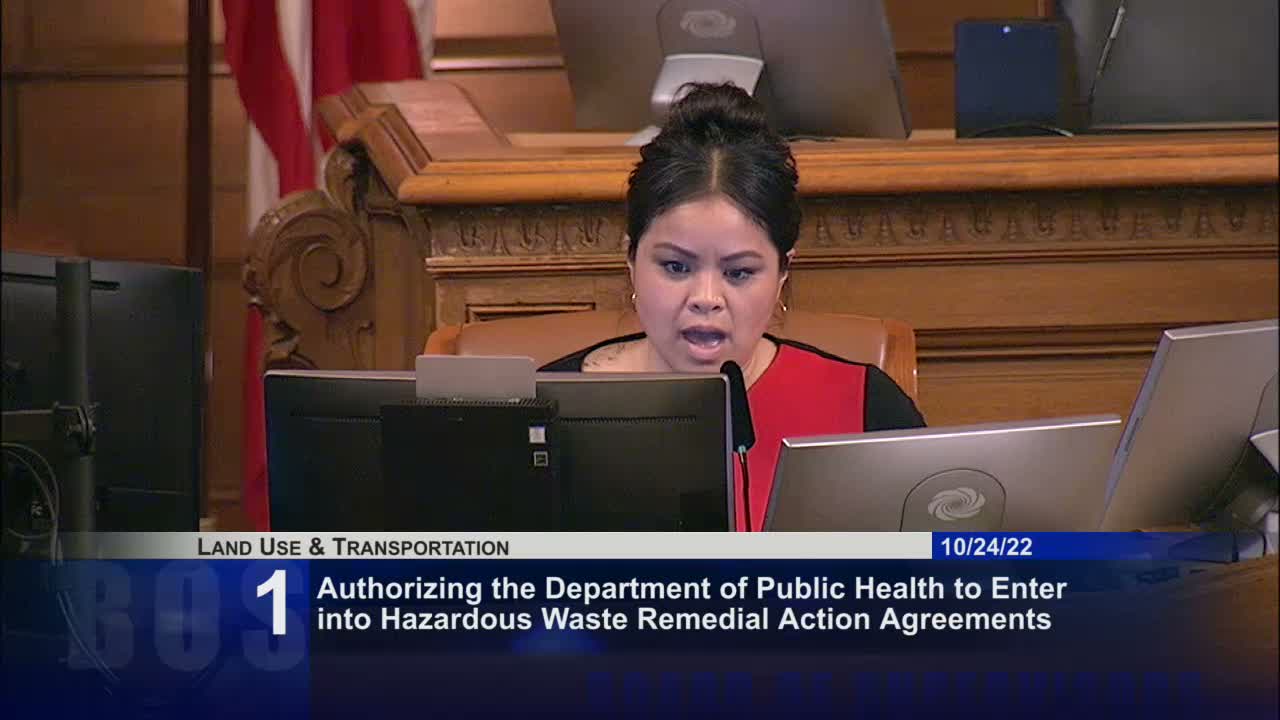
The Land Use and Transportation Committee on Oct. 24 heard a report on implementation of the Refuse Separation Ordinance (RSO) for large refuse generators and continued the item for additional follow-up.
Director Juh of the Department of Environment told the committee there are about 481 entities categorized as large refuse generators and that staff conducted 422 audits in this first three-year cycle. "Within this 3 year cycle we've conducted 422 audits," he said, and the department reported a roughly 57 percent pass rate overall.
Hillary Neer, commercial zero-waste coordinator, explained audit methodology and thresholds: an account passes if landfill (trash) contamination is 25 percent or less, recycling contamination is 10 percent or less, and compost contamination is 5 percent or less; failed accounts are required to engage a 0-waste facilitator and may receive targeted interventions and a re-audit period.
Neer and other presenters said hospitals, major office buildings, libraries and schools tended to perform well, while affordable housing and some residential complexes struggled to meet pass thresholds. Real Estate Division Deputy Managing Director Claudia Gorham and custodial manager Nam described city-facility performance: Hall of Justice and the Public Safety Building passed all audits; City Hall and several other locations exceeded landfill contamination thresholds.
Nam outlined a seven-step action plan for city facilities that includes updating department coordinator contacts, centralizing collection stations, providing custodial staff with separated-collection containers for transport, and increasing training and on-the-job coaching.
Supervisor Safaie asked for a list of failed commercial and residential accounts, remedies and which sites had hired 0-waste facilitators; Neer said the department maintains such lists internally and can provide the requested details and noted the department hosts annual workshops and shares a public roster of 0-waste facilitators.
After public comment from industry and labor representatives that generally supported the program and asked about source-reduction strategies, Chair Mirna Melgar moved to continue Item 2 to the call of the chair for updated reporting; the motion passed unanimously by recorded vote (Peskin aye, Preston aye, Melgar aye).
Director Juh of the Department of Environment told the committee there are about 481 entities categorized as large refuse generators and that staff conducted 422 audits in this first three-year cycle. "Within this 3 year cycle we've conducted 422 audits," he said, and the department reported a roughly 57 percent pass rate overall.
Hillary Neer, commercial zero-waste coordinator, explained audit methodology and thresholds: an account passes if landfill (trash) contamination is 25 percent or less, recycling contamination is 10 percent or less, and compost contamination is 5 percent or less; failed accounts are required to engage a 0-waste facilitator and may receive targeted interventions and a re-audit period.
Neer and other presenters said hospitals, major office buildings, libraries and schools tended to perform well, while affordable housing and some residential complexes struggled to meet pass thresholds. Real Estate Division Deputy Managing Director Claudia Gorham and custodial manager Nam described city-facility performance: Hall of Justice and the Public Safety Building passed all audits; City Hall and several other locations exceeded landfill contamination thresholds.
Nam outlined a seven-step action plan for city facilities that includes updating department coordinator contacts, centralizing collection stations, providing custodial staff with separated-collection containers for transport, and increasing training and on-the-job coaching.
Supervisor Safaie asked for a list of failed commercial and residential accounts, remedies and which sites had hired 0-waste facilitators; Neer said the department maintains such lists internally and can provide the requested details and noted the department hosts annual workshops and shares a public roster of 0-waste facilitators.
After public comment from industry and labor representatives that generally supported the program and asked about source-reduction strategies, Chair Mirna Melgar moved to continue Item 2 to the call of the chair for updated reporting; the motion passed unanimously by recorded vote (Peskin aye, Preston aye, Melgar aye).
Don't Miss a Word: See the Full Meeting!
Go beyond summaries. Unlock every video, transcript, and key insight with a Founder Membership.
✓
Get instant access to full meeting videos
✓
Search and clip any phrase from complete transcripts
✓
Receive AI-powered summaries & custom alerts
✓
Enjoy lifetime, unrestricted access to government data
30-day money-back guarantee
