Planning staff: upzoning auto‑oriented lots improves feasibility but won’t produce housing today
December 05, 2022 | San Francisco County, California
This article was created by AI summarizing key points discussed. AI makes mistakes, so for full details and context, please refer to the video of the full meeting. Please report any errors so we can fix them. Report an error »
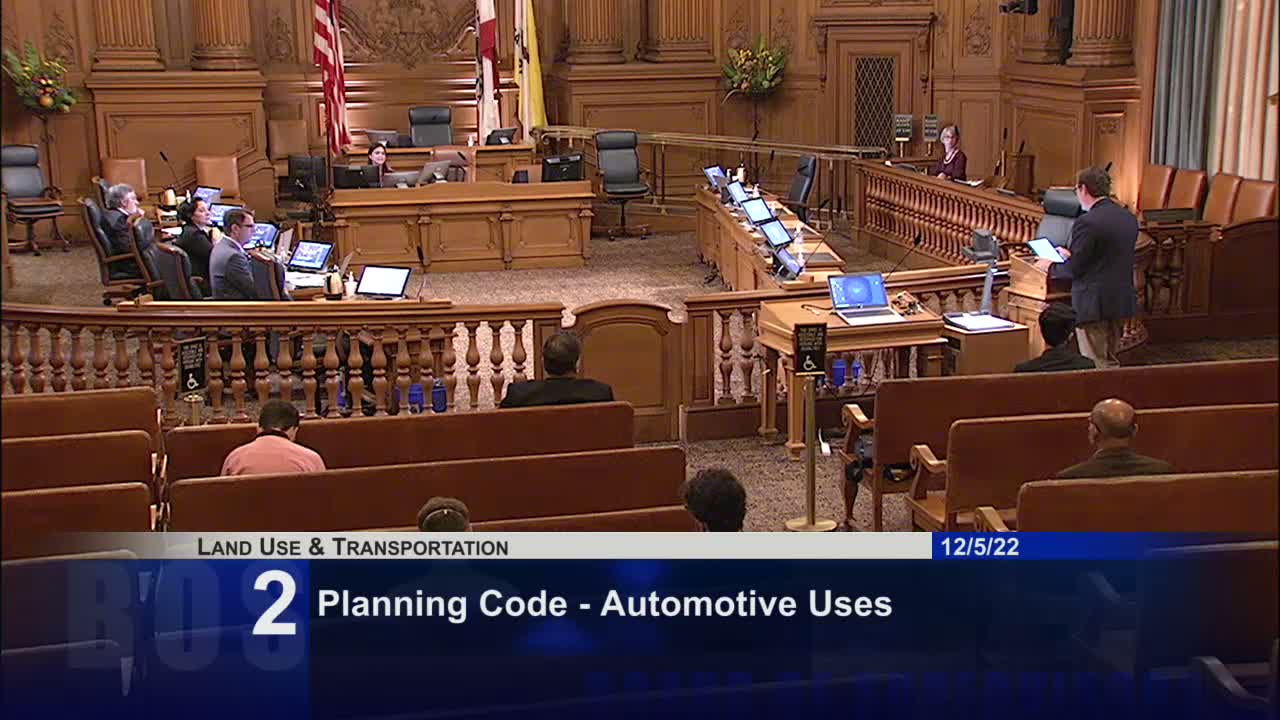
The Land Use & Transportation Committee heard a feasibility analysis on Dec. 5 for an ordinance that would increase allowable housing density on lots with auto‑oriented uses and remove the conditional‑use requirement for converting automotive service stations.
Aaron Star of the Planning Department introduced the item and turned the presentation over to Joshua Switzky, who summarized an analysis done with consultant Century Urban. The team modeled two prototypical sites — a smaller lot (6,000 square feet, 40‑foot height limit) and a larger lot (20,000 square feet, 65‑foot height limit) — and tested a range of scenarios (for‑sale and for‑rent, different neighborhood submarkets, existing and proposed zoning, and the effect of state density bonus). The study examined 32 prototype combinations.
The memo’s central finding: while removing density controls and other proposed changes improved feasibility marginally, none of the prototypes produced positive per‑unit feasibility under current 2022 cost and pricing assumptions. The Planning memo therefore concluded there is no additional feasibility today to increase inclusionary requirements or other exactions tied solely to this ordinance.
Supervisors expressed mixed views. Vice Chair Dean Preston said the results undercut the argument that the ordinance would materially increase housing production under current market conditions, and he questioned the timing of the effort. Chair Mirna Melgar and others said changing market variables (interest rates, construction costs, future inclusionary rates) could alter feasibility over time and that easing conversion of underused auto sites aligned with climate and walkability goals.
Public commenters and housing advocates were divided: some urged the committee to move the ordinance as a step toward more housing and fewer auto‑oriented uses; others disputed its efficacy and urged attention to inclusionary and affordable‑housing strategies.
The committee voted to forward the ordinance to the full Board with a positive committee report.
Aaron Star of the Planning Department introduced the item and turned the presentation over to Joshua Switzky, who summarized an analysis done with consultant Century Urban. The team modeled two prototypical sites — a smaller lot (6,000 square feet, 40‑foot height limit) and a larger lot (20,000 square feet, 65‑foot height limit) — and tested a range of scenarios (for‑sale and for‑rent, different neighborhood submarkets, existing and proposed zoning, and the effect of state density bonus). The study examined 32 prototype combinations.
The memo’s central finding: while removing density controls and other proposed changes improved feasibility marginally, none of the prototypes produced positive per‑unit feasibility under current 2022 cost and pricing assumptions. The Planning memo therefore concluded there is no additional feasibility today to increase inclusionary requirements or other exactions tied solely to this ordinance.
Supervisors expressed mixed views. Vice Chair Dean Preston said the results undercut the argument that the ordinance would materially increase housing production under current market conditions, and he questioned the timing of the effort. Chair Mirna Melgar and others said changing market variables (interest rates, construction costs, future inclusionary rates) could alter feasibility over time and that easing conversion of underused auto sites aligned with climate and walkability goals.
Public commenters and housing advocates were divided: some urged the committee to move the ordinance as a step toward more housing and fewer auto‑oriented uses; others disputed its efficacy and urged attention to inclusionary and affordable‑housing strategies.
The committee voted to forward the ordinance to the full Board with a positive committee report.
View the Full Meeting & All Its Details
This article offers just a summary. Unlock complete video, transcripts, and insights as a Founder Member.
✓
Watch full, unedited meeting videos
✓
Search every word spoken in unlimited transcripts
✓
AI summaries & real-time alerts (all government levels)
✓
Permanent access to expanding government content
30-day money-back guarantee
