Land Use committee advances planning-code overhaul to allow arts, small manufacturing and child-care exemptions
February 13, 2023 | San Francisco County, California
This article was created by AI summarizing key points discussed. AI makes mistakes, so for full details and context, please refer to the video of the full meeting. Please report any errors so we can fix them. Report an error »
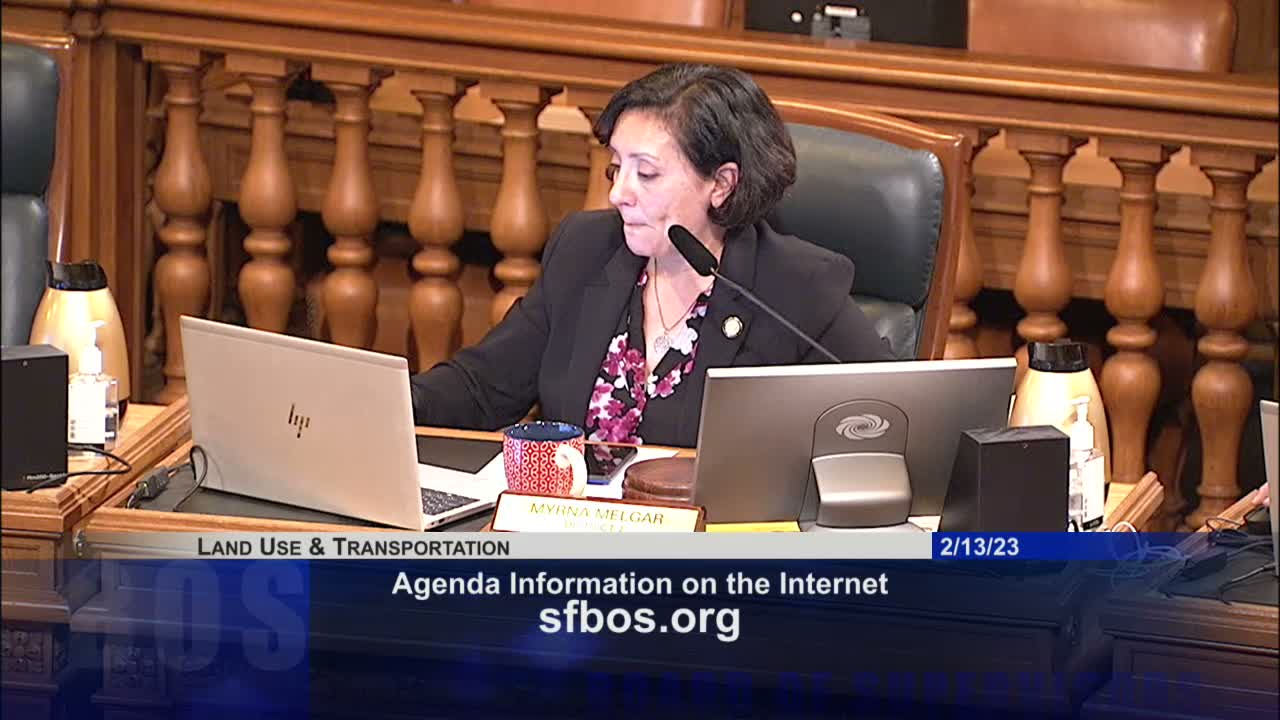
The San Francisco Board of Supervisors’ Land Use & Transportation Committee on Feb. 13 discussed a sweeping revision to the Planning Code intended to standardize use definitions and update zoning controls across Eastern Neighborhood mixed-use districts. Committee members adopted sponsor amendments and voted to continue the item to the Board meeting on Feb. 27 for further consideration.
Madison Tam, representing Supervisor Matt Dorsey (the ordinance sponsor as noted to the committee), said the 211-page measure is the last substantive piece of a code reorganization begun in 2014 and reflects community input from groups including SOMA Filipinas, Somcan and Livable City. “This ordinance sets the stage for that work, allowing more arts and institutional uses,” Tam said.
Aaron Starr, manager of legislative affairs for the Planning Department, summarized the ordinance’s substantive changes. He said the package would: align accessory-use controls across the code to allow limited manufacturing, wholesale and processing to occupy more than one-third of a retail space; permit limited live performance in certain mixed-use districts; allow restaurants to offer accessory catering uses; require larger developments that provide over 10,000 square feet of ground-floor commercial space to include a mix of commercial unit sizes (including some around 1,000 square feet or smaller); liberalize institutional uses such as job training and social services in Eastern neighborhoods and SoMa; and prohibit public parking lots in several districts while requiring automobile sales and rental facilities to be enclosed.
Starr also said the ordinance removes some planning-code nighttime-entertainment standards and relies instead on the Entertainment Commission’s good-neighbor policies for enforcement. That change would principally permit nighttime and general entertainment along Folsom Street (between Seventh and Division) and parts of Eleventh Street (between Howard and Division) while providing exceptions to certain buffer rules where properties meet specified criteria.
Supervisor Aaron Peskin asked why an older conditional-use provision restricting adult-entertainment establishments’ proximity (a roughly 1,000-foot separation) had been stricken from the draft; Starr said he would review section 202.2 to confirm whether duplicate operating conditions already exist. Peskin also asked why “group housing” was added to section 803.8 and whether that could amount to an upzoning; the committee agreed to use the two-week continuance to consult with community stakeholders. On enforcement, Peskin pressed whether shifting good-neighbor rules out of the Planning Code would leave changes subject to decision by the Entertainment Commission rather than the Board; Starr said the Entertainment Commission has stronger on-the-ground enforcement capacity but the department would look into codification to preserve appropriate oversight.
A caller, James Hewitt of the International Union of Painters and Allied Trades, said the changes would allow his union to legitimize a union hall at 65 Oak Grove Street and enable needed Americans with Disabilities Act upgrades. “I’m here to speak in favor of file number 220340,” Hewitt told the committee.
Chair Myrna Melgar moved to adopt the circulating amendments sponsored by Supervisor Dorsey and to continue the item for further review. The committee recorded unanimous support from the three sitting members present — President Aaron Peskin, Vice Chair Dean Preston and Chair Myrna Melgar — and set the item for return on Feb. 27.
Next steps: Committee staff and the Planning Department will review Peskin’s questions about the adult-entertainment conditional-use language and the scope of the “group housing” change; the item will return to the committee on Feb. 27.
Madison Tam, representing Supervisor Matt Dorsey (the ordinance sponsor as noted to the committee), said the 211-page measure is the last substantive piece of a code reorganization begun in 2014 and reflects community input from groups including SOMA Filipinas, Somcan and Livable City. “This ordinance sets the stage for that work, allowing more arts and institutional uses,” Tam said.
Aaron Starr, manager of legislative affairs for the Planning Department, summarized the ordinance’s substantive changes. He said the package would: align accessory-use controls across the code to allow limited manufacturing, wholesale and processing to occupy more than one-third of a retail space; permit limited live performance in certain mixed-use districts; allow restaurants to offer accessory catering uses; require larger developments that provide over 10,000 square feet of ground-floor commercial space to include a mix of commercial unit sizes (including some around 1,000 square feet or smaller); liberalize institutional uses such as job training and social services in Eastern neighborhoods and SoMa; and prohibit public parking lots in several districts while requiring automobile sales and rental facilities to be enclosed.
Starr also said the ordinance removes some planning-code nighttime-entertainment standards and relies instead on the Entertainment Commission’s good-neighbor policies for enforcement. That change would principally permit nighttime and general entertainment along Folsom Street (between Seventh and Division) and parts of Eleventh Street (between Howard and Division) while providing exceptions to certain buffer rules where properties meet specified criteria.
Supervisor Aaron Peskin asked why an older conditional-use provision restricting adult-entertainment establishments’ proximity (a roughly 1,000-foot separation) had been stricken from the draft; Starr said he would review section 202.2 to confirm whether duplicate operating conditions already exist. Peskin also asked why “group housing” was added to section 803.8 and whether that could amount to an upzoning; the committee agreed to use the two-week continuance to consult with community stakeholders. On enforcement, Peskin pressed whether shifting good-neighbor rules out of the Planning Code would leave changes subject to decision by the Entertainment Commission rather than the Board; Starr said the Entertainment Commission has stronger on-the-ground enforcement capacity but the department would look into codification to preserve appropriate oversight.
A caller, James Hewitt of the International Union of Painters and Allied Trades, said the changes would allow his union to legitimize a union hall at 65 Oak Grove Street and enable needed Americans with Disabilities Act upgrades. “I’m here to speak in favor of file number 220340,” Hewitt told the committee.
Chair Myrna Melgar moved to adopt the circulating amendments sponsored by Supervisor Dorsey and to continue the item for further review. The committee recorded unanimous support from the three sitting members present — President Aaron Peskin, Vice Chair Dean Preston and Chair Myrna Melgar — and set the item for return on Feb. 27.
Next steps: Committee staff and the Planning Department will review Peskin’s questions about the adult-entertainment conditional-use language and the scope of the “group housing” change; the item will return to the committee on Feb. 27.
View the Full Meeting & All Its Details
This article offers just a summary. Unlock complete video, transcripts, and insights as a Founder Member.
✓
Watch full, unedited meeting videos
✓
Search every word spoken in unlimited transcripts
✓
AI summaries & real-time alerts (all government levels)
✓
Permanent access to expanding government content
30-day money-back guarantee
