San Francisco committee backs tougher penalties for illegal unit conversions, recommends amended ordinance to full Board
March 06, 2023 | San Francisco County, California
This article was created by AI summarizing key points discussed. AI makes mistakes, so for full details and context, please refer to the video of the full meeting. Please report any errors so we can fix them. Report an error »
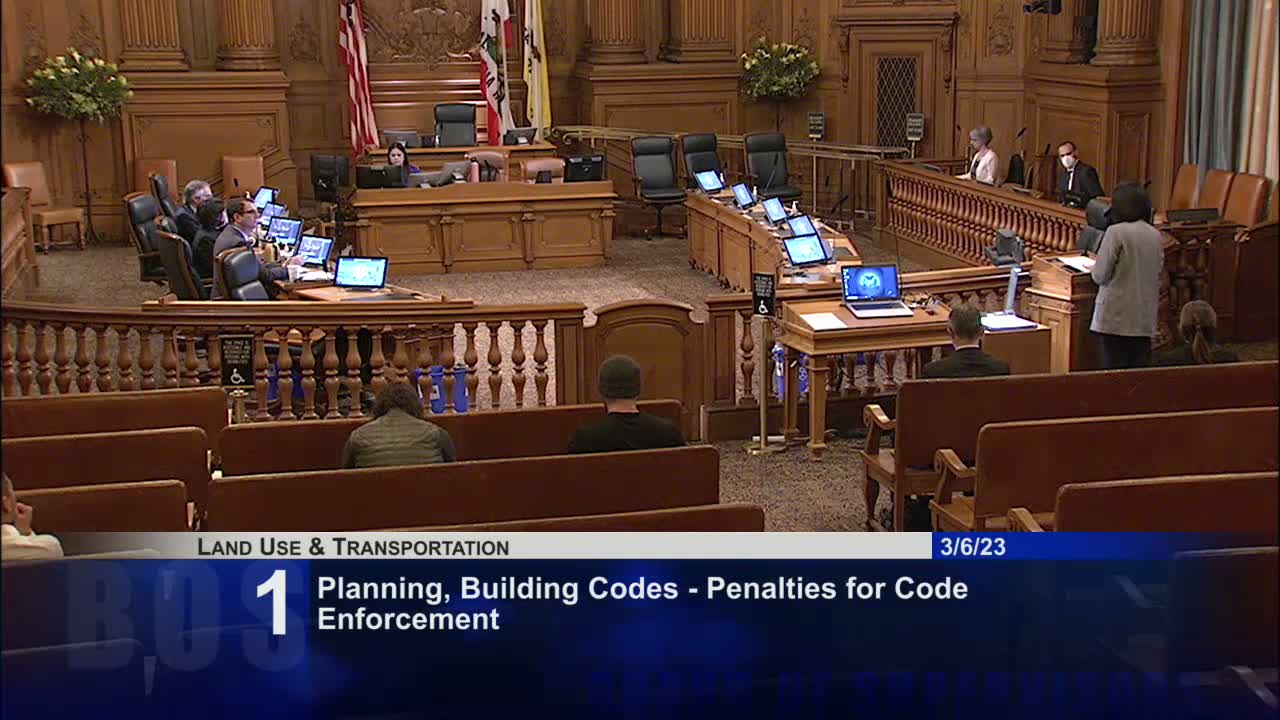
The Land Use and Transportation Committee of the San Francisco Board of Supervisors on March 6 recommended an amendment to the city’s planning and building codes that would sharply increase penalties for serious violations, including unauthorized additions and demolition of historic buildings.
Anna Herrera, speaking on behalf of Supervisor Ronan, told the committee that a developer at 2861 San Bruno Avenue was permitted for 10 units but "built an additional 20 units," did not install adequate fire escapes and is charging "about $3,000 a month for these units," an example Herrera used to argue current penalties fail to deter bad actors. Herrera outlined the measure’s penalties: raising the maximum daily administrative fine from $250 to $1,000, assessing a one-time $250,000 fee for any dwelling unit demolished or added after three units, and a $500,000 fee for demolished or damaged historic buildings. The proposal would also allow fines to be assessed per individual unit rather than per project.
Audrey Maloney of the Planning Department said the Historic Preservation Commission and Planning Commission heard the item and recommended approval with modifications that were largely incorporated into the draft before the committee. Maloney said the Planning Commission recommended that notices of violation (NOV) that will trigger penalties be recorded against property title so a prospective buyer would be aware of outstanding monetary penalties; the Planning Department supports that change.
During public comment, caller Georgia Shutish urged the committee to ask why the Planning Commission had not used its authority under Planning Code Section 3.17 to adjust demolition thresholds and called for a committee inquiry into the Commission’s use of that authority.
After an initial procedural misstep — committee staff transmitted amendment language late and the chair rescinded an early vote — Maloney read the amendment into the record. The committee then voted to adopt the amendments as read and, after clarifying that the amendments were non‑substantive and that the project sponsor preferred moving forward, voted to give the ordinance a positive recommendation to the full Board. The roll-call on the final recommendation recorded three 'aye' votes (Peskin, Preston and Melgar).
The committee’s vote sends the amended measure to the full Board for consideration; the clerk earlier noted items acted upon at committee are expected to appear on the Board agenda of March 14 unless otherwise stated. The ordinance would change how the city calculates penalties for planning and building code violations and add recordation of certain NOVs on title.
Anna Herrera, speaking on behalf of Supervisor Ronan, told the committee that a developer at 2861 San Bruno Avenue was permitted for 10 units but "built an additional 20 units," did not install adequate fire escapes and is charging "about $3,000 a month for these units," an example Herrera used to argue current penalties fail to deter bad actors. Herrera outlined the measure’s penalties: raising the maximum daily administrative fine from $250 to $1,000, assessing a one-time $250,000 fee for any dwelling unit demolished or added after three units, and a $500,000 fee for demolished or damaged historic buildings. The proposal would also allow fines to be assessed per individual unit rather than per project.
Audrey Maloney of the Planning Department said the Historic Preservation Commission and Planning Commission heard the item and recommended approval with modifications that were largely incorporated into the draft before the committee. Maloney said the Planning Commission recommended that notices of violation (NOV) that will trigger penalties be recorded against property title so a prospective buyer would be aware of outstanding monetary penalties; the Planning Department supports that change.
During public comment, caller Georgia Shutish urged the committee to ask why the Planning Commission had not used its authority under Planning Code Section 3.17 to adjust demolition thresholds and called for a committee inquiry into the Commission’s use of that authority.
After an initial procedural misstep — committee staff transmitted amendment language late and the chair rescinded an early vote — Maloney read the amendment into the record. The committee then voted to adopt the amendments as read and, after clarifying that the amendments were non‑substantive and that the project sponsor preferred moving forward, voted to give the ordinance a positive recommendation to the full Board. The roll-call on the final recommendation recorded three 'aye' votes (Peskin, Preston and Melgar).
The committee’s vote sends the amended measure to the full Board for consideration; the clerk earlier noted items acted upon at committee are expected to appear on the Board agenda of March 14 unless otherwise stated. The ordinance would change how the city calculates penalties for planning and building code violations and add recordation of certain NOVs on title.
View the Full Meeting & All Its Details
This article offers just a summary. Unlock complete video, transcripts, and insights as a Founder Member.
✓
Watch full, unedited meeting videos
✓
Search every word spoken in unlimited transcripts
✓
AI summaries & real-time alerts (all government levels)
✓
Permanent access to expanding government content
30-day money-back guarantee
