San Francisco committee advances ADU ministerial approval amendments, continues ordinance to March 20
March 13, 2023 | San Francisco County, California
This article was created by AI summarizing key points discussed. AI makes mistakes, so for full details and context, please refer to the video of the full meeting. Please report any errors so we can fix them. Report an error »
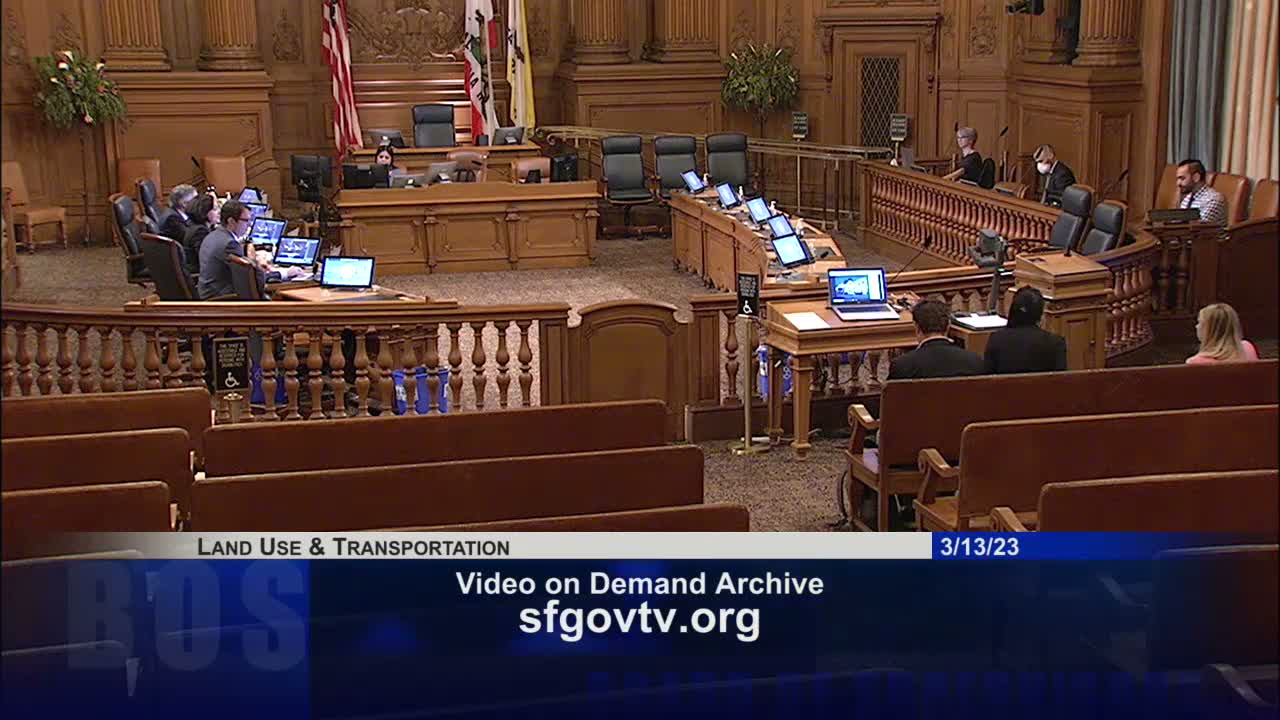
The Land Use and Transportation Committee on March 13 heard a Planning Department presentation and voted to adopt amendments to an ordinance clarifying the ministerial approval process for certain accessory dwelling units (ADUs), then continued final consideration to a March 20 hearing.
Planning Department staffer Veronica Flores told the committee the ordinance updates local code to match recent state ADU changes, describing two state‑mandated ADU categories—a straight state program and a hybrid program—and a new junior ADU type. Flores summarized key changes: the city will act on state‑mandated ADU applications within 60 days of a complete application; junior ADUs may be up to 500 square feet and require owner occupancy of either the junior ADU or the primary unit; detached rear‑yard ADUs may be allowed under state parameters with a 4‑foot setback and a maximum 16‑foot height; impact fees would be waived for state‑mandated ADUs smaller than 750 square feet and reduced for larger units based on comparative unit sizes; and the 30‑day notice requirement for single‑family ADUs would apply only when the single‑family home has a tenant, with compliance documented via a DBI screening form or posted notice as applicable.
"This is really just to catch up to what's already permitted under state law," Flores said, describing the ordinances as aligning the local planning code with state mandates while keeping specific local clarifications such as how detached ADU height is measured.
Committee members pressed staff on implications for rent control. A supervisor asked whether the state ADU program would preempt local rent‑control authority; Flores and planning colleague Natalia Fassi said that only ADUs approved under the city’s local ADU program are subject to local rent‑control requirements. Fassi told the committee that, based on Planning Department data, about 85 percent of built ADUs in San Francisco were approved under the local program (and thus subject to rent control), and about 15 percent were approved under the state program, noting an increase in state‑program ADUs since 2020.
The presentation also included conforming and non‑substantive amendments to align CEQA findings with the housing element environmental impact report and language refinements. Deputy City Attorney Peter Mulyunich confirmed there are conforming amendments and explicit references to the environmental review that supported the planning commission’s proposed changes.
Public comment was brief: a caller identified as Jake Price, representing the Housing Action Coalition, called in to support the ordinance, saying ADUs are "a valuable and essential tool" to address San Francisco’s housing shortage.
Chair Mirna Melgar moved to adopt the presented amendments and continue the ordinance to the March 20 hearing; the motion passed on a 3‑0 voice vote (Supervisors Peskin, Preston and Melgar voting aye).
The committee’s action advances the ordinance while allowing staff time to finalize materials and for the board to consider the item on March 20. The planning changes described by staff will affect how ADU projects are reviewed, how impact fees are applied for smaller ADUs, and how tenant notice is required for single‑family conversions.
Planning Department staffer Veronica Flores told the committee the ordinance updates local code to match recent state ADU changes, describing two state‑mandated ADU categories—a straight state program and a hybrid program—and a new junior ADU type. Flores summarized key changes: the city will act on state‑mandated ADU applications within 60 days of a complete application; junior ADUs may be up to 500 square feet and require owner occupancy of either the junior ADU or the primary unit; detached rear‑yard ADUs may be allowed under state parameters with a 4‑foot setback and a maximum 16‑foot height; impact fees would be waived for state‑mandated ADUs smaller than 750 square feet and reduced for larger units based on comparative unit sizes; and the 30‑day notice requirement for single‑family ADUs would apply only when the single‑family home has a tenant, with compliance documented via a DBI screening form or posted notice as applicable.
"This is really just to catch up to what's already permitted under state law," Flores said, describing the ordinances as aligning the local planning code with state mandates while keeping specific local clarifications such as how detached ADU height is measured.
Committee members pressed staff on implications for rent control. A supervisor asked whether the state ADU program would preempt local rent‑control authority; Flores and planning colleague Natalia Fassi said that only ADUs approved under the city’s local ADU program are subject to local rent‑control requirements. Fassi told the committee that, based on Planning Department data, about 85 percent of built ADUs in San Francisco were approved under the local program (and thus subject to rent control), and about 15 percent were approved under the state program, noting an increase in state‑program ADUs since 2020.
The presentation also included conforming and non‑substantive amendments to align CEQA findings with the housing element environmental impact report and language refinements. Deputy City Attorney Peter Mulyunich confirmed there are conforming amendments and explicit references to the environmental review that supported the planning commission’s proposed changes.
Public comment was brief: a caller identified as Jake Price, representing the Housing Action Coalition, called in to support the ordinance, saying ADUs are "a valuable and essential tool" to address San Francisco’s housing shortage.
Chair Mirna Melgar moved to adopt the presented amendments and continue the ordinance to the March 20 hearing; the motion passed on a 3‑0 voice vote (Supervisors Peskin, Preston and Melgar voting aye).
The committee’s action advances the ordinance while allowing staff time to finalize materials and for the board to consider the item on March 20. The planning changes described by staff will affect how ADU projects are reviewed, how impact fees are applied for smaller ADUs, and how tenant notice is required for single‑family conversions.
Don't Miss a Word: See the Full Meeting!
Go beyond summaries. Unlock every video, transcript, and key insight with a Founder Membership.
✓
Get instant access to full meeting videos
✓
Search and clip any phrase from complete transcripts
✓
Receive AI-powered summaries & custom alerts
✓
Enjoy lifetime, unrestricted access to government data
30-day money-back guarantee
