San Francisco committee advances package trimming inclusionary rates and changing development fees after heated debate
July 24, 2023 | San Francisco County, California
This article was created by AI summarizing key points discussed. AI makes mistakes, so for full details and context, please refer to the video of the full meeting. Please report any errors so we can fix them. Report an error »
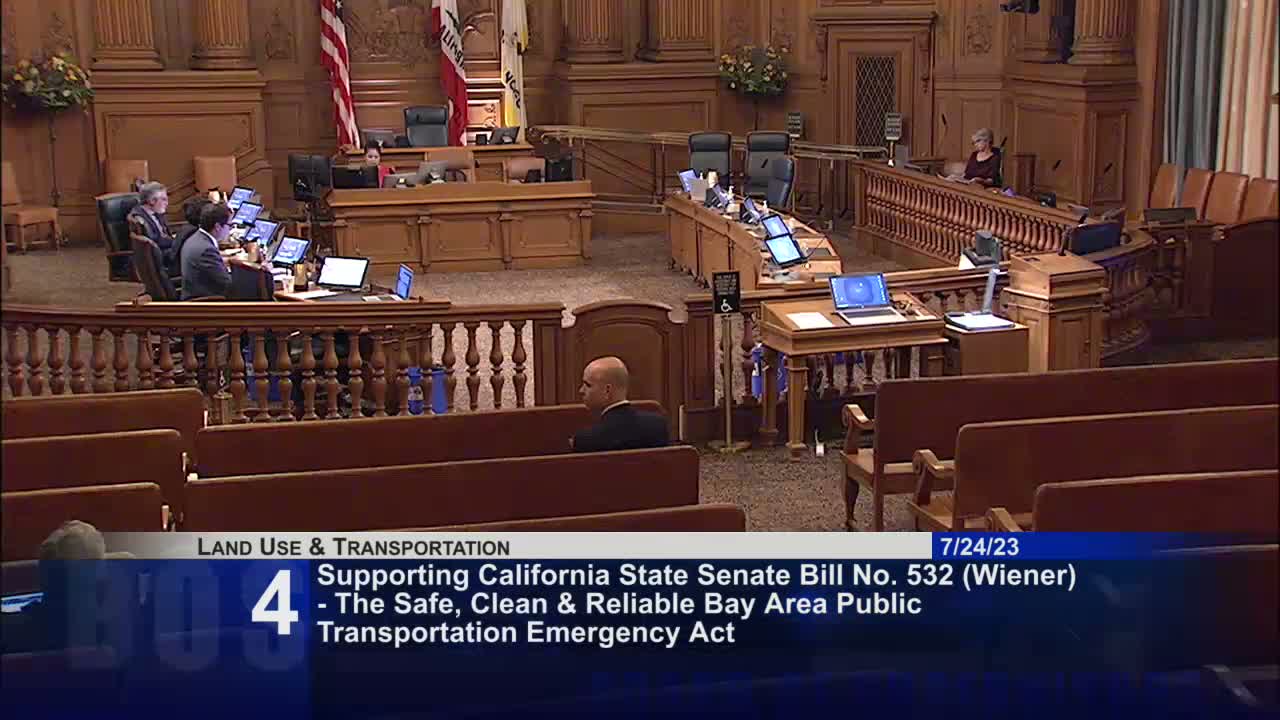
The Land Use and Transportation Committee on Monday moved to forward to the full Board a two‑part housing package that reduces some inclusionary housing obligations and reforms development impact fees, with President Aaron Peskin and Chair Mirna Melgar voting in favor and Vice Chair Dean Preston dissenting.
The measures — brought as companion ordinances after a Technical Advisory Committee (TAC) review and a controller feasibility study — would lower certain on‑site affordable housing percentages and change how the city sets, locks and allows deferrals of development impact fees. Peskin described the package as the product of “very, very careful and deliberate negotiations” among the mayor’s office, controller, developers and affordable‑housing stakeholders and said the changes are intended as a three‑year, temporary measure to improve feasibility for stalled projects.
Ted Conrad of the Office of Economic and Workforce Development told the committee the impact‑fee reforms would: cap annual fee escalators at a flat 2 percent instead of the current construction‑cost index; lock the fee rate at the time a project is approved rather than allowing escalation up to the first construction document; and reestablish a deferral program allowing 80–85 percent of certain fees to be paid at certificate of occupancy to reduce financing costs. “These fees would be paid before properties and buildings are leased up,” Conrad said, adding the package aims to improve predictability for project sponsors and city budgeting.
Planning staff offered a data‑driven view of projects that might be affected. Carly Grove said staff estimate about 101 already‑approved projects (roughly 11,566 units) and about 52 projects under active review (roughly 6,000 units) could be eligible for the reductions. Grove cautioned those figures reflect projects on the planning radar and do not project how many additional projects would arise solely because of the changes.
Vice Chair Dean Preston pressed presenters for clearer fiscal tradeoffs and said he remains unconvinced the measures will produce new housing. “When you read the controller’s analysis, I believe what they say is regardless of what you do with your inclusionary rate … the projection is you’re not going to see new apartments as a result of those changes,” Preston said. “I think the projection is 0.” Planning and OEWD staff said prototypes studied by TAC show substantial variation across project types and neighborhoods, and that external factors — construction costs, interest rates, financing — heavily influence feasibility.
Public comment stretched for hours and produced a sharp split. Representatives of the Building and Construction Trades Council, several unions and industry groups urged support, saying small but targeted changes would unlock entitled projects and jobs. The San Francisco Building Trades’ Rudy Gonzales said the reforms could “break ground immediately” on projects now stalled by current market conditions. By contrast, housing advocates and community groups including the Council of Community Housing Organizations and Our City SF warned the measures would reduce the city’s pipeline of affordable units at a time when the housing element requires tens of thousands of new affordable homes. “We urge the board to move this legislation forward only when there is a greater certainty that we have put in place a funding strategy that advances our affordable housing goals,” said Charlie Shamas of the Council of Community Housing Organizations.
The committee approved technical amendments offered by President Peskin and duplicated the file for further work. On separate roll‑call votes the committee voted to send Item 5 (the impact‑fee reforms) to the full Board with a positive recommendation, 2‑1 (Peskin and Melgar in favor, Preston opposed), and likewise sent amended Item 6 (the inclusionary housing change) 2‑1. The committee record shows proponents hope the three‑year package will be revisited at the end of that period and tied to other funding mechanisms such as a potential bond to preserve overall affordable housing production.
What happens next: the measures will be considered by the full Board; the committee duplicated the file to allow further amendments and analysis. Supporters say the changes are a targeted tool to improve feasibility in a difficult financing environment; critics say the city should not lower affordable‑housing requirements without firm alternative revenue commitments.
The measures — brought as companion ordinances after a Technical Advisory Committee (TAC) review and a controller feasibility study — would lower certain on‑site affordable housing percentages and change how the city sets, locks and allows deferrals of development impact fees. Peskin described the package as the product of “very, very careful and deliberate negotiations” among the mayor’s office, controller, developers and affordable‑housing stakeholders and said the changes are intended as a three‑year, temporary measure to improve feasibility for stalled projects.
Ted Conrad of the Office of Economic and Workforce Development told the committee the impact‑fee reforms would: cap annual fee escalators at a flat 2 percent instead of the current construction‑cost index; lock the fee rate at the time a project is approved rather than allowing escalation up to the first construction document; and reestablish a deferral program allowing 80–85 percent of certain fees to be paid at certificate of occupancy to reduce financing costs. “These fees would be paid before properties and buildings are leased up,” Conrad said, adding the package aims to improve predictability for project sponsors and city budgeting.
Planning staff offered a data‑driven view of projects that might be affected. Carly Grove said staff estimate about 101 already‑approved projects (roughly 11,566 units) and about 52 projects under active review (roughly 6,000 units) could be eligible for the reductions. Grove cautioned those figures reflect projects on the planning radar and do not project how many additional projects would arise solely because of the changes.
Vice Chair Dean Preston pressed presenters for clearer fiscal tradeoffs and said he remains unconvinced the measures will produce new housing. “When you read the controller’s analysis, I believe what they say is regardless of what you do with your inclusionary rate … the projection is you’re not going to see new apartments as a result of those changes,” Preston said. “I think the projection is 0.” Planning and OEWD staff said prototypes studied by TAC show substantial variation across project types and neighborhoods, and that external factors — construction costs, interest rates, financing — heavily influence feasibility.
Public comment stretched for hours and produced a sharp split. Representatives of the Building and Construction Trades Council, several unions and industry groups urged support, saying small but targeted changes would unlock entitled projects and jobs. The San Francisco Building Trades’ Rudy Gonzales said the reforms could “break ground immediately” on projects now stalled by current market conditions. By contrast, housing advocates and community groups including the Council of Community Housing Organizations and Our City SF warned the measures would reduce the city’s pipeline of affordable units at a time when the housing element requires tens of thousands of new affordable homes. “We urge the board to move this legislation forward only when there is a greater certainty that we have put in place a funding strategy that advances our affordable housing goals,” said Charlie Shamas of the Council of Community Housing Organizations.
The committee approved technical amendments offered by President Peskin and duplicated the file for further work. On separate roll‑call votes the committee voted to send Item 5 (the impact‑fee reforms) to the full Board with a positive recommendation, 2‑1 (Peskin and Melgar in favor, Preston opposed), and likewise sent amended Item 6 (the inclusionary housing change) 2‑1. The committee record shows proponents hope the three‑year package will be revisited at the end of that period and tied to other funding mechanisms such as a potential bond to preserve overall affordable housing production.
What happens next: the measures will be considered by the full Board; the committee duplicated the file to allow further amendments and analysis. Supporters say the changes are a targeted tool to improve feasibility in a difficult financing environment; critics say the city should not lower affordable‑housing requirements without firm alternative revenue commitments.
Don't Miss a Word: See the Full Meeting!
Go beyond summaries. Unlock every video, transcript, and key insight with a Founder Membership.
✓
Get instant access to full meeting videos
✓
Search and clip any phrase from complete transcripts
✓
Receive AI-powered summaries & custom alerts
✓
Enjoy lifetime, unrestricted access to government data
30-day money-back guarantee
