Committee advances 'family housing' special use district amendments, duplicates file for additional planning review after heavy public comment
July 10, 2023 | San Francisco County, California
This article was created by AI summarizing key points discussed. AI makes mistakes, so for full details and context, please refer to the video of the full meeting. Please report any errors so we can fix them. Report an error »
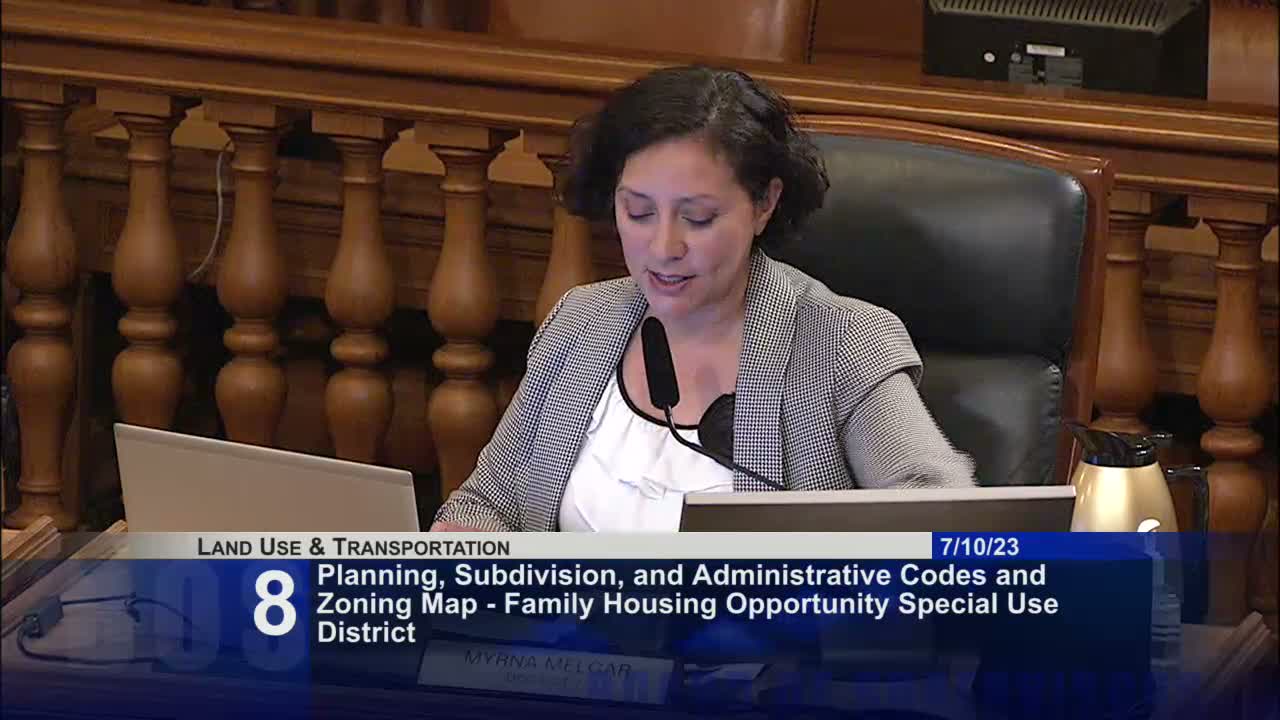
San Francisco — The Land Use and Transportation Committee on June 10 advanced a high‑profile package to create a Family Housing Opportunities Special Use District intended to allow modest additional housing capacity on single‑family lots in selected "well‑resourced" neighborhoods while adding tenant protections.
Chair Supervisor Mirna Melgar said the proposal responds to generational changes on the West Side and is intended primarily for owner‑occupied, single‑family homes seeking to add units for family needs. Melgar read in a suite of amendments that, among other changes, would:
• Allow up to one unit per 1,000 square feet of lot area in certain density exceptions (whichever is greater);
• Require a minimum mix of two‑ and three‑bedroom units on two‑ and three‑lot mergers to ensure family‑sized units;
• Add tenant‑displacement protections with a five‑year look‑back (no eligibility where no‑fault evictions or buyouts occurred in the last five years);
• Deed‑restrict added units and make them subject to rent control; and
• Clarify that projects proposing demolition of two rent‑controlled units still require conditional‑use review.
Planning Commission staff said the Commission recommended approval with suggestions such as extending eligibility into RM1 zoning in some instances and confirming bedroom‑mix and tenure protections; they also said the Housing Element EIR addressed many of the amendments, while individual projects will still undergo CEQA review as required.
A lengthy public‑comment period included both strong support from YIMBY and housing‑advocacy organizations and deep concerns from tenant advocates and neighborhood groups. Opponents warned that eliminating certain demolition notices (section 311) and reducing notification windows could accelerate condo conversions, invite speculation, and undermine environmental review; supporters said the change would create missing‑middle units, help seniors downsize and add family housing stock.
Chair Melgar said she would duplicate the file, incorporate the amendments she and President Aaron Peskin read into the record, and continue the original file to next week to allow Planning Commission review of particular amendments. The committee voted to adopt the read‑in amendments, duplicate the file with additional co‑sponsor amendments and continue the original to the call of the chair; votes were recorded as ayes by Peskin, Preston and Melgar.
Next steps: The duplicate file will be re‑referred to the Planning Commission for review of specified amendments; the original file will be continued to next week's committee meeting for further action.
Chair Supervisor Mirna Melgar said the proposal responds to generational changes on the West Side and is intended primarily for owner‑occupied, single‑family homes seeking to add units for family needs. Melgar read in a suite of amendments that, among other changes, would:
• Allow up to one unit per 1,000 square feet of lot area in certain density exceptions (whichever is greater);
• Require a minimum mix of two‑ and three‑bedroom units on two‑ and three‑lot mergers to ensure family‑sized units;
• Add tenant‑displacement protections with a five‑year look‑back (no eligibility where no‑fault evictions or buyouts occurred in the last five years);
• Deed‑restrict added units and make them subject to rent control; and
• Clarify that projects proposing demolition of two rent‑controlled units still require conditional‑use review.
Planning Commission staff said the Commission recommended approval with suggestions such as extending eligibility into RM1 zoning in some instances and confirming bedroom‑mix and tenure protections; they also said the Housing Element EIR addressed many of the amendments, while individual projects will still undergo CEQA review as required.
A lengthy public‑comment period included both strong support from YIMBY and housing‑advocacy organizations and deep concerns from tenant advocates and neighborhood groups. Opponents warned that eliminating certain demolition notices (section 311) and reducing notification windows could accelerate condo conversions, invite speculation, and undermine environmental review; supporters said the change would create missing‑middle units, help seniors downsize and add family housing stock.
Chair Melgar said she would duplicate the file, incorporate the amendments she and President Aaron Peskin read into the record, and continue the original file to next week to allow Planning Commission review of particular amendments. The committee voted to adopt the read‑in amendments, duplicate the file with additional co‑sponsor amendments and continue the original to the call of the chair; votes were recorded as ayes by Peskin, Preston and Melgar.
Next steps: The duplicate file will be re‑referred to the Planning Commission for review of specified amendments; the original file will be continued to next week's committee meeting for further action.
View the Full Meeting & All Its Details
This article offers just a summary. Unlock complete video, transcripts, and insights as a Founder Member.
✓
Watch full, unedited meeting videos
✓
Search every word spoken in unlimited transcripts
✓
AI summaries & real-time alerts (all government levels)
✓
Permanent access to expanding government content
30-day money-back guarantee
