Committee backs amendments and continues Public Works 'Love Our Neighborhoods' permit overhaul to Nov. 27
October 30, 2023 | San Francisco County, California
This article was created by AI summarizing key points discussed. AI makes mistakes, so for full details and context, please refer to the video of the full meeting. Please report any errors so we can fix them. Report an error »
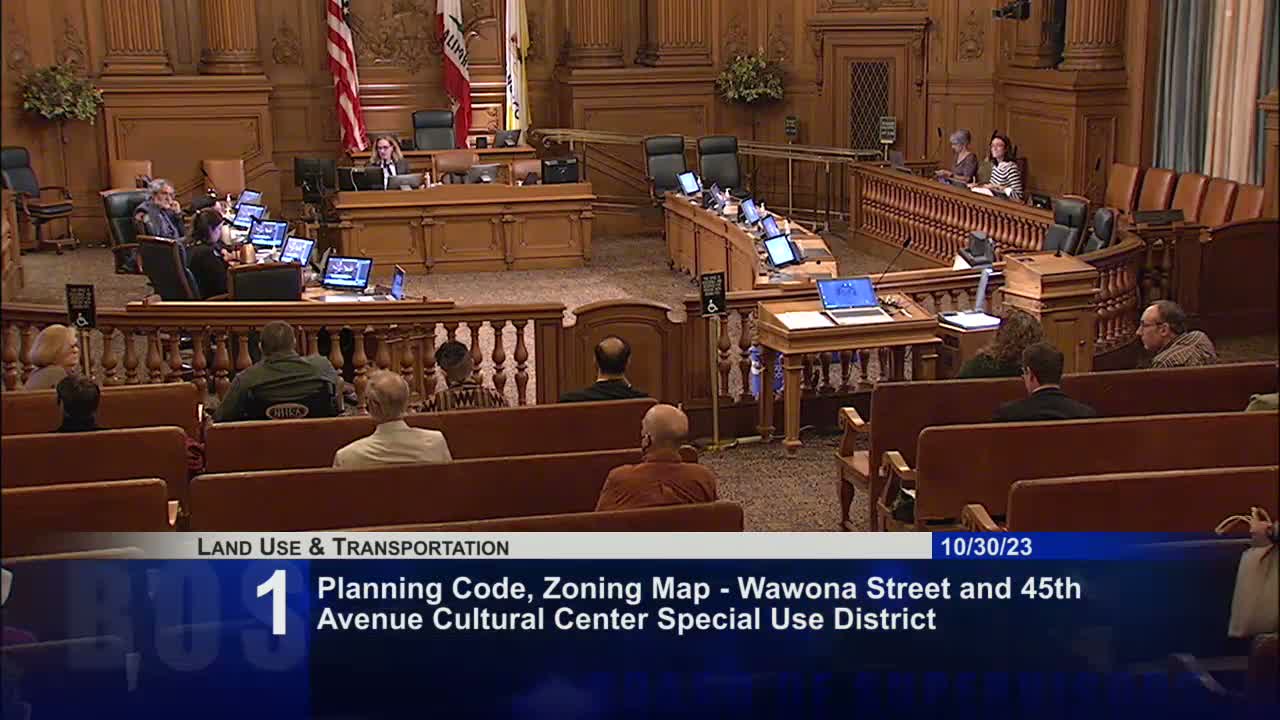
The Land Use and Transportation Committee on Oct. 30 advanced amendments to an ordinance that would let community groups and merchant associations more easily install neighborhood amenities — from little libraries and benches to murals and multi-amenity landscaping — while asking DPW to refine accessibility rules and enforcement before returning on Nov. 27.
Chair Mirna Melgar and Supervisor Hillary Ronan described the ordinance as a response to post-pandemic community desire to beautify public spaces and to a string of cases where residents encountered onerous permitting for small neighborhood projects. Interim Public Works Director Carla Short presented a three-tier permit approach: Tier 1 (registration, no fee, for modest in‑front‑of‑property items such as little libraries and single benches), Tier 2 (modest application fee — $500 — for nonprofit or established community groups for murals and multiple fixtures), and Tier 3 (projects requiring engineering review and greater oversight, with higher fees for substantial infrastructure that previously required a major encroachment permit).
DPW staff clarified a narrow fee paragraph in Tier 1. Beth Rubenstein, who worked on the draft regulations, said City Attorney advice led to a provision permitting DPW to charge a $200 fee where a registered Tier 1 project does not meet the registration guidelines so the department can bring the installation into compliance or address nuisance projects. Rubinstein emphasized that Tier 1 is primarily a registration process and that enforcement would be complaint-driven through 311 inspections.
Speakers from neighborhood groups, the Parks Alliance, the Alliance of Benefit Districts, merchant associations and SF New Deal generally supported the reforms as a way to simplify time-consuming processes and reduce costs. Several residents and advocates urged stronger language on ADA access and safeguards against planter boxes and other installations being used as “hostile architecture” to exclude unhoused people. Public commenters showed photographs and described examples where planters blocked curb‑to‑sidewalk access for wheelchairs.
President Aaron Peskin and others pressed DPW to achieve true “one‑stop shopping” so applicants would not have to cycle through separate fee and permit streams at other agencies; Director Short said DPW's intention is to be the single point of entry and coordinate internal reviews, while acknowledging other agencies set independent fees.
Chair Melgar moved to continue the item to Nov. 27 to allow staff to refine regulations and fee language and to ensure community and CBD feedback could be incorporated. The motion passed on a roll-call vote. DPW will draft implementing regulations with explicit ADA and accessible-path guidance, and the committee asked staff to publish clearer, simplified text so small groups can understand whether a given project fits Tier 1 registration or requires a higher tier permit.
The committee did not finalize all regulatory details; the continuance will allow DPW to return with proposed regulations, clearer fee language, and a communications plan for community groups and Business Improvement Districts.
Chair Mirna Melgar and Supervisor Hillary Ronan described the ordinance as a response to post-pandemic community desire to beautify public spaces and to a string of cases where residents encountered onerous permitting for small neighborhood projects. Interim Public Works Director Carla Short presented a three-tier permit approach: Tier 1 (registration, no fee, for modest in‑front‑of‑property items such as little libraries and single benches), Tier 2 (modest application fee — $500 — for nonprofit or established community groups for murals and multiple fixtures), and Tier 3 (projects requiring engineering review and greater oversight, with higher fees for substantial infrastructure that previously required a major encroachment permit).
DPW staff clarified a narrow fee paragraph in Tier 1. Beth Rubenstein, who worked on the draft regulations, said City Attorney advice led to a provision permitting DPW to charge a $200 fee where a registered Tier 1 project does not meet the registration guidelines so the department can bring the installation into compliance or address nuisance projects. Rubinstein emphasized that Tier 1 is primarily a registration process and that enforcement would be complaint-driven through 311 inspections.
Speakers from neighborhood groups, the Parks Alliance, the Alliance of Benefit Districts, merchant associations and SF New Deal generally supported the reforms as a way to simplify time-consuming processes and reduce costs. Several residents and advocates urged stronger language on ADA access and safeguards against planter boxes and other installations being used as “hostile architecture” to exclude unhoused people. Public commenters showed photographs and described examples where planters blocked curb‑to‑sidewalk access for wheelchairs.
President Aaron Peskin and others pressed DPW to achieve true “one‑stop shopping” so applicants would not have to cycle through separate fee and permit streams at other agencies; Director Short said DPW's intention is to be the single point of entry and coordinate internal reviews, while acknowledging other agencies set independent fees.
Chair Melgar moved to continue the item to Nov. 27 to allow staff to refine regulations and fee language and to ensure community and CBD feedback could be incorporated. The motion passed on a roll-call vote. DPW will draft implementing regulations with explicit ADA and accessible-path guidance, and the committee asked staff to publish clearer, simplified text so small groups can understand whether a given project fits Tier 1 registration or requires a higher tier permit.
The committee did not finalize all regulatory details; the continuance will allow DPW to return with proposed regulations, clearer fee language, and a communications plan for community groups and Business Improvement Districts.
Don't Miss a Word: See the Full Meeting!
Go beyond summaries. Unlock every video, transcript, and key insight with a Founder Membership.
✓
Get instant access to full meeting videos
✓
Search and clip any phrase from complete transcripts
✓
Receive AI-powered summaries & custom alerts
✓
Enjoy lifetime, unrestricted access to government data
30-day money-back guarantee
