Planning-code changes to ease small-business permitting cleared with amendments; continued to Nov. 27
October 30, 2023 | San Francisco County, California
This article was created by AI summarizing key points discussed. AI makes mistakes, so for full details and context, please refer to the video of the full meeting. Please report any errors so we can fix them. Report an error »
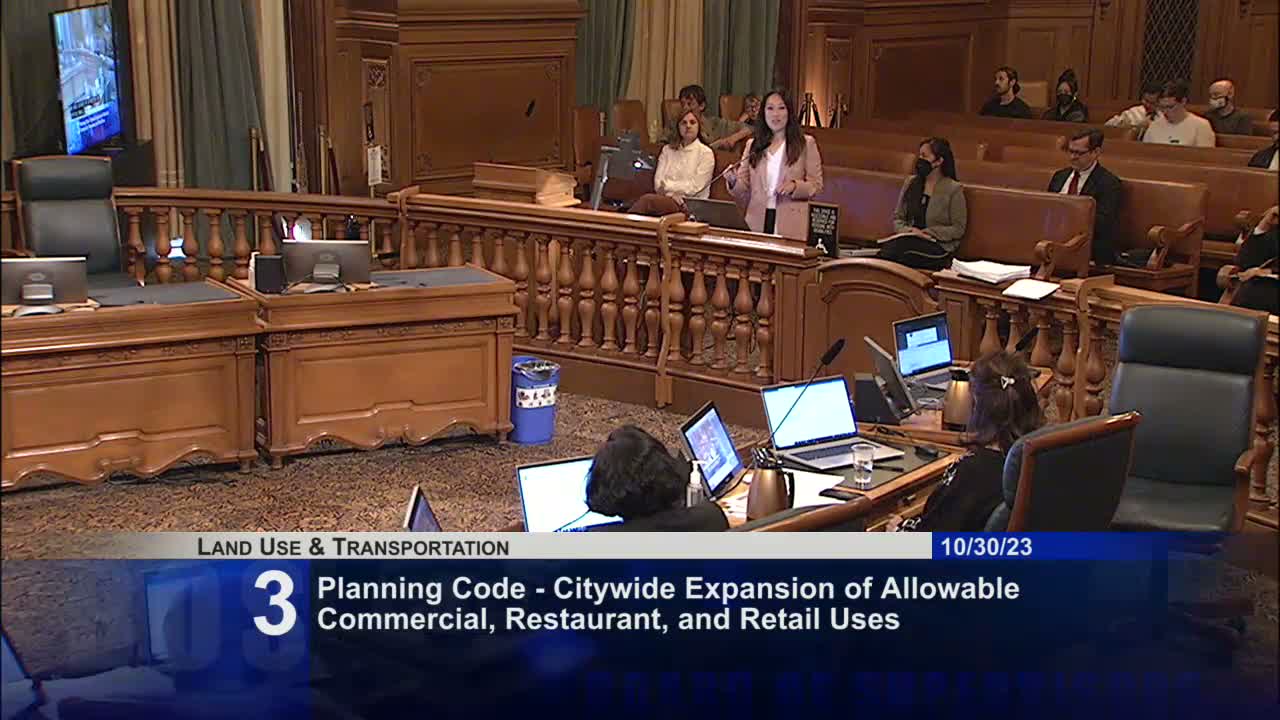
The committee on Oct. 30 approved a package of amendments and continued a broad planning‑code overhaul intended to make it easier for small businesses to open and adapt storefronts across San Francisco, while asking staff to produce clearer consolidated text for public review.
Katie Tang, director of the Office of Small Business, presented the ordinance on behalf of Mayor Breed. The package would principally permit additional commercial retail and restaurant uses on the ground floor in many neighborhood commercial districts, expand flexible retail citywide (allowing businesses to switch among a set of six uses without repeated city approvals), create a consolidated professional‑services category for certain customer‑facing businesses, and clarify regulations for music and entertainment venues distinct from bars. Tang also explained the city sought to incorporate California’s new Type 90 liquor license for music venues into local planning code language.
The ordinance would also legalize certain unpermitted outdoor activity areas, adjust notice and conditional‑use rules in some neighborhoods, and expand eligibility for expedited planning review programs that speed placement on the Planning Commission consent calendar (with some district exceptions). Tang said outreach included merchant walks, permit counseling, and recruitment of two small‑business permit specialists to help applicants.
President Aaron Peskin and other supervisors welcomed the effort but repeatedly raised a larger concern: departmental coordination. Peskin recounted cases where businesses were given inconsistent technical advice by different city departments (DBI, DPW, Fire, DPH), and urged more on-the-ground consistency rather than only statutory fixes. Supervisors asked that substitute or consolidated text be provided so the public could readily compare old and new language.
Public commenters included merchant associations, neighborhood groups and small‑business advocates. Many business groups supported the changes as a way to reduce vacancies and shorten long permitting timelines; neighborhood and tenant advocates urged caution to avoid displacement and to preserve local controls in sensitive corridors.
Chair Melgar moved to adopt the director’s amendments — including two additional corrections read into the record — and to continue the ordinance to Nov. 27 so the city attorney can prepare a substitute text if needed for clearer public review. The committee approved the amendments and the continuance.
The Nov. 27 hearing is expected to include clarified substitute language, additional district exceptions where noted, and discussion of how expedited review will be implemented without undermining local neighborhood controls.
Katie Tang, director of the Office of Small Business, presented the ordinance on behalf of Mayor Breed. The package would principally permit additional commercial retail and restaurant uses on the ground floor in many neighborhood commercial districts, expand flexible retail citywide (allowing businesses to switch among a set of six uses without repeated city approvals), create a consolidated professional‑services category for certain customer‑facing businesses, and clarify regulations for music and entertainment venues distinct from bars. Tang also explained the city sought to incorporate California’s new Type 90 liquor license for music venues into local planning code language.
The ordinance would also legalize certain unpermitted outdoor activity areas, adjust notice and conditional‑use rules in some neighborhoods, and expand eligibility for expedited planning review programs that speed placement on the Planning Commission consent calendar (with some district exceptions). Tang said outreach included merchant walks, permit counseling, and recruitment of two small‑business permit specialists to help applicants.
President Aaron Peskin and other supervisors welcomed the effort but repeatedly raised a larger concern: departmental coordination. Peskin recounted cases where businesses were given inconsistent technical advice by different city departments (DBI, DPW, Fire, DPH), and urged more on-the-ground consistency rather than only statutory fixes. Supervisors asked that substitute or consolidated text be provided so the public could readily compare old and new language.
Public commenters included merchant associations, neighborhood groups and small‑business advocates. Many business groups supported the changes as a way to reduce vacancies and shorten long permitting timelines; neighborhood and tenant advocates urged caution to avoid displacement and to preserve local controls in sensitive corridors.
Chair Melgar moved to adopt the director’s amendments — including two additional corrections read into the record — and to continue the ordinance to Nov. 27 so the city attorney can prepare a substitute text if needed for clearer public review. The committee approved the amendments and the continuance.
The Nov. 27 hearing is expected to include clarified substitute language, additional district exceptions where noted, and discussion of how expedited review will be implemented without undermining local neighborhood controls.
Don't Miss a Word: See the Full Meeting!
Go beyond summaries. Unlock every video, transcript, and key insight with a Founder Membership.
✓
Get instant access to full meeting videos
✓
Search and clip any phrase from complete transcripts
✓
Receive AI-powered summaries & custom alerts
✓
Enjoy lifetime, unrestricted access to government data
30-day money-back guarantee
