Housing streamlining ordinance paused for city‑attorney review after heated public debate; duplicate file amended to curb 'monster homes'
October 30, 2023 | San Francisco County, California
This article was created by AI summarizing key points discussed. AI makes mistakes, so for full details and context, please refer to the video of the full meeting. Please report any errors so we can fix them. Report an error »
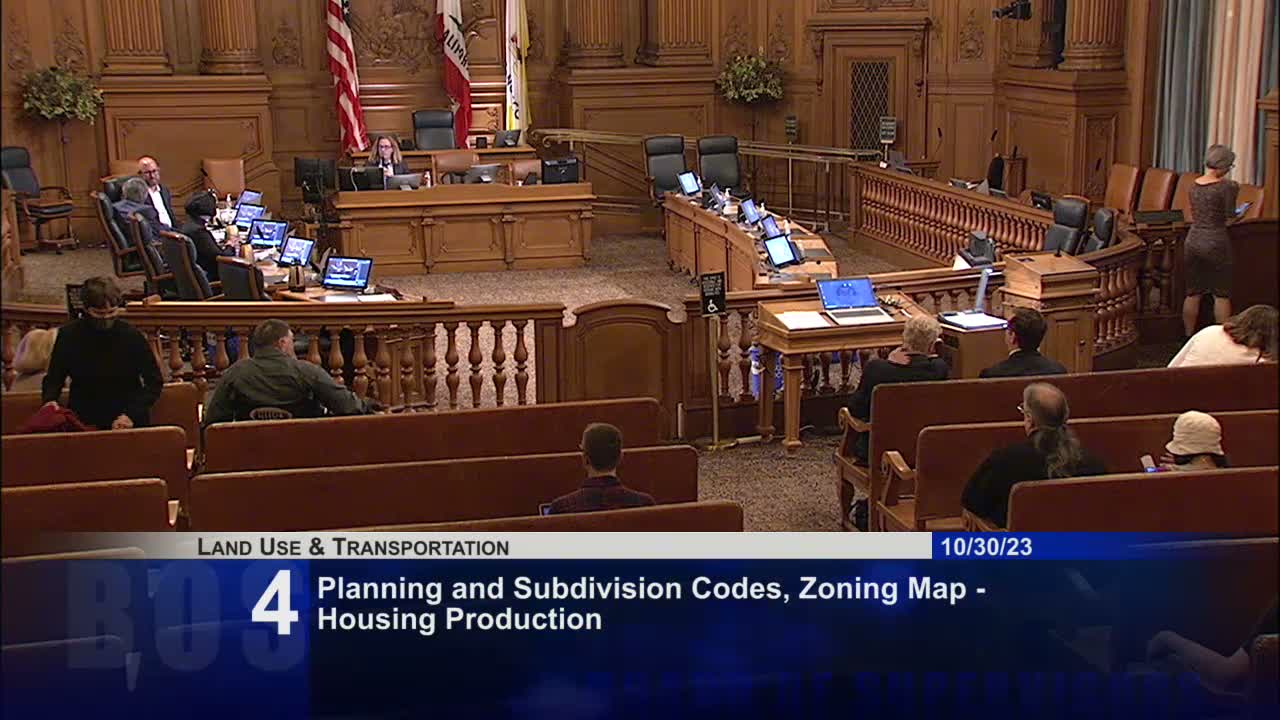
The committee spent the latter portion of its Oct. 30 meeting on a major housing streamlining ordinance intended to promote housing production by exempting some projects from notice and conditional‑use requirements, adjusting setback and lot‑size rules, changing ground‑floor use allowances, and expanding density‑exception and fee‑exemption options for certain affordable projects. Chair Mirna Melgar framed the discussion by saying that immediate City Attorney guidance was necessary after the state Department of Housing and Community Development (HCD) issued a report and an Oct. letter raising compliance questions.
Melgar explained the committee had previously adopted narrowly targeted amendments to preserve much of the housing‑preservation intent (including protections for rent‑controlled units in the chair’s earlier SUD work) but said the HCD correspondence, recent state laws and the complexity of reconciling multiple changes required additional review.
Supervisor Mandelmann proposed a set of amendments to two Special Use Districts — Corona Heights and Central Neighborhoods large‑residence SUDs — intended to prevent the streamlining measures from accelerating construction of very large single‑family “monster homes.” Mandelmann’s text would sunset the existing conditional‑use requirement for certain large residential projects on Dec. 31, 2024, and thereafter prohibit residential development or expansion that would produce individual dwelling units larger than 3,000 square feet of gross floor area (with a narrow exception for increases of less than 15%). He asked that the duplicated file with his changes be referred back to the Planning Commission for expedited review while the original ordinance is continued.
Public comment was extensive and sharply divided. Tenant‑ and equity‑oriented groups, neighborhood associations and affordable‑housing advocates urged rejection or a rewrite, saying the ordinance threatens rent‑controlled housing and fails to prioritize deeply affordable units. Coalition speakers argued the city should instead implement the housing element’s equity actions and build affordable housing, not streamline demolition and market‑rate development. YIMBY and housing‑production advocates countered that delay risks HCD sanctions (including potential decertification of the housing element) and urged moving quickly to comply with state expectations.
After discussion, the committee approved Mandelmann’s amendments to the duplicated file on a voice/roll call vote and instructed staff to send that file to the Planning Commission for review. The committee then voted to continue the original ordinance to Nov. 27 so the City Attorney could review HCD’s report and recent state laws, and so supervisors could refine amendments in light of legal guidance.
The committee’s action leaves a duplicated, amended file in Planning Commission review (on the call of the chair), while the main ordinance remains continued to Nov. 27 with the intention of reconciling the mayor’s proposal, supervisor amendments, HCD guidance and state changes before the Board considers any final action.
Melgar explained the committee had previously adopted narrowly targeted amendments to preserve much of the housing‑preservation intent (including protections for rent‑controlled units in the chair’s earlier SUD work) but said the HCD correspondence, recent state laws and the complexity of reconciling multiple changes required additional review.
Supervisor Mandelmann proposed a set of amendments to two Special Use Districts — Corona Heights and Central Neighborhoods large‑residence SUDs — intended to prevent the streamlining measures from accelerating construction of very large single‑family “monster homes.” Mandelmann’s text would sunset the existing conditional‑use requirement for certain large residential projects on Dec. 31, 2024, and thereafter prohibit residential development or expansion that would produce individual dwelling units larger than 3,000 square feet of gross floor area (with a narrow exception for increases of less than 15%). He asked that the duplicated file with his changes be referred back to the Planning Commission for expedited review while the original ordinance is continued.
Public comment was extensive and sharply divided. Tenant‑ and equity‑oriented groups, neighborhood associations and affordable‑housing advocates urged rejection or a rewrite, saying the ordinance threatens rent‑controlled housing and fails to prioritize deeply affordable units. Coalition speakers argued the city should instead implement the housing element’s equity actions and build affordable housing, not streamline demolition and market‑rate development. YIMBY and housing‑production advocates countered that delay risks HCD sanctions (including potential decertification of the housing element) and urged moving quickly to comply with state expectations.
After discussion, the committee approved Mandelmann’s amendments to the duplicated file on a voice/roll call vote and instructed staff to send that file to the Planning Commission for review. The committee then voted to continue the original ordinance to Nov. 27 so the City Attorney could review HCD’s report and recent state laws, and so supervisors could refine amendments in light of legal guidance.
The committee’s action leaves a duplicated, amended file in Planning Commission review (on the call of the chair), while the main ordinance remains continued to Nov. 27 with the intention of reconciling the mayor’s proposal, supervisor amendments, HCD guidance and state changes before the Board considers any final action.
Don't Miss a Word: See the Full Meeting!
Go beyond summaries. Unlock every video, transcript, and key insight with a Founder Membership.
✓
Get instant access to full meeting videos
✓
Search and clip any phrase from complete transcripts
✓
Receive AI-powered summaries & custom alerts
✓
Enjoy lifetime, unrestricted access to government data
30-day money-back guarantee
