Committee advances form-based density ordinance but refers amendments to Planning
March 04, 2024 | San Francisco County, California
This article was created by AI summarizing key points discussed. AI makes mistakes, so for full details and context, please refer to the video of the full meeting. Please report any errors so we can fix them. Report an error »
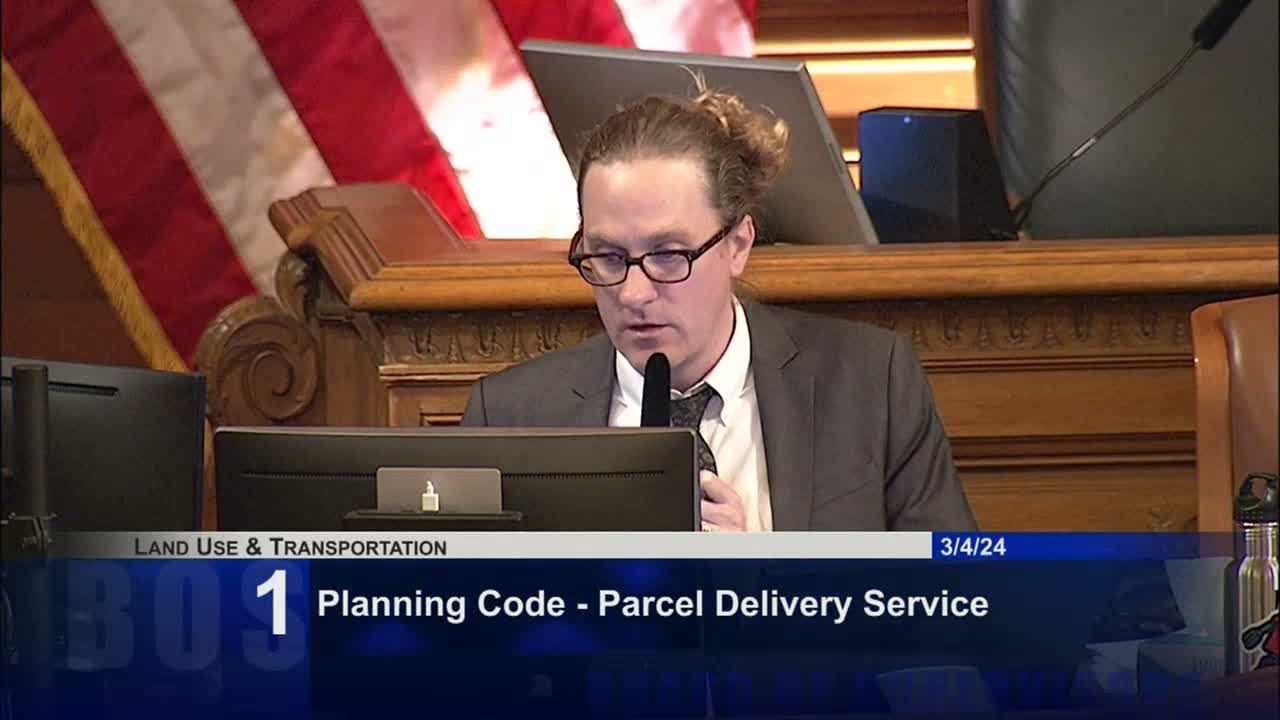
The Land Use & Transportation Committee on March 4 advanced a mayoral ordinance to allow form-based density in select commercial, residential and transit-oriented districts, but the committee also approved sponsor amendments and re-referred the amended parent file to the Planning Commission for further review.
Audrey Marloney of the Planning Department told the committee the ordinance is intended to increase housing capacity where transit and amenities exist while excluding areas identified as vulnerable to displacement; she noted the Planning Commission previously approved the measure 4–2 with recommended modifications. President Eric Peskin framed the item against recent local housing reforms and proposed two pathways in his amendments: one for projects using the state density bonus and one for projects that do not.
Peskin said his amendments would apply rent control to units created above base density for projects that are not using the state density bonus. “For projects that are not using state density bonus...my amendments would apply rent control on units created over the base density,” Peskin said. Supporters (Housing Action Coalition, NorCal Carpenters) urged passing the ordinance without changes, warning that constraints could complicate the city’s Housing Element and rezoning efforts; opponents (neighborhood groups, Cow Hollow Association, Haight Ashbury Neighborhood Council) warned that combining form-based density with the state density bonus could enable larger-than-intended development and accelerate displacement of small businesses and long‑term residents.
The committee approved the amendment to the parent file and a motion to continue the duplicated (unamended) child file to the call of the chair; the amended parent file will be re‑referred to the Planning Commission for further analysis of state-law compliance and impacts. Committee members emphasized the need for a holistic approach to zoning changes to avoid piecemeal outcomes.
Audrey Marloney of the Planning Department told the committee the ordinance is intended to increase housing capacity where transit and amenities exist while excluding areas identified as vulnerable to displacement; she noted the Planning Commission previously approved the measure 4–2 with recommended modifications. President Eric Peskin framed the item against recent local housing reforms and proposed two pathways in his amendments: one for projects using the state density bonus and one for projects that do not.
Peskin said his amendments would apply rent control to units created above base density for projects that are not using the state density bonus. “For projects that are not using state density bonus...my amendments would apply rent control on units created over the base density,” Peskin said. Supporters (Housing Action Coalition, NorCal Carpenters) urged passing the ordinance without changes, warning that constraints could complicate the city’s Housing Element and rezoning efforts; opponents (neighborhood groups, Cow Hollow Association, Haight Ashbury Neighborhood Council) warned that combining form-based density with the state density bonus could enable larger-than-intended development and accelerate displacement of small businesses and long‑term residents.
The committee approved the amendment to the parent file and a motion to continue the duplicated (unamended) child file to the call of the chair; the amended parent file will be re‑referred to the Planning Commission for further analysis of state-law compliance and impacts. Committee members emphasized the need for a holistic approach to zoning changes to avoid piecemeal outcomes.
View the Full Meeting & All Its Details
This article offers just a summary. Unlock complete video, transcripts, and insights as a Founder Member.
✓
Watch full, unedited meeting videos
✓
Search every word spoken in unlimited transcripts
✓
AI summaries & real-time alerts (all government levels)
✓
Permanent access to expanding government content
30-day money-back guarantee
