Supervisors close fleet‑charging loophole, advance parcel‑delivery controls and back state bill for AV local control
February 26, 2024 | San Francisco County, California
This article was created by AI summarizing key points discussed. AI makes mistakes, so for full details and context, please refer to the video of the full meeting. Please report any errors so we can fix them. Report an error »
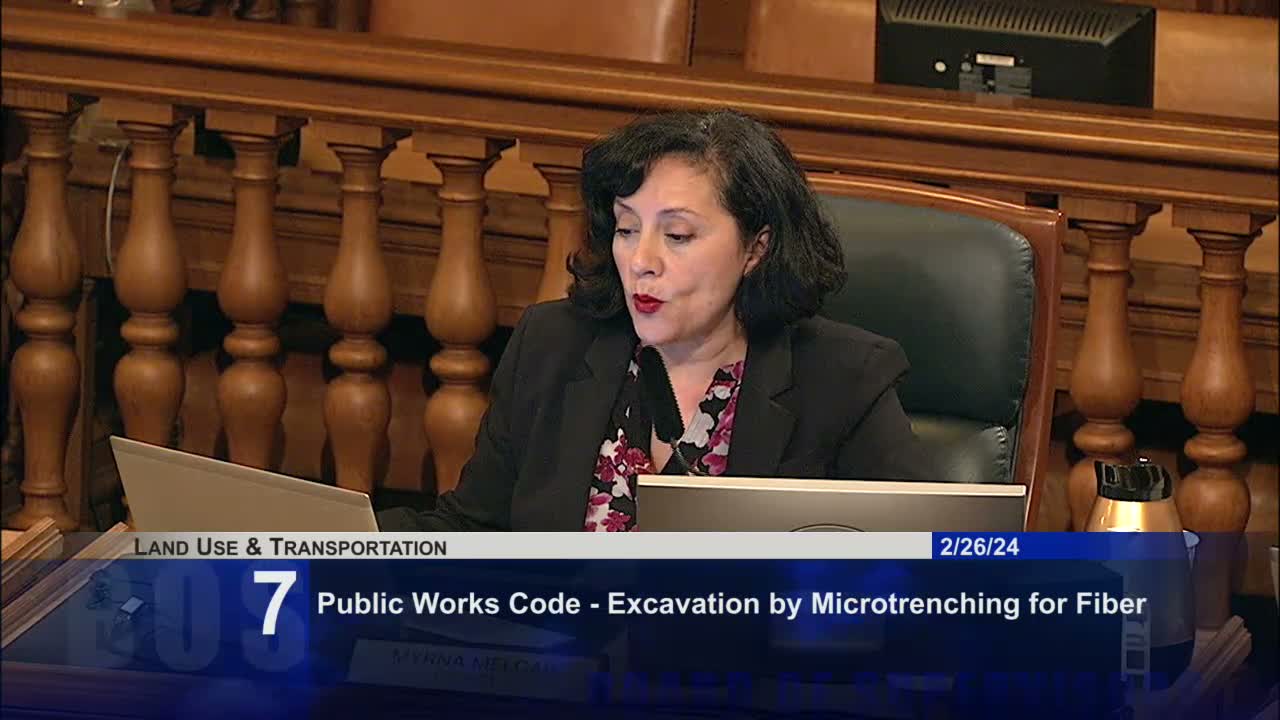
A package of three related items aimed at regulating vehicle‑intensive uses in San Francisco — fleet‑charging sites, parcel‑delivery facilities and a resolution supporting state bill SB 915 to preserve local control over autonomous‑vehicle deployments — received committee action on Feb. 26.
President Aaron Paskin and Supervisor Sandra Chan led discussion of the interrelated land‑use issues. For fleet charging, President Paskin offered an amendment inserting a grandfathering date (projects submitted before Jan. 11, 2024) to avoid unintended retroactivity; the committee adopted the amendment. The fleet‑charging legislation closes a loophole identified by labor and community groups in which property owners changed parcel uses to private parking or vehicle storage to enable later conversion to unreviewed fleet‑charging operations. President Paskin argued that the plain language of prior approvals vested duty with a permitting department rather than creating unreviewed charging facilities.
On parcel‑delivery services, Supervisor Chan described the intent to preserve neighborhood commercial corridors and require conditional‑use approvals for delivery hubs, with a streamlined conditional‑use path for small sites under 5,000 square feet, exclusion of cannabis delivery from the accessory‑use prohibition, and technical code corrections. Planning staff suggested a citywide economic analysis could be preferable to repeated project‑level studies; the Planning Commission had recommended approval while noting several considerations. Labor groups (Teamsters and others) urged enhanced CU criteria, including employment and safety analyses to account for automation and community impacts; business groups raised concerns about access to electrification and potential constraints on companies.
The committee adopted multiple amendments — grandfathering, small‑site CU streamlining, and clarifying cannabis exceptions — and voted to transmit the items as committee reports to the Board for a hearing the following day. The committee also voted to recommend a resolution supporting SB 915, which would delay AV deployment in a jurisdiction until the local government passes an authorizing ordinance and would restore a degree of local control over autonomous vehicle services.
Supporters included labor organizations citing public‑safety and employment concerns; critics included the Chamber of Commerce, which asked for more time to analyze impacts to electrification efforts. The committee balanced competing views by adopting targeted amendments and referring the items to the full Board for consideration as committee reports.
President Aaron Paskin and Supervisor Sandra Chan led discussion of the interrelated land‑use issues. For fleet charging, President Paskin offered an amendment inserting a grandfathering date (projects submitted before Jan. 11, 2024) to avoid unintended retroactivity; the committee adopted the amendment. The fleet‑charging legislation closes a loophole identified by labor and community groups in which property owners changed parcel uses to private parking or vehicle storage to enable later conversion to unreviewed fleet‑charging operations. President Paskin argued that the plain language of prior approvals vested duty with a permitting department rather than creating unreviewed charging facilities.
On parcel‑delivery services, Supervisor Chan described the intent to preserve neighborhood commercial corridors and require conditional‑use approvals for delivery hubs, with a streamlined conditional‑use path for small sites under 5,000 square feet, exclusion of cannabis delivery from the accessory‑use prohibition, and technical code corrections. Planning staff suggested a citywide economic analysis could be preferable to repeated project‑level studies; the Planning Commission had recommended approval while noting several considerations. Labor groups (Teamsters and others) urged enhanced CU criteria, including employment and safety analyses to account for automation and community impacts; business groups raised concerns about access to electrification and potential constraints on companies.
The committee adopted multiple amendments — grandfathering, small‑site CU streamlining, and clarifying cannabis exceptions — and voted to transmit the items as committee reports to the Board for a hearing the following day. The committee also voted to recommend a resolution supporting SB 915, which would delay AV deployment in a jurisdiction until the local government passes an authorizing ordinance and would restore a degree of local control over autonomous vehicle services.
Supporters included labor organizations citing public‑safety and employment concerns; critics included the Chamber of Commerce, which asked for more time to analyze impacts to electrification efforts. The committee balanced competing views by adopting targeted amendments and referring the items to the full Board for consideration as committee reports.
Don't Miss a Word: See the Full Meeting!
Go beyond summaries. Unlock every video, transcript, and key insight with a Founder Membership.
✓
Get instant access to full meeting videos
✓
Search and clip any phrase from complete transcripts
✓
Receive AI-powered summaries & custom alerts
✓
Enjoy lifetime, unrestricted access to government data
30-day money-back guarantee
