Committee forwards planning-code corrections ordinance, citing permit errors and program fixes
March 11, 2024 | San Francisco County, California
This article was created by AI summarizing key points discussed. AI makes mistakes, so for full details and context, please refer to the video of the full meeting. Please report any errors so we can fix them. Report an error »
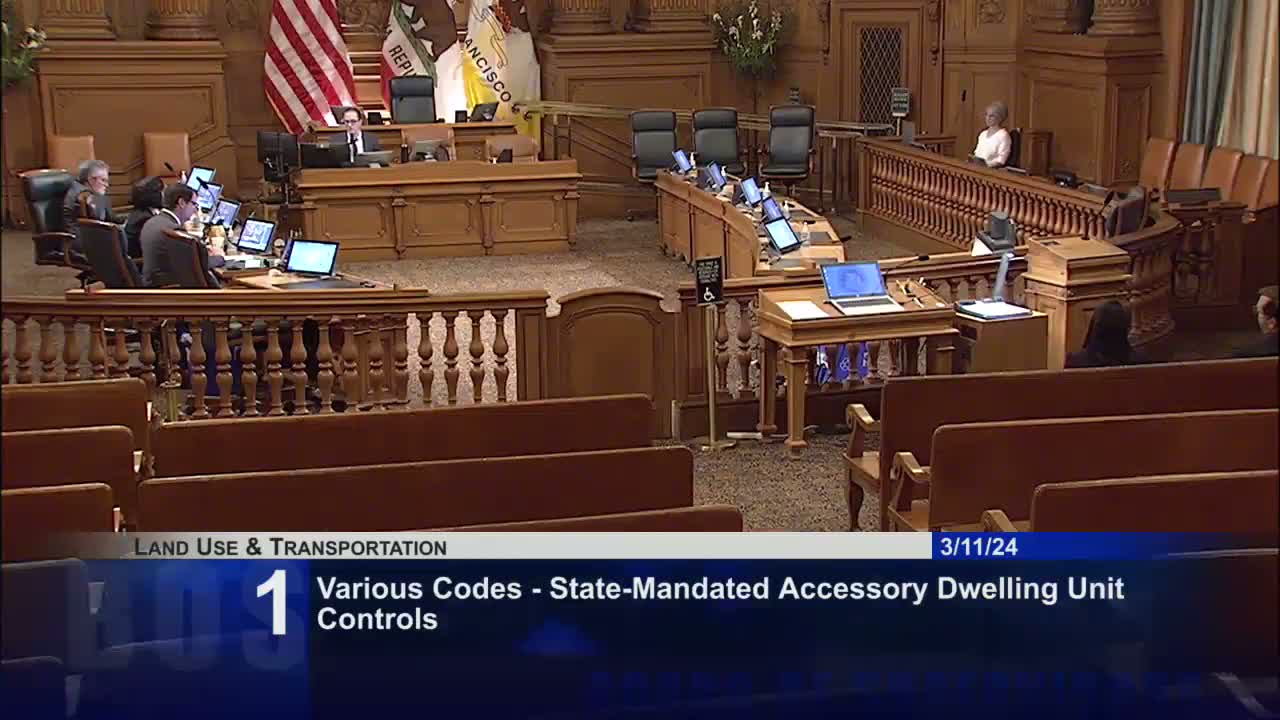
The Land Use and Transportation Committee of the San Francisco Board of Supervisors on March 11 unanimously voted to forward a planning-code corrections ordinance to the full Board that would fix several code errors, allow certain built elements to remain where Planning Department approvals were issued in error, and clarify program eligibilities.
Planning Department staff Audrey Marloney told the committee that the ordinance is sponsored by the Planning Commission and responds to cases in which two specific projects obtained approvals and installed elements that do not comply with the planning code because of Department error. "The planning department approved these permits in error and as such both projects built or installed, approved elements that do not actually meet the planning code," Marloney said. The ordinance would amend the planning code to allow those noncompliant elements to remain to avoid great expense to project sponsors.
Marloney also said the ordinance would modify an offset requirement for heights exceeding 30 feet in the Bernal Heights Special Use District, permit large movie-theater signage in the Japantown neighborhood commercial district, extend authority for medical cannabis dispensaries to continue operating as temporary cannabis retail uses until Dec. 31, 2024, and correct a zoning control table error. She described the package as intended to ensure the temporary-cannabis-retail and temporary reduction in inclusionary-housing programs operate consistently across city codes.
Chair Mirna Melgar asked whether there were questions and reported she had checked with Supervisor Ronan's office regarding height limits for the Bernal Heights SUD and that "everything is okay." The clerk reported there were no public speakers. Chair Melgar moved to forward the ordinance with a positive recommendation to the Board; Vice Chair Dean Preston and Member Erin Peskin voted "aye," the clerk recorded three ayes and the motion passed. The committee then adjourned.
Marloney said a minor nonsubstantive code correction was also included because it was discovered after an earlier code corrections ordinance was finalized. Planning staff said they appreciate the committee's support and are available for follow-up questions.
Planning Department staff Audrey Marloney told the committee that the ordinance is sponsored by the Planning Commission and responds to cases in which two specific projects obtained approvals and installed elements that do not comply with the planning code because of Department error. "The planning department approved these permits in error and as such both projects built or installed, approved elements that do not actually meet the planning code," Marloney said. The ordinance would amend the planning code to allow those noncompliant elements to remain to avoid great expense to project sponsors.
Marloney also said the ordinance would modify an offset requirement for heights exceeding 30 feet in the Bernal Heights Special Use District, permit large movie-theater signage in the Japantown neighborhood commercial district, extend authority for medical cannabis dispensaries to continue operating as temporary cannabis retail uses until Dec. 31, 2024, and correct a zoning control table error. She described the package as intended to ensure the temporary-cannabis-retail and temporary reduction in inclusionary-housing programs operate consistently across city codes.
Chair Mirna Melgar asked whether there were questions and reported she had checked with Supervisor Ronan's office regarding height limits for the Bernal Heights SUD and that "everything is okay." The clerk reported there were no public speakers. Chair Melgar moved to forward the ordinance with a positive recommendation to the Board; Vice Chair Dean Preston and Member Erin Peskin voted "aye," the clerk recorded three ayes and the motion passed. The committee then adjourned.
Marloney said a minor nonsubstantive code correction was also included because it was discovered after an earlier code corrections ordinance was finalized. Planning staff said they appreciate the committee's support and are available for follow-up questions.
View the Full Meeting & All Its Details
This article offers just a summary. Unlock complete video, transcripts, and insights as a Founder Member.
✓
Watch full, unedited meeting videos
✓
Search every word spoken in unlimited transcripts
✓
AI summaries & real-time alerts (all government levels)
✓
Permanent access to expanding government content
30-day money-back guarantee
