Supervisors press MTA for clearer timeline, unions and riders push for full restoration
November 04, 2021 | San Francisco County, California
This article was created by AI summarizing key points discussed. AI makes mistakes, so for full details and context, please refer to the video of the full meeting. Please report any errors so we can fix them. Report an error »
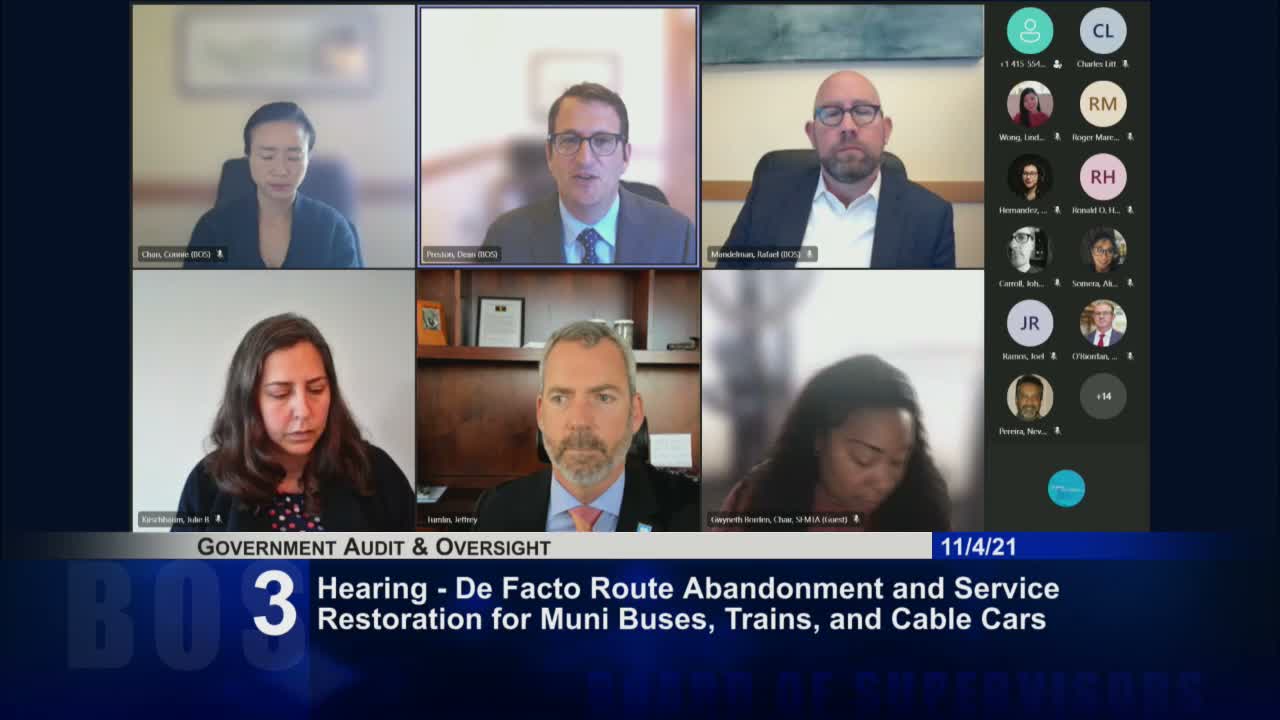
The Government Audit & Oversight Committee held a public hearing on Nov. 4, 2021 to examine the San Francisco Municipal Transportation Agency’s winter 2022 draft service restoration plan and the question of de facto route abandonment.
Chair Dean Preston framed the hearing around three goals: clarify the MTA’s recommended restorations, get clarity on plans beyond February 2022, and identify barriers (funding and operator availability). SFMTA leadership — Director of Transportation Jeff Tumlin and Director of Transit Julie Kirschbaum — presented a plan that restores many lines (examples cited included the 6 Parnassus at reduced frequency, the 43 Masonic to full route, and partial restorations for lines such as the 21 Hayes and the 31 Balboa) but leaves some corridors shortened or at lower frequency.
MTA emphasized two constraints: operator availability and the agency’s funding cliff. MTA said about 95% of employees are fully vaccinated but roughly 110 operators remained unavailable as they work through reasonable-accommodation processes; the agency also noted federal relief funds do not eliminate a structural deficit and the $29,000,000 from the Metropolitan Transportation Commission buys time but does not solve hiring-day-of shortages for the winter implementation.
TWU Local 250A representatives argued MTA’s approach risks pitting neighborhoods against neighborhoods and called for full restoration of services to pre-pandemic levels, saying operators are willing and able to staff additional runs and raising concerns about meeting-and-conferring practices for schedule changes. Union leaders also raised issues about cable-car run schedules and the San Francisco Charter’s protections for cable-car schedules.
Public commenters (dozens called in) overwhelmingly urged full restoration of pre-pandemic service — repeatedly naming the 21 Hayes, 31 Balboa, and J Church among priority lines — and many highlighted equity impacts on seniors, people with disabilities and low-income riders. Callers also criticized elements of MTA’s outreach as too digitally focused and urged deeper community engagement before permanent changes.
Supervisors pressed MTA for concrete cost estimates and a timeline to 100% restoration; MTA said it is working with the controller’s office to refine the revenue and cost picture and that hiring is being accelerated (operator class sizes to rise in January). The committee concluded by voting to continue the hearing to the call of the chair so MTA can supply more detailed cost projections, outreach plans and post‑pilot test data.
Chair Dean Preston framed the hearing around three goals: clarify the MTA’s recommended restorations, get clarity on plans beyond February 2022, and identify barriers (funding and operator availability). SFMTA leadership — Director of Transportation Jeff Tumlin and Director of Transit Julie Kirschbaum — presented a plan that restores many lines (examples cited included the 6 Parnassus at reduced frequency, the 43 Masonic to full route, and partial restorations for lines such as the 21 Hayes and the 31 Balboa) but leaves some corridors shortened or at lower frequency.
MTA emphasized two constraints: operator availability and the agency’s funding cliff. MTA said about 95% of employees are fully vaccinated but roughly 110 operators remained unavailable as they work through reasonable-accommodation processes; the agency also noted federal relief funds do not eliminate a structural deficit and the $29,000,000 from the Metropolitan Transportation Commission buys time but does not solve hiring-day-of shortages for the winter implementation.
TWU Local 250A representatives argued MTA’s approach risks pitting neighborhoods against neighborhoods and called for full restoration of services to pre-pandemic levels, saying operators are willing and able to staff additional runs and raising concerns about meeting-and-conferring practices for schedule changes. Union leaders also raised issues about cable-car run schedules and the San Francisco Charter’s protections for cable-car schedules.
Public commenters (dozens called in) overwhelmingly urged full restoration of pre-pandemic service — repeatedly naming the 21 Hayes, 31 Balboa, and J Church among priority lines — and many highlighted equity impacts on seniors, people with disabilities and low-income riders. Callers also criticized elements of MTA’s outreach as too digitally focused and urged deeper community engagement before permanent changes.
Supervisors pressed MTA for concrete cost estimates and a timeline to 100% restoration; MTA said it is working with the controller’s office to refine the revenue and cost picture and that hiring is being accelerated (operator class sizes to rise in January). The committee concluded by voting to continue the hearing to the call of the chair so MTA can supply more detailed cost projections, outreach plans and post‑pilot test data.
Don't Miss a Word: See the Full Meeting!
Go beyond summaries. Unlock every video, transcript, and key insight with a Founder Membership.
✓
Get instant access to full meeting videos
✓
Search and clip any phrase from complete transcripts
✓
Receive AI-powered summaries & custom alerts
✓
Enjoy lifetime, unrestricted access to government data
30-day money-back guarantee
