San Francisco readies to implement state Care Court; DPH warns capacity and staffing limits
September 29, 2023 | San Francisco County, California
This article was created by AI summarizing key points discussed. AI makes mistakes, so for full details and context, please refer to the video of the full meeting. Please report any errors so we can fix them. Report an error »
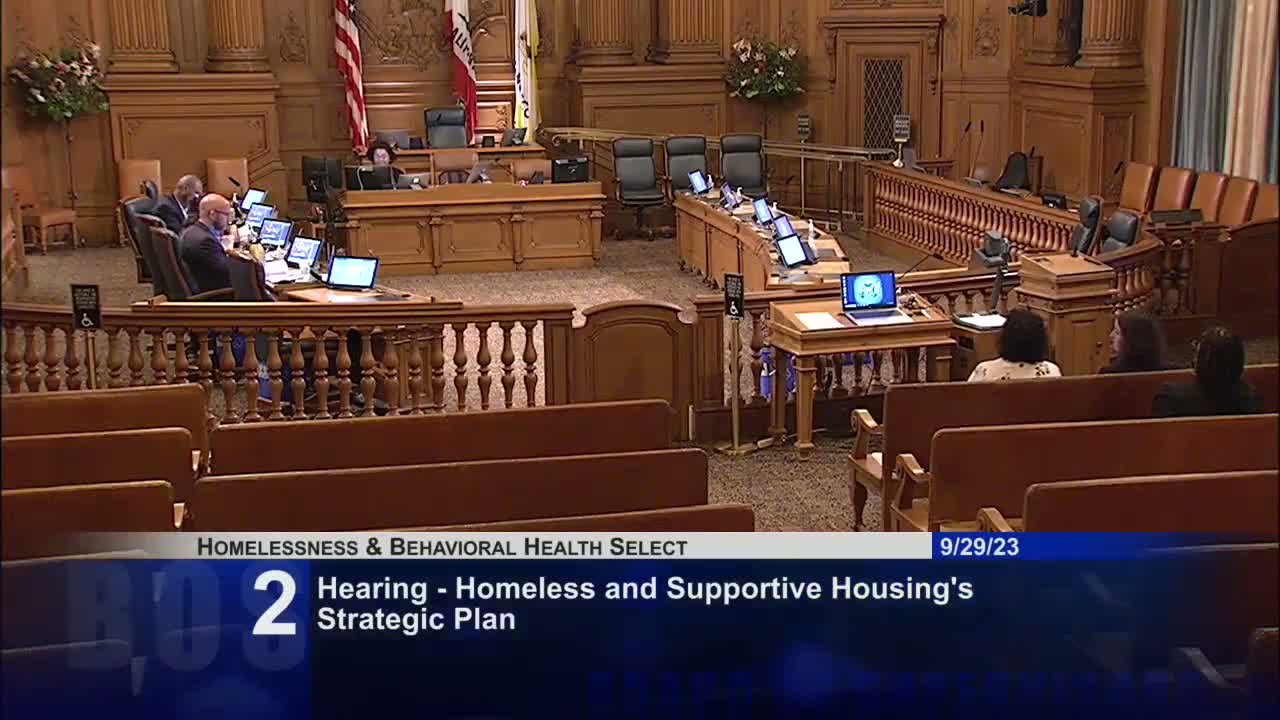
San Francisco officials told a Board of Supervisors select committee Sept. 29 they are prepared to begin receiving petitions under California’s new Care Court law (SB 1338) on Oct. 2, but cautioned that staffing and bed capacity may limit how many people the city can immediately serve.
Department of Public Health (DPH) presenters described Care Court as a civil‑court tool intended for people over 18 with schizophrenia‑spectrum or other psychotic disorders who are not engaged in voluntary treatment and are deteriorating in the community. The law allows a broad set of parties — family members, first responders, hospitals and treatment providers — to file petitions; DPH said it will review referrals, investigate cases, and in practice become the petitioner for cases the department advances to the Superior Court.
DPH said it used multiple methods to estimate the eligible population and produced a midrange estimate of 1,000–2,000 people who may meet criteria in San Francisco, though DPH emphasized that not all eligible cases will result in filed petitions. The department also noted important operational constraints: the process from petition to court order can take months, and Care Court requires repeated notices and hearings that can be difficult when prospective respondents are transient or unhoused.
DPH also described a $32 million state bridge‑housing grant over four years intended to increase short‑term placements (emergency stabilization, boarding care, non‑congregate shelter and transitional housing) prioritized for Care Court participants. The department said the grant cannot be used for permanent supportive housing; it is intended for temporary or transitional placements and to expand navigation, outreach and clinical capacity.
Panelists and supervisors discussed practical implementation questions: how petitions filed by first responders would be triaged, whether the department can distinguish which cases belong in Care Court versus assisted outpatient treatment or conservatorship, and how to ensure continuity of care. Supervisors asked for a return report after several months; the committee voted unanimously to continue the item to the call of the chair and requested a 4–6 month implementation report to evaluate how the tool is functioning and what state legislative changes might be advisable.
DPH said it will monitor petitions, triage cases, and provide regular feedback to the state as a cohort‑1 jurisdiction implementing the program.
Department of Public Health (DPH) presenters described Care Court as a civil‑court tool intended for people over 18 with schizophrenia‑spectrum or other psychotic disorders who are not engaged in voluntary treatment and are deteriorating in the community. The law allows a broad set of parties — family members, first responders, hospitals and treatment providers — to file petitions; DPH said it will review referrals, investigate cases, and in practice become the petitioner for cases the department advances to the Superior Court.
DPH said it used multiple methods to estimate the eligible population and produced a midrange estimate of 1,000–2,000 people who may meet criteria in San Francisco, though DPH emphasized that not all eligible cases will result in filed petitions. The department also noted important operational constraints: the process from petition to court order can take months, and Care Court requires repeated notices and hearings that can be difficult when prospective respondents are transient or unhoused.
DPH also described a $32 million state bridge‑housing grant over four years intended to increase short‑term placements (emergency stabilization, boarding care, non‑congregate shelter and transitional housing) prioritized for Care Court participants. The department said the grant cannot be used for permanent supportive housing; it is intended for temporary or transitional placements and to expand navigation, outreach and clinical capacity.
Panelists and supervisors discussed practical implementation questions: how petitions filed by first responders would be triaged, whether the department can distinguish which cases belong in Care Court versus assisted outpatient treatment or conservatorship, and how to ensure continuity of care. Supervisors asked for a return report after several months; the committee voted unanimously to continue the item to the call of the chair and requested a 4–6 month implementation report to evaluate how the tool is functioning and what state legislative changes might be advisable.
DPH said it will monitor petitions, triage cases, and provide regular feedback to the state as a cohort‑1 jurisdiction implementing the program.
Don't Miss a Word: See the Full Meeting!
Go beyond summaries. Unlock every video, transcript, and key insight with a Founder Membership.
✓
Get instant access to full meeting videos
✓
Search and clip any phrase from complete transcripts
✓
Receive AI-powered summaries & custom alerts
✓
Enjoy lifetime, unrestricted access to government data
30-day money-back guarantee
