Supervisors urge Superior Court to prioritize criminal trials as public defenders warn of prolonged pretrial incarceration
December 02, 2021 | San Francisco County, California
This article was created by AI summarizing key points discussed. AI makes mistakes, so for full details and context, please refer to the video of the full meeting. Please report any errors so we can fix them. Report an error »
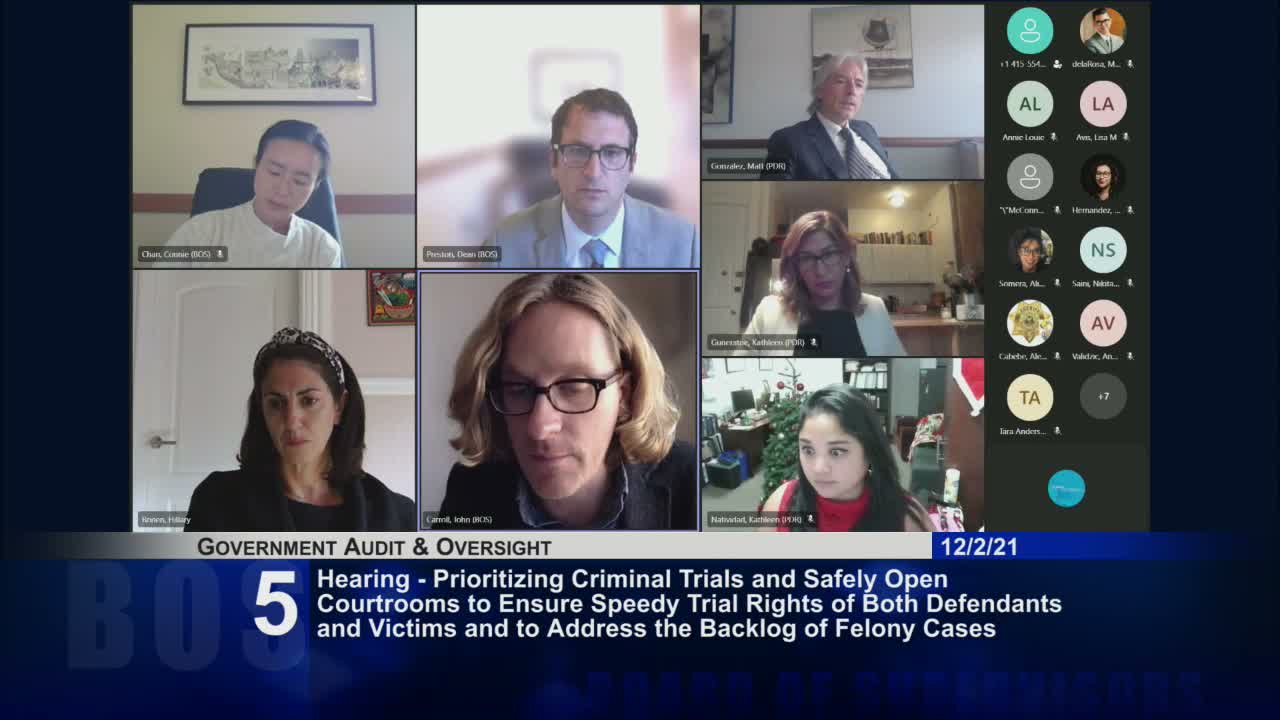
The Government Audit and Oversight Committee on Dec. 2 took up a hearing and resolution urging the San Francisco Superior Court to prioritize criminal trials and safely open more courtrooms to address a backlog of cases and people held past statutory speedy‑trial deadlines.
Supervisor Hillary Ronan, who led the hearing, described the backlog as a crisis, saying the court "cannot use [the pandemic] as an excuse" and urging local branches of government to work with the court to find space and resources to hold more criminal trials. Ronan noted the chief judge declined an invitation to participate in the hearing.
Public Defender Office representatives detailed human costs and racial disparities tied to the backlog. Kathleen Punarotne and Deputy Public Defender Kathleen Natividad described roughly 451 cases that have passed statutory trial deadlines and about 218 people currently in custody past those deadlines, asserting the backlog disproportionately affects Black residents. Natividad recounted a client who spent 259 days in custody and was acquitted after a two‑day trial, saying the delay had harmed the client’s family and health.
The Public Defender’s office urged several remedies: enforce Penal Code §1382 speedy‑trial requirements, reassign general civil courtrooms (including the Civic Center Courthouse) to criminal matters, use alternative venues such as the War Memorial Building or other city facilities for spillover criminal trials, and better coordinate with the Sheriff for security and staffing.
Chief Assistant District Attorney Marshall Klein told the committee the DA’s Office has worked with justice partners to limit jail populations for public‑health reasons and has prioritized custody cases where possible; Klein said the court and offices have cleared some backlog in recent months but noted administrative and staffing challenges that complicate rapid scaling of trials.
Sheriff’s Chief Kevin McConnell said the Civic Center Courthouse was configured for civil trials and not for in‑custody criminal trials: it has three holding cells and would require security upgrades, additional staff and some infrastructure changes. McConnell said the last comprehensive assessment dated from 2014 and that significant staffing and facility work would be needed to repurpose sites for long‑term criminal trial use.
Public comment featured multiple public defenders and callers who described clients held many months beyond statutory deadlines and reiterated that the city has unused courtrooms currently assigned to civil matters. Julie Tron of the Bar Association urged supervisors to work directly with the sheriff to inspect facilities and identify practical steps to expand courtroom capacity.
Supervisor Ronan moved to continue the hearing to the call of the chair so officials could follow up; the committee approved the continuance. The committee also approved forwarding the resolution as amended — changing the directive to emphasize prioritizing criminal trials over "non urgent civil cases" — to the full Board of Supervisors with a positive recommendation (recorded: 3 ayes). The committee said it will press the court to engage and pursue follow‑up meetings with justice partners and that staff will seek facility assessments and staffing cost estimates.
The resolution urges the Superior Court to prioritize assignment of criminal trials, use alternative venues and provide progress updates to the Board; it does not compel the court but forms a formal request and an expression of the Board’s oversight concern.
Supervisor Hillary Ronan, who led the hearing, described the backlog as a crisis, saying the court "cannot use [the pandemic] as an excuse" and urging local branches of government to work with the court to find space and resources to hold more criminal trials. Ronan noted the chief judge declined an invitation to participate in the hearing.
Public Defender Office representatives detailed human costs and racial disparities tied to the backlog. Kathleen Punarotne and Deputy Public Defender Kathleen Natividad described roughly 451 cases that have passed statutory trial deadlines and about 218 people currently in custody past those deadlines, asserting the backlog disproportionately affects Black residents. Natividad recounted a client who spent 259 days in custody and was acquitted after a two‑day trial, saying the delay had harmed the client’s family and health.
The Public Defender’s office urged several remedies: enforce Penal Code §1382 speedy‑trial requirements, reassign general civil courtrooms (including the Civic Center Courthouse) to criminal matters, use alternative venues such as the War Memorial Building or other city facilities for spillover criminal trials, and better coordinate with the Sheriff for security and staffing.
Chief Assistant District Attorney Marshall Klein told the committee the DA’s Office has worked with justice partners to limit jail populations for public‑health reasons and has prioritized custody cases where possible; Klein said the court and offices have cleared some backlog in recent months but noted administrative and staffing challenges that complicate rapid scaling of trials.
Sheriff’s Chief Kevin McConnell said the Civic Center Courthouse was configured for civil trials and not for in‑custody criminal trials: it has three holding cells and would require security upgrades, additional staff and some infrastructure changes. McConnell said the last comprehensive assessment dated from 2014 and that significant staffing and facility work would be needed to repurpose sites for long‑term criminal trial use.
Public comment featured multiple public defenders and callers who described clients held many months beyond statutory deadlines and reiterated that the city has unused courtrooms currently assigned to civil matters. Julie Tron of the Bar Association urged supervisors to work directly with the sheriff to inspect facilities and identify practical steps to expand courtroom capacity.
Supervisor Ronan moved to continue the hearing to the call of the chair so officials could follow up; the committee approved the continuance. The committee also approved forwarding the resolution as amended — changing the directive to emphasize prioritizing criminal trials over "non urgent civil cases" — to the full Board of Supervisors with a positive recommendation (recorded: 3 ayes). The committee said it will press the court to engage and pursue follow‑up meetings with justice partners and that staff will seek facility assessments and staffing cost estimates.
The resolution urges the Superior Court to prioritize assignment of criminal trials, use alternative venues and provide progress updates to the Board; it does not compel the court but forms a formal request and an expression of the Board’s oversight concern.
Don't Miss a Word: See the Full Meeting!
Go beyond summaries. Unlock every video, transcript, and key insight with a Founder Membership.
✓
Get instant access to full meeting videos
✓
Search and clip any phrase from complete transcripts
✓
Receive AI-powered summaries & custom alerts
✓
Enjoy lifetime, unrestricted access to government data
30-day money-back guarantee
