Supervisors press PUC and DPW after Castro residents lose driveway access during pipe work
January 06, 2022 | San Francisco County, California
This article was created by AI summarizing key points discussed. AI makes mistakes, so for full details and context, please refer to the video of the full meeting. Please report any errors so we can fix them. Report an error »
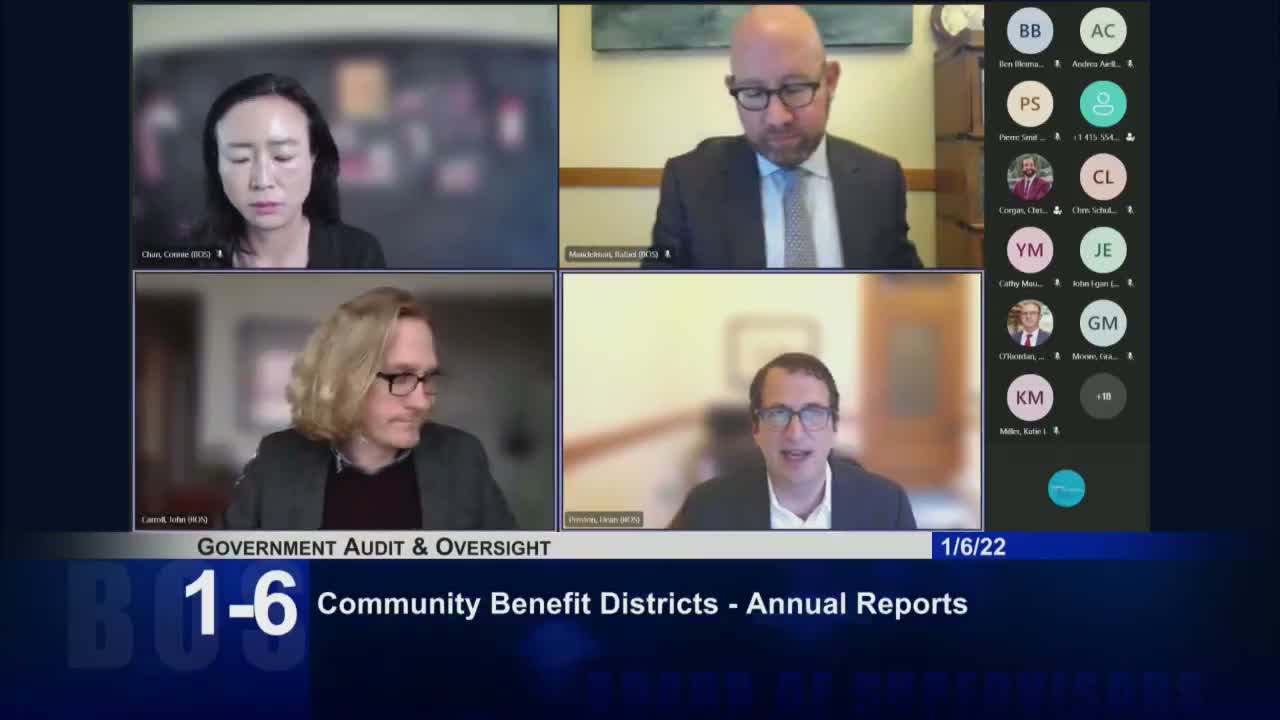
Supervisor Rafael Mandelmann opened a Feb. 6 Government Audit & Oversight Committee hearing to examine how the city notifies residents about infrastructure work after multiple Castro Street neighbors reported being unable to access driveways for days during a sewer and water main replacement project.
Mandelmann said a Sept. 17 contractor notice (vetted by the Public Utilities Commission) indicated steel plates would maintain driveway access, but in practice some residents were cut off from garages or driveways for up to 10 days. "This led residents to believe that while there might be some disruption ... they would still have access to their driveways and sidewalks throughout the duration of the project," Mandelmann said, and he described constituent reports of significant hardship and unexpected expense.
Jeremy Spitz, presenting for the San Francisco Public Utilities Commission, reviewed the project goals (replace aging pipes installed in the late 19th–early 20th century and install seismically stronger infrastructure) and the outreach rules that guide excavation work (Public Works Code Article 2.4 and Public Works Order 1187005). He said the written outreach process requires a contractor 30‑day mailed notice and a 10‑day mailed or hand‑delivered notice, and PUC specifications require contractors to vet mailing lists and notice content with PUC construction management and communications. Spitz acknowledged a failure in this case: the contractor mailed a 10‑day notice that had not been submitted to PUC for review and contained vague language about driveway impacts. Spitz said PUC and the contractor met on site after complaints surfaced and implemented operational mitigations, including a revised pour sequence to allow use of steel plates for most nights and weekends and, in some cases, opening concrete earlier than typical. "Concrete normally needs to cure for 7 to 10 days, but we did take a risk to open the concrete street to local access after 1 or 2 days, to mitigate the impacts on the residents," Spitz said.
Spitz also told the committee that PUC added a communication change: in addition to the contractor’s 30‑ and 10‑day notices, PUC Communications now issues an additional two‑week and 24‑hour notice when driveway restrictions are expected for more than one day.
Brian Dahl of Public Works described DPW’s outreach and review practices, noting formal reviews at design milestones, a DPW‑issued 14‑day mailed notice in addition to contractor mailings, web pages, Nextdoor postings and an opt‑in email list for residents who want regular updates. DPW said it reviews contractor notices before distribution to prevent misleading language and performs in‑person corridor outreach to merchants and door‑hanger notices for imminent restricted access.
Supervisors focused questions on whether PUC will bake the additional two‑week/24‑hour requirement into future contract templates and whether past contractor performance can meaningfully influence award decisions under low‑bid rules. Spitz said PUC intends to add the requirement to contract templates and pointed to recent steps to include safety prequalification in bid evaluations; he also said that prime contractors choose subs but DBI/contract managers perform lessons‑learned reviews before future contracts.
Vice Chair Connie Chan asked whether penalty clauses exist for oversight failures; Spitz said a range of penalties is available but usually reserved for egregious violations and that PUC would provide specifics in follow‑up. Public comment included a single caller urging focus on prime contractors and subcontracting patterns.
Supervisor Mandelmann moved to file the hearing record; the motion passed by roll call (Chan — Aye; Mandelmann — Aye; Preston — Aye). PUC and DPW committed to follow up with specifics on penalty language, contract‑template changes and how the new notice practice will be sustained across relevant projects.
Mandelmann said a Sept. 17 contractor notice (vetted by the Public Utilities Commission) indicated steel plates would maintain driveway access, but in practice some residents were cut off from garages or driveways for up to 10 days. "This led residents to believe that while there might be some disruption ... they would still have access to their driveways and sidewalks throughout the duration of the project," Mandelmann said, and he described constituent reports of significant hardship and unexpected expense.
Jeremy Spitz, presenting for the San Francisco Public Utilities Commission, reviewed the project goals (replace aging pipes installed in the late 19th–early 20th century and install seismically stronger infrastructure) and the outreach rules that guide excavation work (Public Works Code Article 2.4 and Public Works Order 1187005). He said the written outreach process requires a contractor 30‑day mailed notice and a 10‑day mailed or hand‑delivered notice, and PUC specifications require contractors to vet mailing lists and notice content with PUC construction management and communications. Spitz acknowledged a failure in this case: the contractor mailed a 10‑day notice that had not been submitted to PUC for review and contained vague language about driveway impacts. Spitz said PUC and the contractor met on site after complaints surfaced and implemented operational mitigations, including a revised pour sequence to allow use of steel plates for most nights and weekends and, in some cases, opening concrete earlier than typical. "Concrete normally needs to cure for 7 to 10 days, but we did take a risk to open the concrete street to local access after 1 or 2 days, to mitigate the impacts on the residents," Spitz said.
Spitz also told the committee that PUC added a communication change: in addition to the contractor’s 30‑ and 10‑day notices, PUC Communications now issues an additional two‑week and 24‑hour notice when driveway restrictions are expected for more than one day.
Brian Dahl of Public Works described DPW’s outreach and review practices, noting formal reviews at design milestones, a DPW‑issued 14‑day mailed notice in addition to contractor mailings, web pages, Nextdoor postings and an opt‑in email list for residents who want regular updates. DPW said it reviews contractor notices before distribution to prevent misleading language and performs in‑person corridor outreach to merchants and door‑hanger notices for imminent restricted access.
Supervisors focused questions on whether PUC will bake the additional two‑week/24‑hour requirement into future contract templates and whether past contractor performance can meaningfully influence award decisions under low‑bid rules. Spitz said PUC intends to add the requirement to contract templates and pointed to recent steps to include safety prequalification in bid evaluations; he also said that prime contractors choose subs but DBI/contract managers perform lessons‑learned reviews before future contracts.
Vice Chair Connie Chan asked whether penalty clauses exist for oversight failures; Spitz said a range of penalties is available but usually reserved for egregious violations and that PUC would provide specifics in follow‑up. Public comment included a single caller urging focus on prime contractors and subcontracting patterns.
Supervisor Mandelmann moved to file the hearing record; the motion passed by roll call (Chan — Aye; Mandelmann — Aye; Preston — Aye). PUC and DPW committed to follow up with specifics on penalty language, contract‑template changes and how the new notice practice will be sustained across relevant projects.
Don't Miss a Word: See the Full Meeting!
Go beyond summaries. Unlock every video, transcript, and key insight with a Founder Membership.
✓
Get instant access to full meeting videos
✓
Search and clip any phrase from complete transcripts
✓
Receive AI-powered summaries & custom alerts
✓
Enjoy lifetime, unrestricted access to government data
30-day money-back guarantee
