Committee hears plastic pollution breakdown, recycling limits and reuse pilots; hearing filed
March 17, 2022 | San Francisco County, California
This article was created by AI summarizing key points discussed. AI makes mistakes, so for full details and context, please refer to the video of the full meeting. Please report any errors so we can fix them. Report an error »
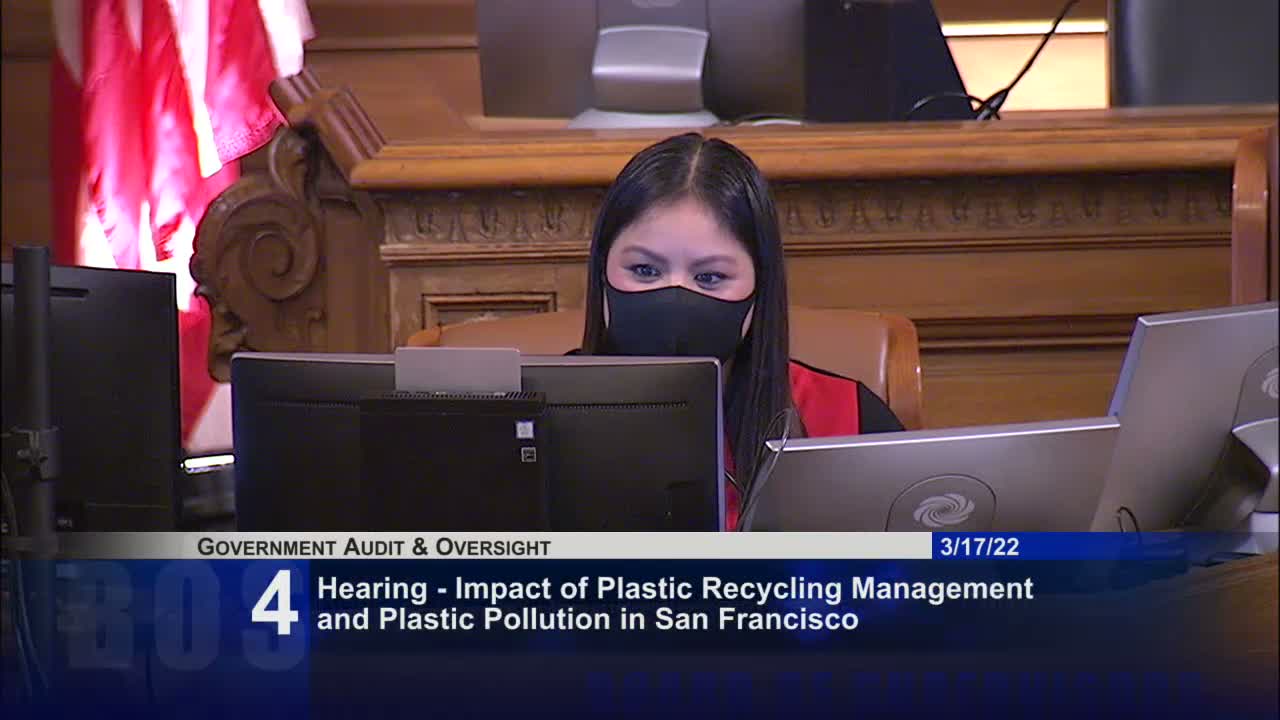
Item 4 brought expert presentations and public comment on plastic recycling management and plastic pollution in San Francisco. Jamario Jackson of Recology explained how household sorting affects contamination of recycling streams, noted limits in processing small single-use and film plastics, and described the company's commitment to stop exports of low-grade plastics received after Jan. 1, 2021.
Recology summarized a material characterization (two-week sample extrapolated to an annual estimate) indicating roughly 15% of trash collected in San Francisco is plastic and that about 20% of every ton entering processing is unsortable or unsellable and goes to landfill. Recology representatives said roughly 32.4% of the processing-derived landfill residual is plastic and gave an annual estimate in the transcript of about 8,000 to 10,000 tons in one stream and just under 15,000 tons per year across combined streams (numbers given as estimates in the presentation).
Brian Dahl of Public Works described street environmental services: approximately 350 staff, a bureau budget near $110 million and more than 10,000 monthly service requests. Jack Macy of the Department of Environment framed the issue as both an upstream production problem and a downstream waste-management one, described San Francisco's history of bans (polystyrene, plastic bag policies) and highlighted current pilot efforts to encourage reusables, including technical assistance for takeout businesses and private initiatives such as Dispatch Goods.
Public commenters (Save the Bay and Jobs with Justice) urged stronger producer responsibility, limits on shipping materials and an equitable corporate-targeted plastic tax that would generate revenue for climate and workforce investments. After testimony, Vice Chair Chan moved to file the hearing; the committee voted to file the item.
Recology summarized a material characterization (two-week sample extrapolated to an annual estimate) indicating roughly 15% of trash collected in San Francisco is plastic and that about 20% of every ton entering processing is unsortable or unsellable and goes to landfill. Recology representatives said roughly 32.4% of the processing-derived landfill residual is plastic and gave an annual estimate in the transcript of about 8,000 to 10,000 tons in one stream and just under 15,000 tons per year across combined streams (numbers given as estimates in the presentation).
Brian Dahl of Public Works described street environmental services: approximately 350 staff, a bureau budget near $110 million and more than 10,000 monthly service requests. Jack Macy of the Department of Environment framed the issue as both an upstream production problem and a downstream waste-management one, described San Francisco's history of bans (polystyrene, plastic bag policies) and highlighted current pilot efforts to encourage reusables, including technical assistance for takeout businesses and private initiatives such as Dispatch Goods.
Public commenters (Save the Bay and Jobs with Justice) urged stronger producer responsibility, limits on shipping materials and an equitable corporate-targeted plastic tax that would generate revenue for climate and workforce investments. After testimony, Vice Chair Chan moved to file the hearing; the committee voted to file the item.
Don't Miss a Word: See the Full Meeting!
Go beyond summaries. Unlock every video, transcript, and key insight with a Founder Membership.
✓
Get instant access to full meeting videos
✓
Search and clip any phrase from complete transcripts
✓
Receive AI-powered summaries & custom alerts
✓
Enjoy lifetime, unrestricted access to government data
30-day money-back guarantee
