Board committee questions mayor’s office and SFPD on taxpayer‑funded communications about policing
May 05, 2022 | San Francisco County, California
This article was created by AI summarizing key points discussed. AI makes mistakes, so for full details and context, please refer to the video of the full meeting. Please report any errors so we can fix them. Report an error »
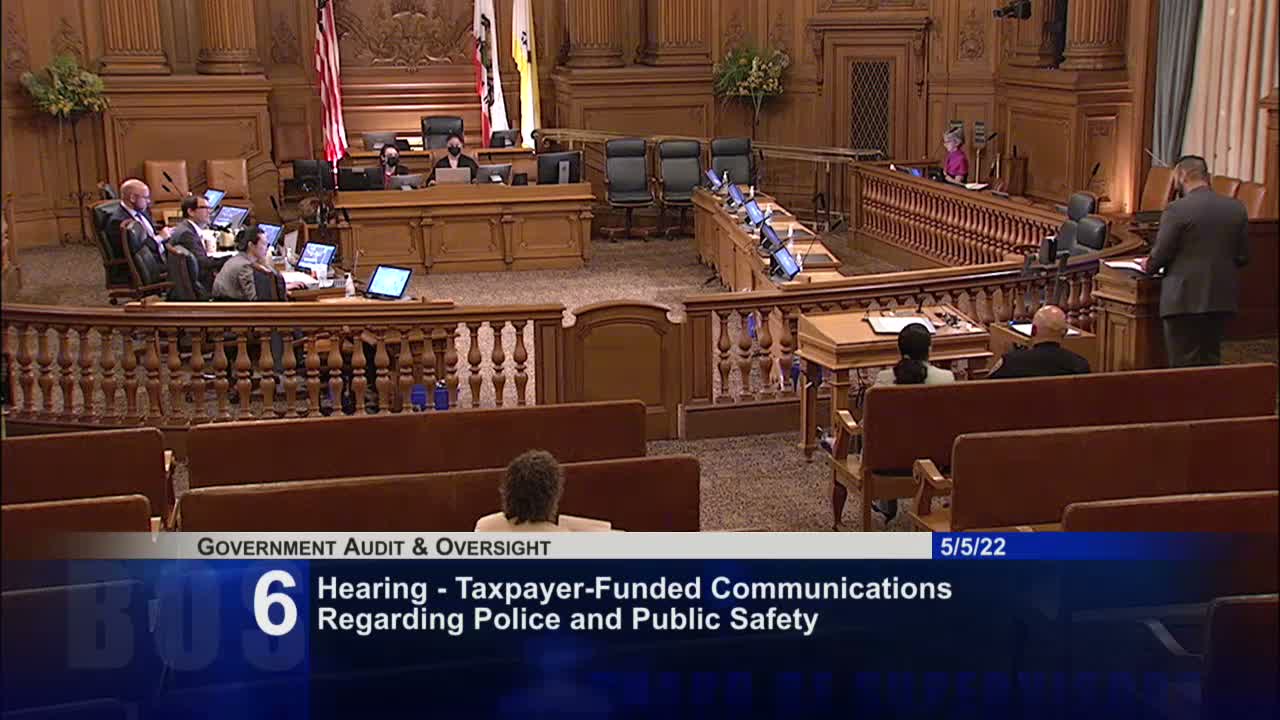
The Government Audit and Oversight Committee held a hearing May 5 to examine how the City of San Francisco spends public money on communications about policing and public safety, whether those communications are governed by written policies, and whether they shape public narratives and funding priorities.
Chair Supervisor Dean Preston framed the review as an examination of "taxpayer‑funded communications" the city uses to convey information about crime and public safety. Tom Paulino, mayoral liaison to the Board, told the committee the mayor’s Office of Communications coordinates with public safety departments on urgent incidents and mayoral priorities, has an approximate $1.3 million annual budget and eight full‑time communications staff, currently has no outside PR contracts and — he said — does not have documented internal policies governing what the office highlights.
Assistant Chief Bob Moser, chief of staff for the San Francisco Police Department, said SFPD’s Strategic Communications & Media Relations unit handles incident information, press events and public records requests; the unit is budgeted for nine positions (eight filled at the time) with an approximate FY cost of $1.6 million. Moser said the unit seeks transparency and that public‑facing communications serve a community‑relations purpose, but acknowledged the department can do more to address racial‑disparity concerns directly in public messaging.
Alec Karakatsanis, executive director of Civil Rights Corps, told the committee the combined communications output from police and some media outlets has narrowed public conversations about harm, amplified certain street crimes and built a sense of crisis that can justify expanded policing and surveillance budgets. He urged the city to focus on root causes such as housing and health and warned that repeated messaging claiming San Francisco is a national model for reform can obscure persistent racial disparities in stops and use of force.
The hearing drew extensive public comment. Dozens of callers expressed sharply divided views: many urged reduced police spending and greater investment in housing, mental health and social services and criticized SFPD and the mayor’s office for selective messaging; others described personal experiences of crime and urged support for police and first responders. Multiple callers reported frustrations with Public Records Act requests to SFPD.
Chair Preston concluded that the hearing showed both omissions (for example, the committee noted that press releases often highlight reform success but do not mention persistent racial disparities or low clearance rates) and an absence of written mayoral communications policies; he said he hopes the mayor’s office will develop formal policies and that further oversight will continue. The committee voted to file the hearing record for its oversight file.
What the record shows: Mayor’s Office — reported staffing and budget, no external PR contracts and no written communications policy; SFPD — reported a media relations staff and budget, and acknowledged opportunities to address disparity issues more directly in public materials; outside expert — alleged strategic narrative work seeks to expand policing budgets and to narrow public focus away from other harms.
Next steps: The committee filed the hearing and signaled interest in follow‑up oversight, including development of written policies and better public accounting of communications practices.
Chair Supervisor Dean Preston framed the review as an examination of "taxpayer‑funded communications" the city uses to convey information about crime and public safety. Tom Paulino, mayoral liaison to the Board, told the committee the mayor’s Office of Communications coordinates with public safety departments on urgent incidents and mayoral priorities, has an approximate $1.3 million annual budget and eight full‑time communications staff, currently has no outside PR contracts and — he said — does not have documented internal policies governing what the office highlights.
Assistant Chief Bob Moser, chief of staff for the San Francisco Police Department, said SFPD’s Strategic Communications & Media Relations unit handles incident information, press events and public records requests; the unit is budgeted for nine positions (eight filled at the time) with an approximate FY cost of $1.6 million. Moser said the unit seeks transparency and that public‑facing communications serve a community‑relations purpose, but acknowledged the department can do more to address racial‑disparity concerns directly in public messaging.
Alec Karakatsanis, executive director of Civil Rights Corps, told the committee the combined communications output from police and some media outlets has narrowed public conversations about harm, amplified certain street crimes and built a sense of crisis that can justify expanded policing and surveillance budgets. He urged the city to focus on root causes such as housing and health and warned that repeated messaging claiming San Francisco is a national model for reform can obscure persistent racial disparities in stops and use of force.
The hearing drew extensive public comment. Dozens of callers expressed sharply divided views: many urged reduced police spending and greater investment in housing, mental health and social services and criticized SFPD and the mayor’s office for selective messaging; others described personal experiences of crime and urged support for police and first responders. Multiple callers reported frustrations with Public Records Act requests to SFPD.
Chair Preston concluded that the hearing showed both omissions (for example, the committee noted that press releases often highlight reform success but do not mention persistent racial disparities or low clearance rates) and an absence of written mayoral communications policies; he said he hopes the mayor’s office will develop formal policies and that further oversight will continue. The committee voted to file the hearing record for its oversight file.
What the record shows: Mayor’s Office — reported staffing and budget, no external PR contracts and no written communications policy; SFPD — reported a media relations staff and budget, and acknowledged opportunities to address disparity issues more directly in public materials; outside expert — alleged strategic narrative work seeks to expand policing budgets and to narrow public focus away from other harms.
Next steps: The committee filed the hearing and signaled interest in follow‑up oversight, including development of written policies and better public accounting of communications practices.
Don't Miss a Word: See the Full Meeting!
Go beyond summaries. Unlock every video, transcript, and key insight with a Founder Membership.
✓
Get instant access to full meeting videos
✓
Search and clip any phrase from complete transcripts
✓
Receive AI-powered summaries & custom alerts
✓
Enjoy lifetime, unrestricted access to government data
30-day money-back guarantee
