City staff warn of billions‑dollar annual funding gap to meet upcoming RHNA affordable‑housing goals
May 19, 2022 | San Francisco County, California
This article was created by AI summarizing key points discussed. AI makes mistakes, so for full details and context, please refer to the video of the full meeting. Please report any errors so we can fix them. Report an error »
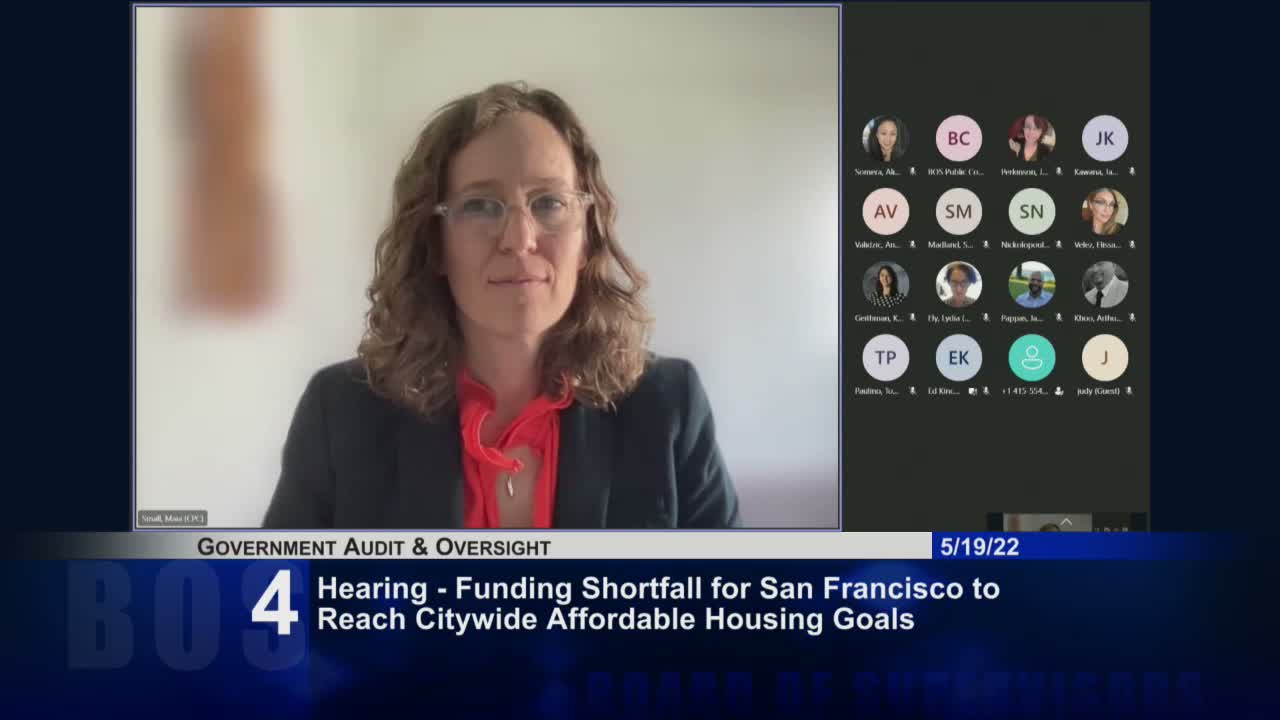
San Francisco — City planning and housing officials told the Government Audit and Oversight Committee that the local funding needed to meet new regional housing needs assessment (RHNA) targets will be far larger than existing revenue streams can support, placing unprecedented pressure on municipal, state and federal funding systems.
Maya Small of the Planning Department summarized changes to the city’s housing element and the scale of new unit goals, noting the next RHNA cycle will nearly triple prior targets. Lydia Ealy of the Mayor’s Office of Housing and Community Development (MOHCD) described funding mechanics for affordable multifamily development: federal Low Income Housing Tax Credits, tax-exempt private activity bonds and state competitive allocations remain central but are now highly competitive; locally, the city relies on inclusionary and linkage fees, general obligation bonds and the housing trust fund — each of which is volatile or constrained.
MOHCD presented a model (slide 19) showing an estimated local funding gap beginning in 2023 of roughly $1.3 billion a year after projecting available local funds and required spending to meet new goals; MOHCD and Planning officials emphasized that the figure depends on whether anticipated state and federal leverage is available and that the city’s ability to move projects depends on that leverage.
Supervisors pressed for up‑to‑date figures for recent fiscal years (2020–2022), a clearer inventory of uncommitted housing funds, and a roster of projects currently in MOHCD’s pipeline to validate the gap. Officials acknowledged pandemic-era disruptions and the need to update earlier estimates; they committed to providing revised, itemized data on funds committed, expended and unencumbered.
Staff described advocacy strategies to increase California bond and tax-credit allocations for Bay Area projects (advocating scoring changes at CDLAC and for state tax‑credit rules that recognize deeper affordability, prevailing wage and higher local costs) and urged local creativity (new revenue tools, voter support for bonds, Prop I allocation). Dozens of public commenters — labor groups, community housing advocates and members of the Housing Stability Fund Oversight Board — urged the City to program Prop I funds, consider an empty‑homes tax, minimize reliance on volatile fee revenue and build capacity for community developers.
Why it matters: The RHNA increase and the state’s redesigned competitive allocation systems introduce sustained new demands for subsidy funding. Without local revenue and better access to state/federal allocations, San Francisco is unlikely to meet state housing element and RHNA targets while preventing displacement and serving extremely low‑income households.
What’s next: Planning and MOHCD will update the funding‑gap figures, provide detailed year‑by‑year funding and pipeline data, and return with recommendations on local funding tools and advocacy steps; the committee continued the hearing to the call of the chair.
Maya Small of the Planning Department summarized changes to the city’s housing element and the scale of new unit goals, noting the next RHNA cycle will nearly triple prior targets. Lydia Ealy of the Mayor’s Office of Housing and Community Development (MOHCD) described funding mechanics for affordable multifamily development: federal Low Income Housing Tax Credits, tax-exempt private activity bonds and state competitive allocations remain central but are now highly competitive; locally, the city relies on inclusionary and linkage fees, general obligation bonds and the housing trust fund — each of which is volatile or constrained.
MOHCD presented a model (slide 19) showing an estimated local funding gap beginning in 2023 of roughly $1.3 billion a year after projecting available local funds and required spending to meet new goals; MOHCD and Planning officials emphasized that the figure depends on whether anticipated state and federal leverage is available and that the city’s ability to move projects depends on that leverage.
Supervisors pressed for up‑to‑date figures for recent fiscal years (2020–2022), a clearer inventory of uncommitted housing funds, and a roster of projects currently in MOHCD’s pipeline to validate the gap. Officials acknowledged pandemic-era disruptions and the need to update earlier estimates; they committed to providing revised, itemized data on funds committed, expended and unencumbered.
Staff described advocacy strategies to increase California bond and tax-credit allocations for Bay Area projects (advocating scoring changes at CDLAC and for state tax‑credit rules that recognize deeper affordability, prevailing wage and higher local costs) and urged local creativity (new revenue tools, voter support for bonds, Prop I allocation). Dozens of public commenters — labor groups, community housing advocates and members of the Housing Stability Fund Oversight Board — urged the City to program Prop I funds, consider an empty‑homes tax, minimize reliance on volatile fee revenue and build capacity for community developers.
Why it matters: The RHNA increase and the state’s redesigned competitive allocation systems introduce sustained new demands for subsidy funding. Without local revenue and better access to state/federal allocations, San Francisco is unlikely to meet state housing element and RHNA targets while preventing displacement and serving extremely low‑income households.
What’s next: Planning and MOHCD will update the funding‑gap figures, provide detailed year‑by‑year funding and pipeline data, and return with recommendations on local funding tools and advocacy steps; the committee continued the hearing to the call of the chair.
Don't Miss a Word: See the Full Meeting!
Go beyond summaries. Unlock every video, transcript, and key insight with a Founder Membership.
✓
Get instant access to full meeting videos
✓
Search and clip any phrase from complete transcripts
✓
Receive AI-powered summaries & custom alerts
✓
Enjoy lifetime, unrestricted access to government data
30-day money-back guarantee
