San Francisco committee votes to send ordinance implementing SB 1383 edible‑food recovery to full board
June 02, 2022 | San Francisco County, California
This article was created by AI summarizing key points discussed. AI makes mistakes, so for full details and context, please refer to the video of the full meeting. Please report any errors so we can fix them. Report an error »
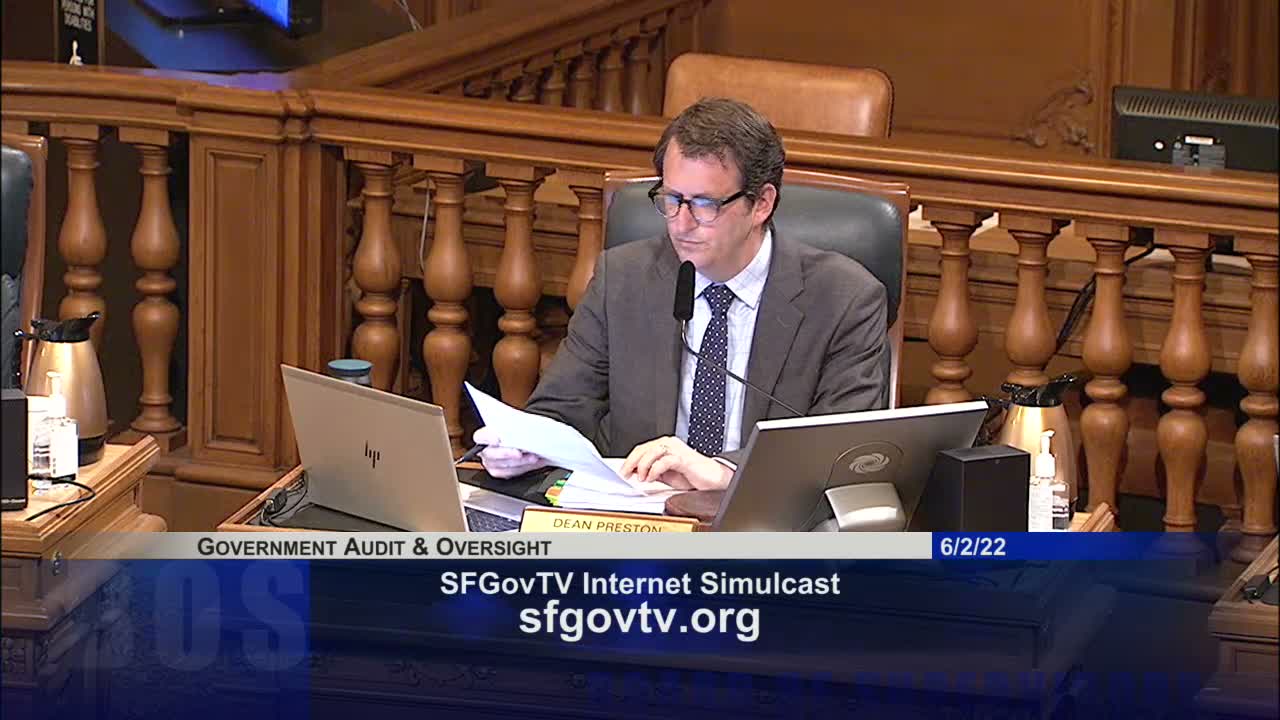
San Francisco’s Government Audit & Oversight Committee voted June 2 to send an ordinance implementing California’s Senate Bill 1383 — aimed at diverting edible food from landfill to human consumption — to the full Board of Supervisors.
Committee Chair Supervisor Dean Preston moved the item after presentations from a representative of Board President Shimon Walton’s office and Department of Environment staff. Committee members recorded support without substantive amendment from the floor; the clerk recorded the roll and the motion passed.
The measure codifies elements of SB 1383 locally and gives city staff authority to enforce state requirements within San Francisco. A city presenter said the ordinance aims to achieve a state‑set goal that 20% of edible food that would otherwise be disposed be recovered for human consumption by 2025. Department of Environment staff described the city’s implementation plan, including outreach and technical assistance as the first step before enforcement.
Staff told the committee the ordinance would apply to roughly 800 identified commercial edible‑food generators in San Francisco and described two compliance tiers: Tier 1 (approximately 172 supermarkets, produce markets and wholesale food distributors) effective Jan. 1, 2022, and Tier 2 (about 500 large restaurants, hotels and venues) beginning in 2024. Requirements for covered generators include donating the maximum edible surplus, executing signed agreements with food recovery organizations and maintaining donation records so the Department can report to the state.
Department presenters said San Francisco has piloted SB 1383 strategies with partners such as SF Produce Market and Grocery Outlet. They cited local pilot outcomes including more than 400,000 pounds recovered in one supervisorial district and a multi‑partner pilot that recovered about 3,000,000 pounds of food from 2019–2022 (which staff estimated could equate to roughly 2,500,000 meals). Staff also said timely local adoption would make the city eligible for up to $1,100,000 from CalRecycle to support composting and outreach efforts tied to the city’s Climate Action Plan.
Staff explained interagency implementation: the Department of Public Health’s environmental health branch will inspect businesses that fall under its public‑health inspections, while the Department of Environment will inspect other distributors, wholesale vendors and food recovery organizations. Officials emphasized an education‑first approach and said enforcement authority is intended to achieve compliance rather than penalize immediately.
The committee closed public comment on the item after the clerk reported no in‑person speakers and advanced the ordinance as a committee report to the full Board of Supervisors.
The next step is Board consideration; staff told the committee they hope to place the item on the next Board meeting agenda.
Committee Chair Supervisor Dean Preston moved the item after presentations from a representative of Board President Shimon Walton’s office and Department of Environment staff. Committee members recorded support without substantive amendment from the floor; the clerk recorded the roll and the motion passed.
The measure codifies elements of SB 1383 locally and gives city staff authority to enforce state requirements within San Francisco. A city presenter said the ordinance aims to achieve a state‑set goal that 20% of edible food that would otherwise be disposed be recovered for human consumption by 2025. Department of Environment staff described the city’s implementation plan, including outreach and technical assistance as the first step before enforcement.
Staff told the committee the ordinance would apply to roughly 800 identified commercial edible‑food generators in San Francisco and described two compliance tiers: Tier 1 (approximately 172 supermarkets, produce markets and wholesale food distributors) effective Jan. 1, 2022, and Tier 2 (about 500 large restaurants, hotels and venues) beginning in 2024. Requirements for covered generators include donating the maximum edible surplus, executing signed agreements with food recovery organizations and maintaining donation records so the Department can report to the state.
Department presenters said San Francisco has piloted SB 1383 strategies with partners such as SF Produce Market and Grocery Outlet. They cited local pilot outcomes including more than 400,000 pounds recovered in one supervisorial district and a multi‑partner pilot that recovered about 3,000,000 pounds of food from 2019–2022 (which staff estimated could equate to roughly 2,500,000 meals). Staff also said timely local adoption would make the city eligible for up to $1,100,000 from CalRecycle to support composting and outreach efforts tied to the city’s Climate Action Plan.
Staff explained interagency implementation: the Department of Public Health’s environmental health branch will inspect businesses that fall under its public‑health inspections, while the Department of Environment will inspect other distributors, wholesale vendors and food recovery organizations. Officials emphasized an education‑first approach and said enforcement authority is intended to achieve compliance rather than penalize immediately.
The committee closed public comment on the item after the clerk reported no in‑person speakers and advanced the ordinance as a committee report to the full Board of Supervisors.
The next step is Board consideration; staff told the committee they hope to place the item on the next Board meeting agenda.
Don't Miss a Word: See the Full Meeting!
Go beyond summaries. Unlock every video, transcript, and key insight with a Founder Membership.
✓
Get instant access to full meeting videos
✓
Search and clip any phrase from complete transcripts
✓
Receive AI-powered summaries & custom alerts
✓
Enjoy lifetime, unrestricted access to government data
30-day money-back guarantee
