Supervisors review controller's nonprofit performance audit, probe red-flag process for troubled providers
February 16, 2023 | San Francisco County, California
This article was created by AI summarizing key points discussed. AI makes mistakes, so for full details and context, please refer to the video of the full meeting. Please report any errors so we can fix them. Report an error »
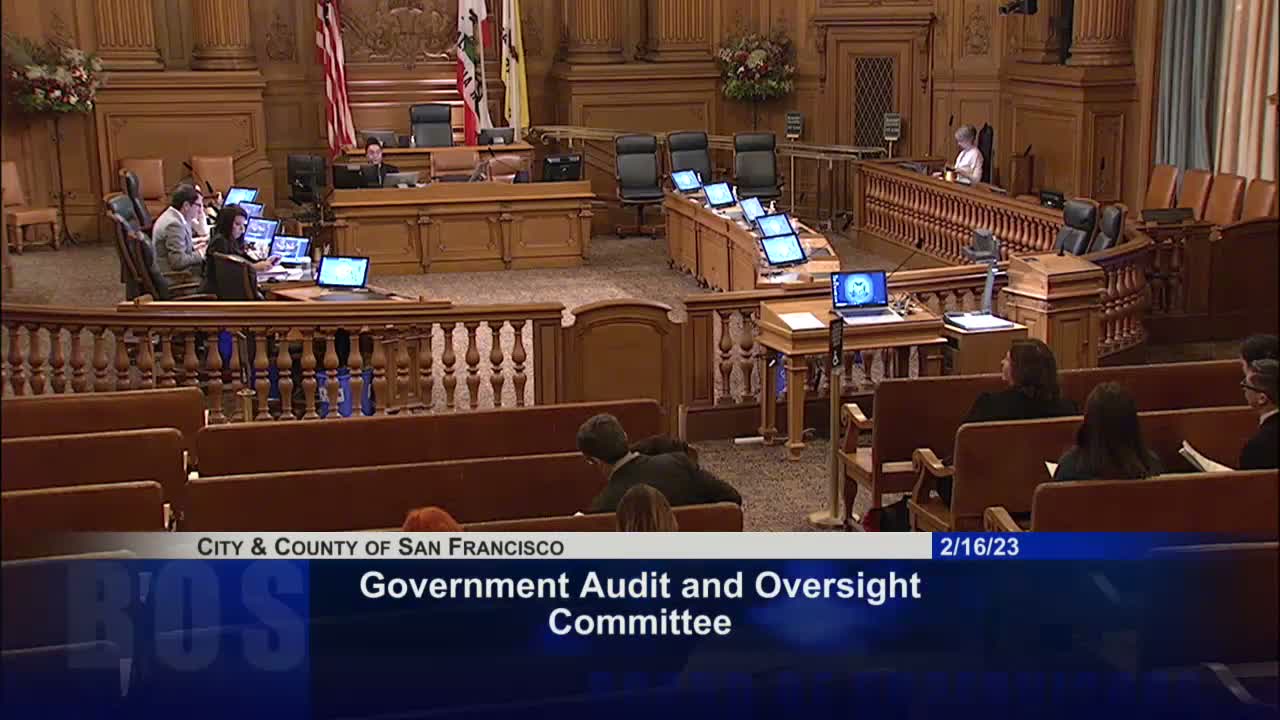
The Government Audit and Oversight Committee of the San Francisco Board of Supervisors on Feb. 16 reviewed findings from an August 2022 citywide nonprofit performance audit and the controller's fiscal-year 2022 nonprofit monitoring and capacity-building program, with supervisors pressing staff on how serious monitoring findings are communicated to departments and the Board.
The controller's office and City Performance Division framed the scope of the audit and monitoring program. Audit staff said the review examined more than 2,000 contracts in the fiscal-year 2017-18 universe, sampled 30 contracts (total payments in the sample of $42,800,000) and found that performance measures and reporting varied widely across departments, which limited the city's ability to evaluate the overall impact of funds paid to community-based organizations (CBOs). Auditor Amanda Kelly said the audit applied a common program taxonomy to group services and recommended standardizing monitoring, strengthening performance measurement, and increasing transparency.
"We need to make sure that those taxpayer dollars are being spent wisely and that the critical services that our nonprofits deliver are being delivered with positive outcomes," Vice Chair Catherine Stephanie told the hearing, noting the city contracts roughly $1.4 billion annually for nonprofit services.
City Performance staff described the monitoring program that launched in 2005 to centralize fiscal and compliance reviews across 12 participating departments. Wendy Lee of the controller's office said the program uses a risk-based annual assessment to assign nonprofits to "core" or "expanded" monitoring. Core monitoring covers a focused set of fiscal and compliance indicators; expanded monitoring covers those core standards plus additional indicators and is assigned to organizations deemed higher risk.
Lee said the monitoring pool in fiscal year 2022 included 192 contractors accounting for about 85% of citywide nonprofit spending. Of the organizations reviewed that cycle, most were in conformance, but 21 nonprofits had initial findings; several resolved findings by the end of the cycle and 15 remained with unresolved findings. City Performance also placed two organizations on elevated-concern status and two on red-flag status, which can restrict competitiveness for new solicitations and lead to mandatory technical assistance or, in severe cases, defunding.
Supervisors pressed staff on how red-flag designations are communicated and what authority the controller has to stop contracting. "If the controller's office is concerned with a particular department, how should that be brought to light?" Vice Chair Stephanie asked, citing Baker Place and other high-profile cases. Controller staff said the office notifies funding departments and convenes joint funders to provide technical assistance, but it does not have the statutory authority to end or defund contracts; those decisions rest with the departments and the mayor's budget process. "That was something for us to consider to where in the process we would be able to bring in items to the board before you are hearing about something that is in such an advanced state of concern," an auditor said.
Committee members and controller staff discussed the corrective-action policy that guides escalation. Laura Marshall of the controller's office said the office looks at findings year over year and identifies which indicators constitute high risk (for example, audit issues flagged as going concern) and which require faster escalation. Some issues are addressed within a single monitoring cycle; others are escalated only after repeated nonconformance.
Supervisors also focused on implementation: the monitoring program's funding thresholds, which staff said are applied at the organization level during an annual risk assessment. Lee described thresholds used to include organizations that receive $1,000,000 or more from a single department or those that receive at least $200,000 from multiple departments (with each department contributing at least $50,000). She confirmed the pool is re-evaluated annually and entities can fall out of the pool if funding drops below thresholds.
On capacity building, the controller's office said it provides both citywide trainings and individualized coaching through a prequalified consultant pool to help nonprofits address fiscal-management weaknesses and compliance gaps. "We have established an RFQ pool of prequalified vendors... to work directly with nonprofits," Lee said.
Public commenters, including nonprofit leaders and service providers, largely supported improved transparency and accountability while urging the city to pair oversight with predictable funding and capacity-building support. Sherilyn Adams of the Health & Human Services Network and Larkin Street Youth Services noted the operational burden of multiple department-specific site visits (she said she had 28 site visits across multiple contracts) and urged greater program-level consistency.
Procedurally, Vice Chair Catherine Stephanie moved to file the hearing; the committee recorded unanimous approval by the three members present (Stephanie, Chan and Chair Preston) and the motion passed. The committee also recommended closed-session items 2 through 8 to the full board with a positive recommendation and voted not to disclose closed-session deliberations.
The hearing highlighted tensions that officials said they plan to address through a combination of corrective-action policy use, better departmental coordination, capacity-building investments and possible legislative changes to improve transparency and to ensure board members and contract decision-makers have access to red-flag information earlier in the contracting process.
Next steps noted at the hearing: controller staff will continue collaboration with departments on escalation procedures and capacity-building operations, and Vice Chair Stephanie said she is drafting legislation to increase transparency around nonprofit contracting and oversight.
The controller's office and City Performance Division framed the scope of the audit and monitoring program. Audit staff said the review examined more than 2,000 contracts in the fiscal-year 2017-18 universe, sampled 30 contracts (total payments in the sample of $42,800,000) and found that performance measures and reporting varied widely across departments, which limited the city's ability to evaluate the overall impact of funds paid to community-based organizations (CBOs). Auditor Amanda Kelly said the audit applied a common program taxonomy to group services and recommended standardizing monitoring, strengthening performance measurement, and increasing transparency.
"We need to make sure that those taxpayer dollars are being spent wisely and that the critical services that our nonprofits deliver are being delivered with positive outcomes," Vice Chair Catherine Stephanie told the hearing, noting the city contracts roughly $1.4 billion annually for nonprofit services.
City Performance staff described the monitoring program that launched in 2005 to centralize fiscal and compliance reviews across 12 participating departments. Wendy Lee of the controller's office said the program uses a risk-based annual assessment to assign nonprofits to "core" or "expanded" monitoring. Core monitoring covers a focused set of fiscal and compliance indicators; expanded monitoring covers those core standards plus additional indicators and is assigned to organizations deemed higher risk.
Lee said the monitoring pool in fiscal year 2022 included 192 contractors accounting for about 85% of citywide nonprofit spending. Of the organizations reviewed that cycle, most were in conformance, but 21 nonprofits had initial findings; several resolved findings by the end of the cycle and 15 remained with unresolved findings. City Performance also placed two organizations on elevated-concern status and two on red-flag status, which can restrict competitiveness for new solicitations and lead to mandatory technical assistance or, in severe cases, defunding.
Supervisors pressed staff on how red-flag designations are communicated and what authority the controller has to stop contracting. "If the controller's office is concerned with a particular department, how should that be brought to light?" Vice Chair Stephanie asked, citing Baker Place and other high-profile cases. Controller staff said the office notifies funding departments and convenes joint funders to provide technical assistance, but it does not have the statutory authority to end or defund contracts; those decisions rest with the departments and the mayor's budget process. "That was something for us to consider to where in the process we would be able to bring in items to the board before you are hearing about something that is in such an advanced state of concern," an auditor said.
Committee members and controller staff discussed the corrective-action policy that guides escalation. Laura Marshall of the controller's office said the office looks at findings year over year and identifies which indicators constitute high risk (for example, audit issues flagged as going concern) and which require faster escalation. Some issues are addressed within a single monitoring cycle; others are escalated only after repeated nonconformance.
Supervisors also focused on implementation: the monitoring program's funding thresholds, which staff said are applied at the organization level during an annual risk assessment. Lee described thresholds used to include organizations that receive $1,000,000 or more from a single department or those that receive at least $200,000 from multiple departments (with each department contributing at least $50,000). She confirmed the pool is re-evaluated annually and entities can fall out of the pool if funding drops below thresholds.
On capacity building, the controller's office said it provides both citywide trainings and individualized coaching through a prequalified consultant pool to help nonprofits address fiscal-management weaknesses and compliance gaps. "We have established an RFQ pool of prequalified vendors... to work directly with nonprofits," Lee said.
Public commenters, including nonprofit leaders and service providers, largely supported improved transparency and accountability while urging the city to pair oversight with predictable funding and capacity-building support. Sherilyn Adams of the Health & Human Services Network and Larkin Street Youth Services noted the operational burden of multiple department-specific site visits (she said she had 28 site visits across multiple contracts) and urged greater program-level consistency.
Procedurally, Vice Chair Catherine Stephanie moved to file the hearing; the committee recorded unanimous approval by the three members present (Stephanie, Chan and Chair Preston) and the motion passed. The committee also recommended closed-session items 2 through 8 to the full board with a positive recommendation and voted not to disclose closed-session deliberations.
The hearing highlighted tensions that officials said they plan to address through a combination of corrective-action policy use, better departmental coordination, capacity-building investments and possible legislative changes to improve transparency and to ensure board members and contract decision-makers have access to red-flag information earlier in the contracting process.
Next steps noted at the hearing: controller staff will continue collaboration with departments on escalation procedures and capacity-building operations, and Vice Chair Stephanie said she is drafting legislation to increase transparency around nonprofit contracting and oversight.
View the Full Meeting & All Its Details
This article offers just a summary. Unlock complete video, transcripts, and insights as a Founder Member.
✓
Watch full, unedited meeting videos
✓
Search every word spoken in unlimited transcripts
✓
AI summaries & real-time alerts (all government levels)
✓
Permanent access to expanding government content
30-day money-back guarantee
