SFPUC and resilience office outline multi‑billion dollar plan and financing options for emergency firefighting water; supervisors direct formal response to 2019
June 01, 2023 | San Francisco County, California
This article was created by AI summarizing key points discussed. AI makes mistakes, so for full details and context, please refer to the video of the full meeting. Please report any errors so we can fix them. Report an error »
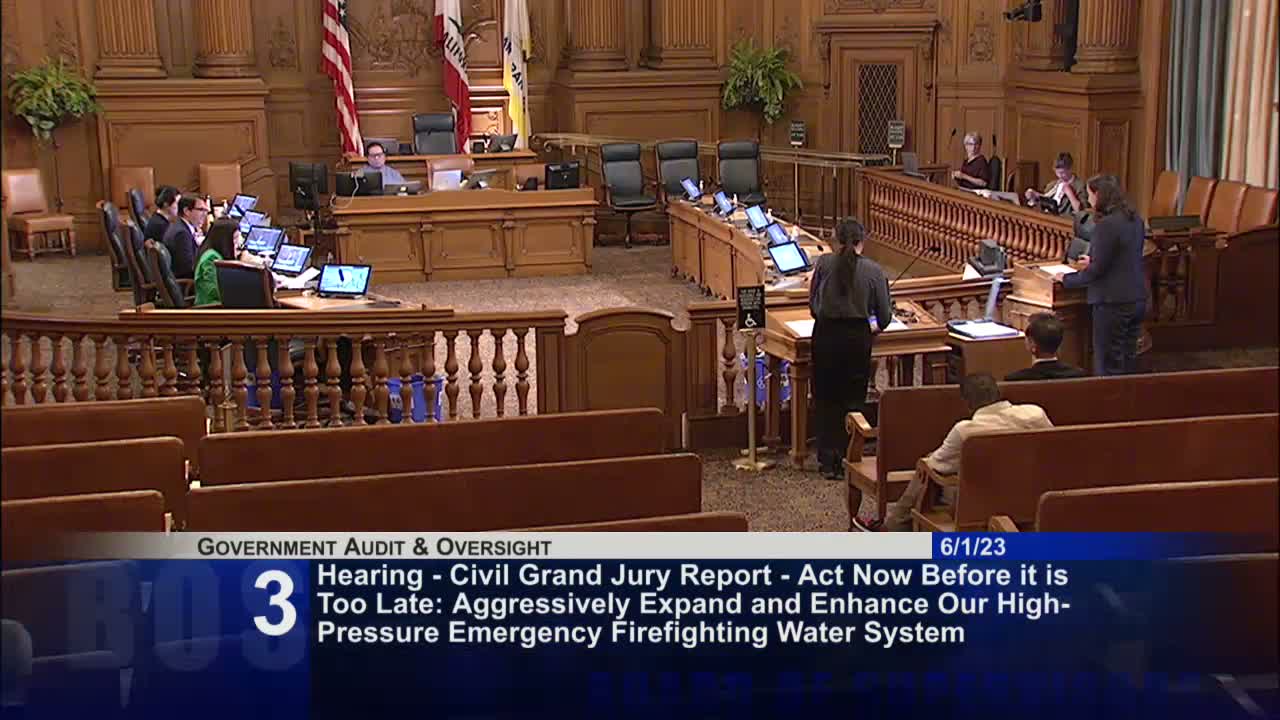
At a June 1 hearing the Government Audit & Oversight Committee considered the 2019 Civil Grand Jury report that urged expansion of San Francisco’s Emergency Firefighting Water System (EFWS). Katie Miller, Director of Water Capital Programs for the San Francisco Public Utilities Commission, summarized work since 2010 — pump station and pipeline improvements, new cisterns and fireboat manifold upgrades — and noted SFPUC planning studies carried out in 2021 and 2022.
Miller said the EFWS 2050 planning study produced a high‑level build‑out estimate of about $2 billion un‑escalated, rising to $3–4 billion if completed by 2034 depending on escalation assumptions. She explained that initial funded segments use larger‑diameter piping and that later segments (for example on the west side) are smaller diameter but can be costlier per mile because of equipment and system needs.
Brian Strong of the Office of Resilience and Capital Planning summarized the financing study and said the City has used earthquake safety and emergency response (ESER) geobonds and some PUC revenue bonds to date but faces competition across capital priorities. He identified developer agreements, water revenue bonds where co‑benefits exist, and a localized community facilities district (a Mello‑Roos–style mechanism) as potential ways to raise substantial sums. Strong also noted complementary strategies to reduce post‑quake ignitions (electrification programs and gas shutoff valves) that could lower overall EFWS demand.
Supervisors pressed SFPUC staff on apparent differences between recently updated pipeline alignment and cost estimates and AECOM maps from 2021, with Supervisor Connie Chan noting concern about funded segments not reaching the Richmond as previously expected. SFPUC staff said conceptual engineering has refined estimates in the last month and that higher per‑mile costs are driven by current market pricing and larger initial pipeline diameters.
Chair Preston moved to direct the Clerk to submit updated responses to the Civil Grand Jury recommendations, citing the BLA and SFPUC reports (Seawater Supply Study, EFWS 2050 Planning Study, BLA financing analysis). The motion to file and forward the response to the full Board was recorded without objection.
Miller said the EFWS 2050 planning study produced a high‑level build‑out estimate of about $2 billion un‑escalated, rising to $3–4 billion if completed by 2034 depending on escalation assumptions. She explained that initial funded segments use larger‑diameter piping and that later segments (for example on the west side) are smaller diameter but can be costlier per mile because of equipment and system needs.
Brian Strong of the Office of Resilience and Capital Planning summarized the financing study and said the City has used earthquake safety and emergency response (ESER) geobonds and some PUC revenue bonds to date but faces competition across capital priorities. He identified developer agreements, water revenue bonds where co‑benefits exist, and a localized community facilities district (a Mello‑Roos–style mechanism) as potential ways to raise substantial sums. Strong also noted complementary strategies to reduce post‑quake ignitions (electrification programs and gas shutoff valves) that could lower overall EFWS demand.
Supervisors pressed SFPUC staff on apparent differences between recently updated pipeline alignment and cost estimates and AECOM maps from 2021, with Supervisor Connie Chan noting concern about funded segments not reaching the Richmond as previously expected. SFPUC staff said conceptual engineering has refined estimates in the last month and that higher per‑mile costs are driven by current market pricing and larger initial pipeline diameters.
Chair Preston moved to direct the Clerk to submit updated responses to the Civil Grand Jury recommendations, citing the BLA and SFPUC reports (Seawater Supply Study, EFWS 2050 Planning Study, BLA financing analysis). The motion to file and forward the response to the full Board was recorded without objection.
View the Full Meeting & All Its Details
This article offers just a summary. Unlock complete video, transcripts, and insights as a Founder Member.
✓
Watch full, unedited meeting videos
✓
Search every word spoken in unlimited transcripts
✓
AI summaries & real-time alerts (all government levels)
✓
Permanent access to expanding government content
30-day money-back guarantee
