BLA audit finds MOHCD reporting gaps; department pledges clearer fund breakdowns
May 18, 2023 | San Francisco County, California
This article was created by AI summarizing key points discussed. AI makes mistakes, so for full details and context, please refer to the video of the full meeting. Please report any errors so we can fix them. Report an error »
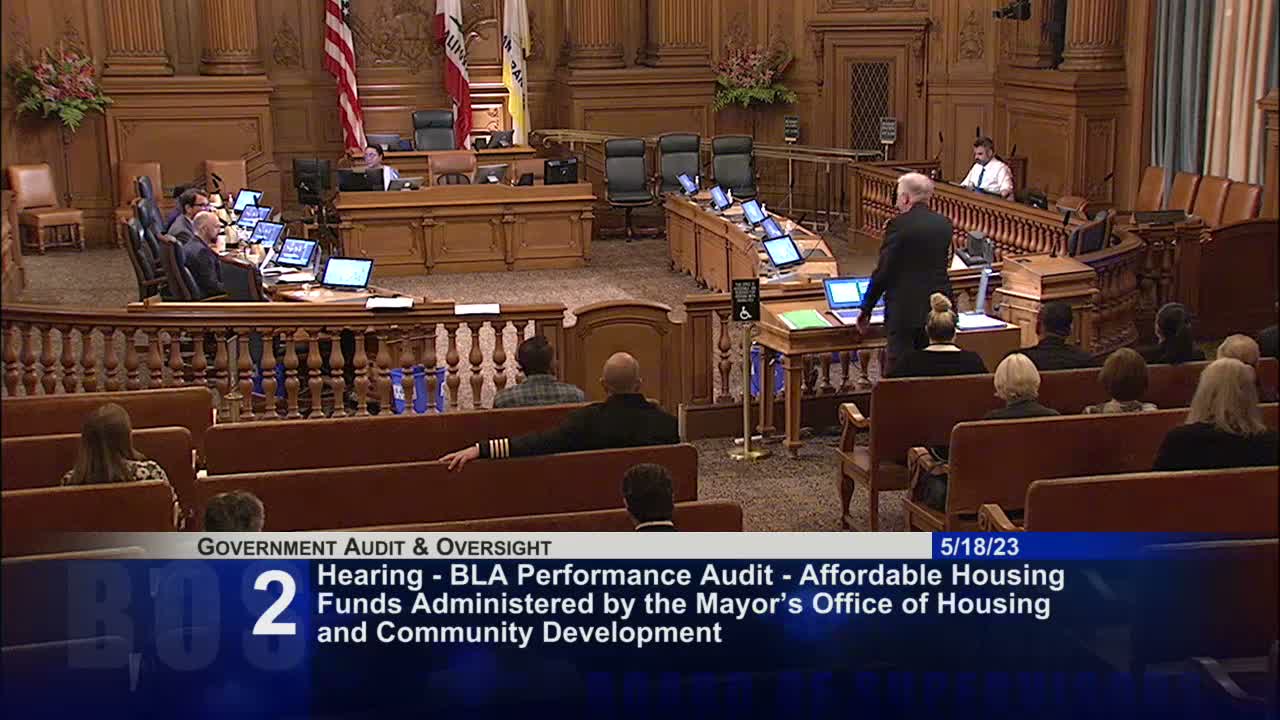
The Budget and Legislative Analyst (BLA) told the Government Audit and Oversight Committee on May 18 that San Francisco’s Mayor’s Office of Housing and Community Development (MOHCD) needs stronger reporting and clearer records of fund commitments to improve transparency over affordable housing financing.
Fred Brussell of the BLA summarized three findings and nine recommendations after a five‑year review of revenues, expenditures and fund balances. The BLA reported that average expenditures from 2018–22 were about $177 million per year while average revenues were roughly $215.2 million, producing a multi‑hundred‑million dollar fund balance. At the end of fiscal 2021–22 that fund balance measured about $536 million, but the department’s financial records and public reports do not consistently distinguish between funds committed by executed loan agreement, anticipated commitments, and uncommitted balances.
BLA analysts said the audit could not reliably identify how much of a $313 million planned loan‑closing figure represented loans with fully executed agreements versus loans merely anticipated for closing; the office recommended MOHCD provide year‑end breakdowns that separate executed loans from earmarked or anticipated uses and add plan‑versus‑actual cost reporting to quarterly milestone reports required by the Administrative Code.
Deputy Director Benjamin McCloskey of MOHCD told the committee the department shares the objective of producing affordable housing quickly and that some fund balances reflect deliberate reservations for gap financing to keep projects moving through site acquisition, predevelopment and construction. McCloskey said MOHCD has already revised quarterly report formats, begun including per‑unit local subsidy figures in its presentations and is launching work this month to implement written principles and a housing development performance assessment tied to the mayor’s Housing for All directive.
Supervisors pressed the department on whether some commitments remain opaque and asked for a site‑by‑site, year‑end snapshot that would show how much is encumbered by executed loan agreements versus earmarked for future years. MOHCD said it can produce a loan‑by‑loan breakdown but that doing so requires defining a snapshot date and some manual reconciliation due to how the office’s records are organized.
Public comment included both calls for stronger controls and defenses of MOHCD’s need for flexibility from housing developers and advocates. The committee voted to file the hearing and committed to working with MOHCD and the BLA on follow‑up reporting changes.
Fred Brussell of the BLA summarized three findings and nine recommendations after a five‑year review of revenues, expenditures and fund balances. The BLA reported that average expenditures from 2018–22 were about $177 million per year while average revenues were roughly $215.2 million, producing a multi‑hundred‑million dollar fund balance. At the end of fiscal 2021–22 that fund balance measured about $536 million, but the department’s financial records and public reports do not consistently distinguish between funds committed by executed loan agreement, anticipated commitments, and uncommitted balances.
BLA analysts said the audit could not reliably identify how much of a $313 million planned loan‑closing figure represented loans with fully executed agreements versus loans merely anticipated for closing; the office recommended MOHCD provide year‑end breakdowns that separate executed loans from earmarked or anticipated uses and add plan‑versus‑actual cost reporting to quarterly milestone reports required by the Administrative Code.
Deputy Director Benjamin McCloskey of MOHCD told the committee the department shares the objective of producing affordable housing quickly and that some fund balances reflect deliberate reservations for gap financing to keep projects moving through site acquisition, predevelopment and construction. McCloskey said MOHCD has already revised quarterly report formats, begun including per‑unit local subsidy figures in its presentations and is launching work this month to implement written principles and a housing development performance assessment tied to the mayor’s Housing for All directive.
Supervisors pressed the department on whether some commitments remain opaque and asked for a site‑by‑site, year‑end snapshot that would show how much is encumbered by executed loan agreements versus earmarked for future years. MOHCD said it can produce a loan‑by‑loan breakdown but that doing so requires defining a snapshot date and some manual reconciliation due to how the office’s records are organized.
Public comment included both calls for stronger controls and defenses of MOHCD’s need for flexibility from housing developers and advocates. The committee voted to file the hearing and committed to working with MOHCD and the BLA on follow‑up reporting changes.
Don't Miss a Word: See the Full Meeting!
Go beyond summaries. Unlock every video, transcript, and key insight with a Founder Membership.
✓
Get instant access to full meeting videos
✓
Search and clip any phrase from complete transcripts
✓
Receive AI-powered summaries & custom alerts
✓
Enjoy lifetime, unrestricted access to government data
30-day money-back guarantee
