Board hears from PG&E, city agencies and residents after April vault fire left thousands without power
May 18, 2023 | San Francisco County, California
This article was created by AI summarizing key points discussed. AI makes mistakes, so for full details and context, please refer to the video of the full meeting. Please report any errors so we can fix them. Report an error »
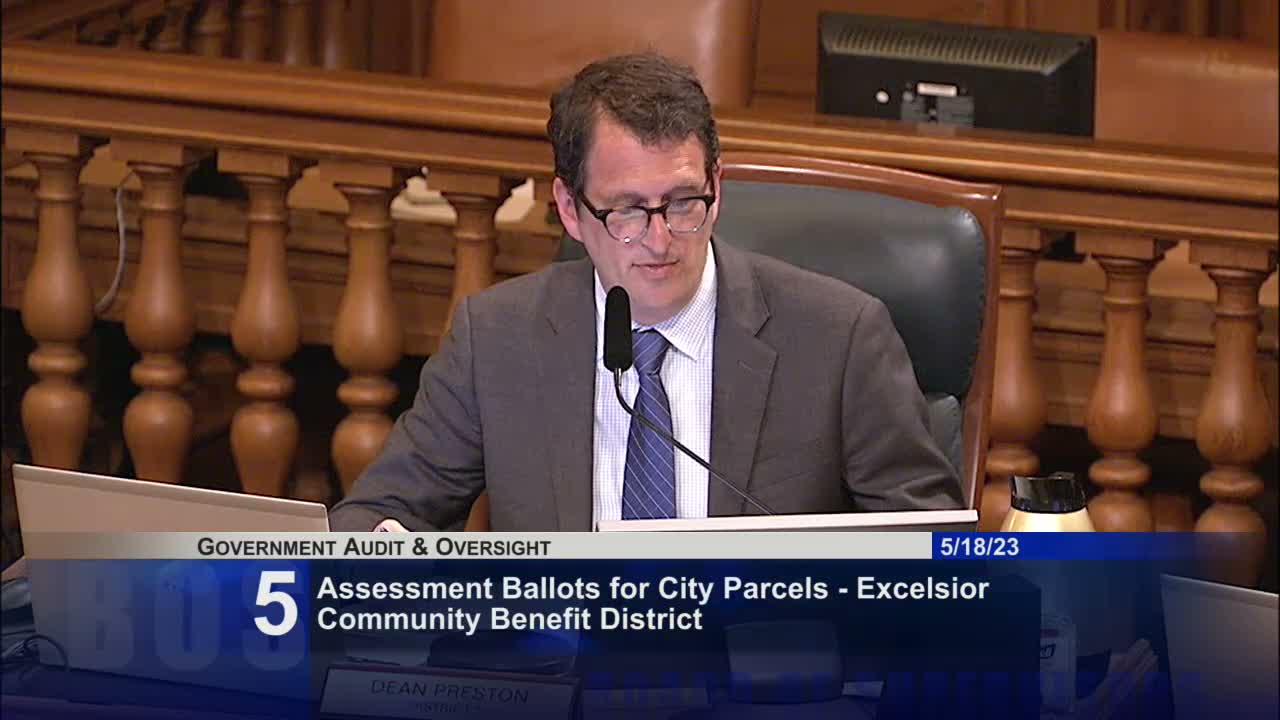
City and utility officials, health care providers and hundreds of residents testified May 18 at a Government Audit and Oversight Committee hearing about an April 26 underground vault fire and the extended power outage that disrupted electricity and water for thousands in San Francisco’s Northeast quadrant.
President of the Board Aaron Peskin, who sponsored the hearing, described widespread impacts — outages that affected elevators, water pumps and refrigeration in high‑rise residential buildings — and said he expected PG&E to improve outage communications and coordination with the city. “These outages are not new,” Peskin said; the hearing focused on response times, communications and accountability.
Deputy Chief Bob Postel of the Fire Department said the first unit arrived within four minutes of the initial 8:42 p.m. call on April 26 and PG&E crews were requested immediately. PG&E personnel arrived on scene about 20 minutes after the request, Postel said, and the department prioritized public safety and isolation of affected areas. Mary Ellen Carroll, executive director of the Department of Emergency Management, said the city activated its Emergency Operations Center and that PG&E participated in EOC activity but provided “inconsistent and untimely” information the city needed to coordinate assistance.
Employees at San Francisco General Hospital and hosting facilities said the outage and a subsequent event in late March threatened medical operations. A DPH official said critical systems — MRI cooling, vaccine refrigeration, lab instruments and elevators — were disrupted and that clearer communications from PG&E could have shortened outage duration.
Aaron Johnson, PG&E’s Bay Area regional vice president, said the company recorded 9,454 affected service connections (meters) from the April 26 incident, restored about 94% of those customers within 24 hours, and completed restoration for the final connections by April 30. He said PG&E had crews working around the clock, activated its Emergency Operations Center and will file a formal incident report with the California Public Utilities Commission within 20 business days.
But resident testimony described a different experience. Tenants at the Golden Gateway complex said the property’s master meter left roughly 2,500 people without water, electricity, elevators and internet for several days; building management bought and installed generators after PG&E said some installations were “technically infeasible.” Residents described walking many flights of stairs, spoiled food, out‑of‑pocket costs for hotels and meals, and messages from PG&E and the media that understated the outage’s scale.
The committee voted to file the hearing and directed staff to pursue improved communication protocols among PG&E, the Department of Emergency Management, SFPUC, the Fire Department and public health officials. PG&E said it will share the CPUC incident report and work with city partners to identify improvements.
President of the Board Aaron Peskin, who sponsored the hearing, described widespread impacts — outages that affected elevators, water pumps and refrigeration in high‑rise residential buildings — and said he expected PG&E to improve outage communications and coordination with the city. “These outages are not new,” Peskin said; the hearing focused on response times, communications and accountability.
Deputy Chief Bob Postel of the Fire Department said the first unit arrived within four minutes of the initial 8:42 p.m. call on April 26 and PG&E crews were requested immediately. PG&E personnel arrived on scene about 20 minutes after the request, Postel said, and the department prioritized public safety and isolation of affected areas. Mary Ellen Carroll, executive director of the Department of Emergency Management, said the city activated its Emergency Operations Center and that PG&E participated in EOC activity but provided “inconsistent and untimely” information the city needed to coordinate assistance.
Employees at San Francisco General Hospital and hosting facilities said the outage and a subsequent event in late March threatened medical operations. A DPH official said critical systems — MRI cooling, vaccine refrigeration, lab instruments and elevators — were disrupted and that clearer communications from PG&E could have shortened outage duration.
Aaron Johnson, PG&E’s Bay Area regional vice president, said the company recorded 9,454 affected service connections (meters) from the April 26 incident, restored about 94% of those customers within 24 hours, and completed restoration for the final connections by April 30. He said PG&E had crews working around the clock, activated its Emergency Operations Center and will file a formal incident report with the California Public Utilities Commission within 20 business days.
But resident testimony described a different experience. Tenants at the Golden Gateway complex said the property’s master meter left roughly 2,500 people without water, electricity, elevators and internet for several days; building management bought and installed generators after PG&E said some installations were “technically infeasible.” Residents described walking many flights of stairs, spoiled food, out‑of‑pocket costs for hotels and meals, and messages from PG&E and the media that understated the outage’s scale.
The committee voted to file the hearing and directed staff to pursue improved communication protocols among PG&E, the Department of Emergency Management, SFPUC, the Fire Department and public health officials. PG&E said it will share the CPUC incident report and work with city partners to identify improvements.
Don't Miss a Word: See the Full Meeting!
Go beyond summaries. Unlock every video, transcript, and key insight with a Founder Membership.
✓
Get instant access to full meeting videos
✓
Search and clip any phrase from complete transcripts
✓
Receive AI-powered summaries & custom alerts
✓
Enjoy lifetime, unrestricted access to government data
30-day money-back guarantee
