Controller: downtown business remittances still below pre-pandemic levels; recovery uneven across ZIP codes
November 02, 2023 | San Francisco County, California
This article was created by AI summarizing key points discussed. AI makes mistakes, so for full details and context, please refer to the video of the full meeting. Please report any errors so we can fix them. Report an error »
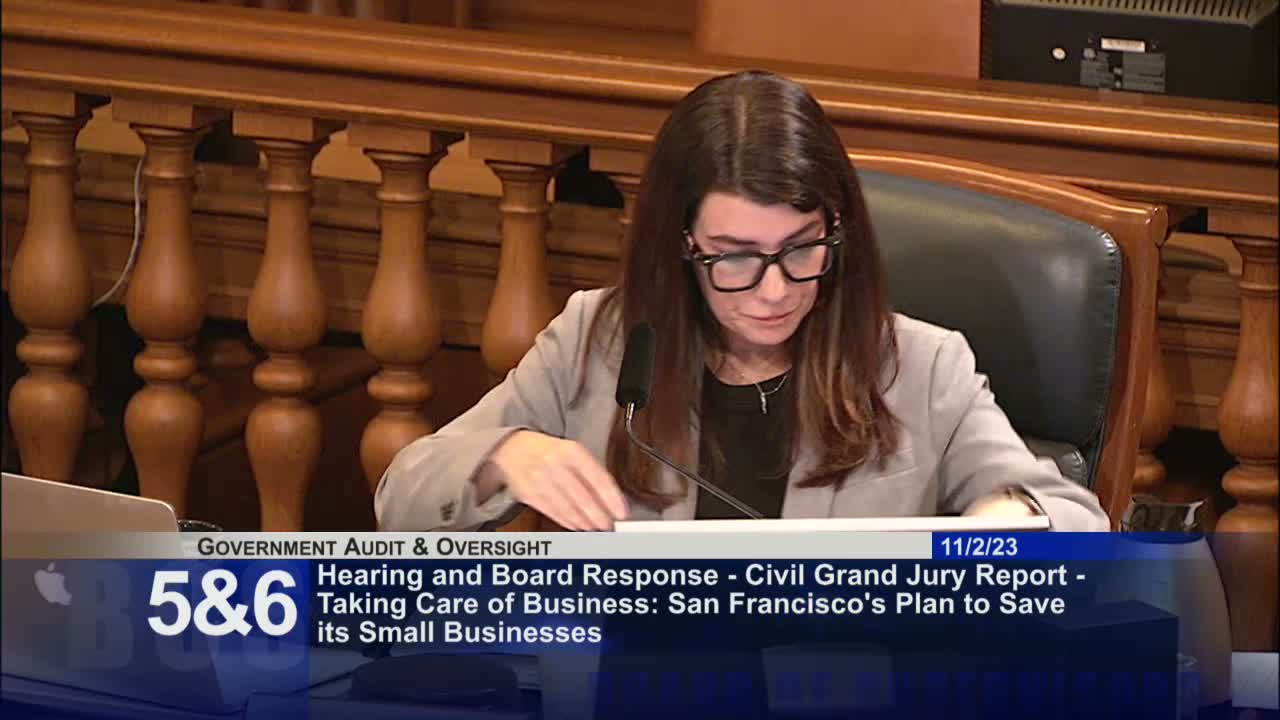
The Government Audit and Oversight Committee heard a controller's office briefing on Nov. 2 showing downtown business activity remains below pre-pandemic levels and that the recovery has been uneven across ZIP codes.
Ted Egan, chief economist in the controller's office, presented sales-tax-remittance data for downtown (ZIP codes 94102, 94103, 94104, 94105, 94108 and 94111). He said downtown had roughly 4,000 businesses remitting sales tax before the pandemic and about 3,200 in recent quarters, a drop of roughly 20 percent. Recovery rates vary by ZIP code (for example, Egan cited an 85 percent recovery in some areas versus 68 percent in 94104 and 73 percent in 94111). Egan linked the weak downtown recovery to remote work, higher office vacancy and lower tourism.
Egan said restaurants and hospitality have recovered more strongly than downtown retail, with restaurants near 90 percent of pre-pandemic remittance levels while downtown retail is below 80 percent. He noted the city now collects about $1.4 billion in business tax revenue and warned that a small number of very large payers account for a disproportionate share of collections.
Sarah Dennis Phillips of the Office of Economic and Workforce Development described the city's recovery roadmap and actions to support downtown: activations and event programming, vacant-to-vibrant storefront pilots, retail recruitment and retention, workforce training and coordination with tourism partners. She said the city has seen increased foot traffic and that some activation pilots are converting to longer-term leases.
Supervisors and presenters discussed structural challenges (office conversions, housing and transportation connections) and policy levers such as business tax reform and targeted incentives. Supervisor sponsor (listed as) and Guardio moved to file the hearing; the committee voted to file.
Ted Egan, chief economist in the controller's office, presented sales-tax-remittance data for downtown (ZIP codes 94102, 94103, 94104, 94105, 94108 and 94111). He said downtown had roughly 4,000 businesses remitting sales tax before the pandemic and about 3,200 in recent quarters, a drop of roughly 20 percent. Recovery rates vary by ZIP code (for example, Egan cited an 85 percent recovery in some areas versus 68 percent in 94104 and 73 percent in 94111). Egan linked the weak downtown recovery to remote work, higher office vacancy and lower tourism.
Egan said restaurants and hospitality have recovered more strongly than downtown retail, with restaurants near 90 percent of pre-pandemic remittance levels while downtown retail is below 80 percent. He noted the city now collects about $1.4 billion in business tax revenue and warned that a small number of very large payers account for a disproportionate share of collections.
Sarah Dennis Phillips of the Office of Economic and Workforce Development described the city's recovery roadmap and actions to support downtown: activations and event programming, vacant-to-vibrant storefront pilots, retail recruitment and retention, workforce training and coordination with tourism partners. She said the city has seen increased foot traffic and that some activation pilots are converting to longer-term leases.
Supervisors and presenters discussed structural challenges (office conversions, housing and transportation connections) and policy levers such as business tax reform and targeted incentives. Supervisor sponsor (listed as) and Guardio moved to file the hearing; the committee voted to file.
Don't Miss a Word: See the Full Meeting!
Go beyond summaries. Unlock every video, transcript, and key insight with a Founder Membership.
✓
Get instant access to full meeting videos
✓
Search and clip any phrase from complete transcripts
✓
Receive AI-powered summaries & custom alerts
✓
Enjoy lifetime, unrestricted access to government data
30-day money-back guarantee
