Supervisors find uneven on-scene support after apartment fires, press for sprinkler retrofits and a single fact sheet
September 07, 2023 | San Francisco County, California
This article was created by AI summarizing key points discussed. AI makes mistakes, so for full details and context, please refer to the video of the full meeting. Please report any errors so we can fix them. Report an error »
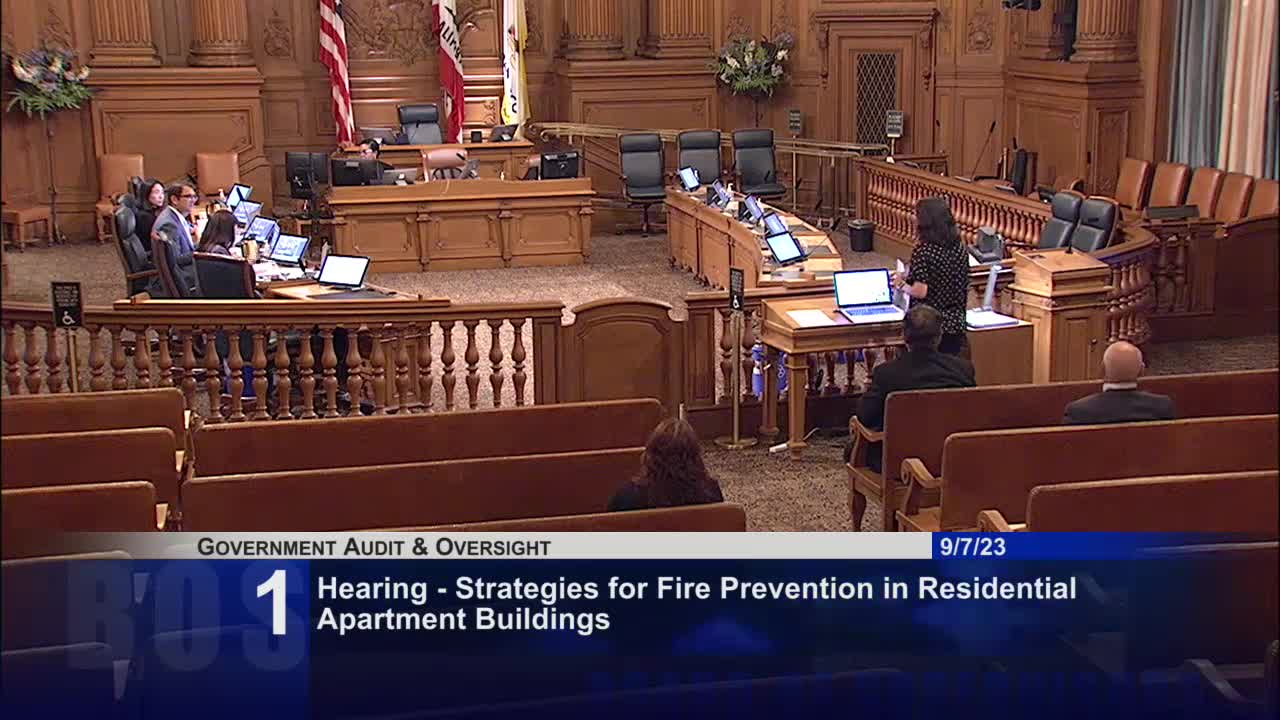
Supervisor Dean Preston opened the Government Audit and Oversight Committee hearing on Sept. 7, saying recent apartment fires in his district have displaced more than 200 residents and exposed gaps in the city's response and victim support. "I think there are real gaps in our city's fire response," he said, calling for a solutions-oriented review of prevention, on-scene assistance and rehousing.
Fire Marshal Ken Coughlin reviewed 13 years of department data, acknowledging limits in the available records and noting a long-term decline in building fires with a spike in 2022. He told the committee that most residential fires occur in low-rise buildings and that sprinklers limit fire spread. "Automatic sprinkler systems are intended to aid in the control of fires and protect against injury and loss of life," he said, and described a 2022 fire-code update that phases in requirements for certain residential properties over 12 years. Coughlin recommended prioritizing retrofits for objectively high-risk buildings, including those with repeated failures to abate fire-safety violations.
Doris Barone, director of disaster preparedness and response at the Human Services Agency, outlined the multi-agency response that activates after a fire: the San Francisco Fire Department leads on scene, the American Red Cross typically provides initial intake and immediate funds via a client assistance card, and HSA and the Department of Emergency Management coordinate stabilization and referrals. Barone described immediate assistance practices — Red Cross client cards intended to cover needs for two to three days, and HSA hoteling for up to three weeks with case-by-case extensions — and said HSA's emergency rental assistance program can provide a subsidy for up to four years for eligible displaced households.
Committee members pressed departments on response time and capacity. Several supervisors said their offices had seen delayed Red Cross arrivals and inconsistent on-scene support; Barone confirmed that Red Cross volunteer numbers in San Francisco have fallen and that the organization now relies on a regional model that can slow local response. She said HSA and the Department of Emergency Management will deploy staff when Red Cross cannot assemble a team quickly, and urged better notification so city staff can supplement relief sooner.
Matthew Green, acting deputy director at the Department of Building Inspection, described DBI's on-call inspector system and post-fire procedures. He said DBI may request a structural engineer's report within 72 hours, issue a notice of violation, and set repair timelines (a common target is 90 days, though officials acknowledged that complex repairs often take longer). When owners do not meet timelines, DBI can pursue code enforcement steps, emergency orders and liens.
Public commenters and service providers told the committee they often had to fill gaps in immediate assistance and follow-up. Representatives of the transgender gender variant intersex justice project (TGIJP) and other nonprofits described using organizational funds to house clients after SRO fires, while tenants and tenant advocates urged stronger tenant tracking, clearer timelines for return and better protections against looting of damaged units.
Members and witnesses agreed on several near-term steps. The Fire Department and HSA said versions of on-scene fact sheets already exist; the committee asked departments to create one universal, multilingual fact sheet with phone numbers, a brief description of tenants'rights, landlord obligations, Red Cross voucher information and how to apply for HSA subsidies. Chair Preston asked for a one-page document to be produced quickly and noted his office would work with departments on that task. The committee moved to continue the item to the call of the chair to allow follow-up; the motion passed 3-0.
The hearing highlighted three persistent gaps the committee asked departments to address: (1) reduced Red Cross volunteer capacity and the need for earlier notification or supplementary city staffing, (2) limited long-term case-management capacity at HSA (HSA identified one full-time disaster-response coordinator and three rotating duty officers for immediate response), and (3) uneven ability to secure damaged buildings immediately after a fire. Supervisors discussed exploring targeted funding and incentives — including whether bond revenues could help fund sprinkler retrofits for high-risk buildings — and asked departments to return with concrete proposals and the requested fact sheet.
Fire Marshal Ken Coughlin reviewed 13 years of department data, acknowledging limits in the available records and noting a long-term decline in building fires with a spike in 2022. He told the committee that most residential fires occur in low-rise buildings and that sprinklers limit fire spread. "Automatic sprinkler systems are intended to aid in the control of fires and protect against injury and loss of life," he said, and described a 2022 fire-code update that phases in requirements for certain residential properties over 12 years. Coughlin recommended prioritizing retrofits for objectively high-risk buildings, including those with repeated failures to abate fire-safety violations.
Doris Barone, director of disaster preparedness and response at the Human Services Agency, outlined the multi-agency response that activates after a fire: the San Francisco Fire Department leads on scene, the American Red Cross typically provides initial intake and immediate funds via a client assistance card, and HSA and the Department of Emergency Management coordinate stabilization and referrals. Barone described immediate assistance practices — Red Cross client cards intended to cover needs for two to three days, and HSA hoteling for up to three weeks with case-by-case extensions — and said HSA's emergency rental assistance program can provide a subsidy for up to four years for eligible displaced households.
Committee members pressed departments on response time and capacity. Several supervisors said their offices had seen delayed Red Cross arrivals and inconsistent on-scene support; Barone confirmed that Red Cross volunteer numbers in San Francisco have fallen and that the organization now relies on a regional model that can slow local response. She said HSA and the Department of Emergency Management will deploy staff when Red Cross cannot assemble a team quickly, and urged better notification so city staff can supplement relief sooner.
Matthew Green, acting deputy director at the Department of Building Inspection, described DBI's on-call inspector system and post-fire procedures. He said DBI may request a structural engineer's report within 72 hours, issue a notice of violation, and set repair timelines (a common target is 90 days, though officials acknowledged that complex repairs often take longer). When owners do not meet timelines, DBI can pursue code enforcement steps, emergency orders and liens.
Public commenters and service providers told the committee they often had to fill gaps in immediate assistance and follow-up. Representatives of the transgender gender variant intersex justice project (TGIJP) and other nonprofits described using organizational funds to house clients after SRO fires, while tenants and tenant advocates urged stronger tenant tracking, clearer timelines for return and better protections against looting of damaged units.
Members and witnesses agreed on several near-term steps. The Fire Department and HSA said versions of on-scene fact sheets already exist; the committee asked departments to create one universal, multilingual fact sheet with phone numbers, a brief description of tenants'rights, landlord obligations, Red Cross voucher information and how to apply for HSA subsidies. Chair Preston asked for a one-page document to be produced quickly and noted his office would work with departments on that task. The committee moved to continue the item to the call of the chair to allow follow-up; the motion passed 3-0.
The hearing highlighted three persistent gaps the committee asked departments to address: (1) reduced Red Cross volunteer capacity and the need for earlier notification or supplementary city staffing, (2) limited long-term case-management capacity at HSA (HSA identified one full-time disaster-response coordinator and three rotating duty officers for immediate response), and (3) uneven ability to secure damaged buildings immediately after a fire. Supervisors discussed exploring targeted funding and incentives — including whether bond revenues could help fund sprinkler retrofits for high-risk buildings — and asked departments to return with concrete proposals and the requested fact sheet.
View the Full Meeting & All Its Details
This article offers just a summary. Unlock complete video, transcripts, and insights as a Founder Member.
✓
Watch full, unedited meeting videos
✓
Search every word spoken in unlimited transcripts
✓
AI summaries & real-time alerts (all government levels)
✓
Permanent access to expanding government content
30-day money-back guarantee
