Committee forwards retroactive HealthRight 360 contract amendment after scrutiny about oversight and vendor roles
November 03, 2021 | San Francisco County, California
This article was created by AI summarizing key points discussed. AI makes mistakes, so for full details and context, please refer to the video of the full meeting. Please report any errors so we can fix them. Report an error »
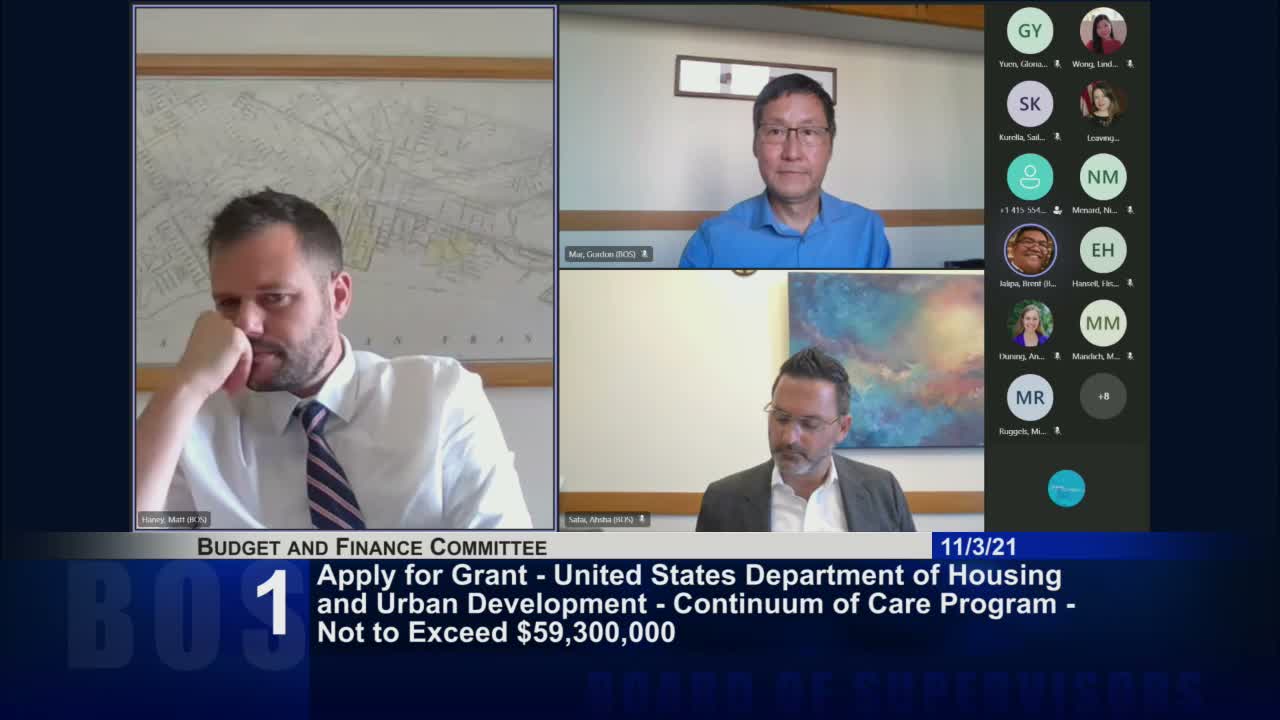
The San Francisco Budget and Finance Committee on Nov. 3 voted to forward to the full Board a retroactive amendment to the Department of Public Health's fiscal intermediary check-writing contract with HealthRight 360, a measure DPH said is necessary to continue payments to board-and-care homes, emergency stabilization hotel rooms and other providers.
DPH's Michelle Ruggles told the committee the amendment would extend the contract through June 30, 2023 and increase the contract ceiling (reported in committee materials as about $46.7 million to $46.8 million). She said HealthRight 360 performs check-writing for hundreds of small behavioral-health providers that do not contract directly with the city and that the agency has multi-layered verification checks before payments are sent.
Why it matters: the contract channels large pass-through sums to community providers and covers services for unhoused residents and foster youth; supervisors said the arrangement can obscure which organizations ultimately receive city funding and raised oversight questions.
Supervisor Asha Safai asked for more detail about the contract's beneficiaries and noted the budget report showed roughly $11.5 million going to licensed residential care facilities out of roughly $17.4 million in annual spending for those slots, leaving about $6 million for other categories. Safai singled out line items such as parent-training institutes, the Boys & Girls Club of San Francisco and San Francisco State University, asking why some entities that already have city contracts were appearing under the intermediary.
"It doesn't feel as though we should be operating in this way," Safai said, urging DPH to examine whether some providers could become direct city vendors to improve public disclosure and oversight.
DPH replied that the department is already moving several programmatic items (for example, parent-training supports) into separate contracts and said some payments are for services that are difficult to set up as direct contracts (for example, out-of-county placements and emergency stabilization hotel stays). Ruggles said HealthRight 360 receives a modest annual reimbursement for check-writing (DPH and BLA cited roughly $50,000 per year retained by the intermediary) and that staff plan to analyze which vendors could transition to direct contracting.
Budget Analyst Nick Menard told the committee the BLA reviewed the amendment and recommended approval; the BLA report also included a table of actual and proposed spending and confirmed the bulk of the funds are passed through to providers.
Members pressed DPH for clarity on scale: DPH estimated several hundred payment "slots" and the BLA noted roughly 2,300 checks are written annually; committee members sought a clearer inventory of the vendors served under the intermediary model.
Outcome: the committee approved the amendments and voted (3 ayes) to forward the amended resolution to the full Board with a positive recommendation. The resolution is retroactive and, as presented, does not change the department's intent to pursue measures that would increase transparency and, where feasible, move providers to direct contracts.
DPH's Michelle Ruggles told the committee the amendment would extend the contract through June 30, 2023 and increase the contract ceiling (reported in committee materials as about $46.7 million to $46.8 million). She said HealthRight 360 performs check-writing for hundreds of small behavioral-health providers that do not contract directly with the city and that the agency has multi-layered verification checks before payments are sent.
Why it matters: the contract channels large pass-through sums to community providers and covers services for unhoused residents and foster youth; supervisors said the arrangement can obscure which organizations ultimately receive city funding and raised oversight questions.
Supervisor Asha Safai asked for more detail about the contract's beneficiaries and noted the budget report showed roughly $11.5 million going to licensed residential care facilities out of roughly $17.4 million in annual spending for those slots, leaving about $6 million for other categories. Safai singled out line items such as parent-training institutes, the Boys & Girls Club of San Francisco and San Francisco State University, asking why some entities that already have city contracts were appearing under the intermediary.
"It doesn't feel as though we should be operating in this way," Safai said, urging DPH to examine whether some providers could become direct city vendors to improve public disclosure and oversight.
DPH replied that the department is already moving several programmatic items (for example, parent-training supports) into separate contracts and said some payments are for services that are difficult to set up as direct contracts (for example, out-of-county placements and emergency stabilization hotel stays). Ruggles said HealthRight 360 receives a modest annual reimbursement for check-writing (DPH and BLA cited roughly $50,000 per year retained by the intermediary) and that staff plan to analyze which vendors could transition to direct contracting.
Budget Analyst Nick Menard told the committee the BLA reviewed the amendment and recommended approval; the BLA report also included a table of actual and proposed spending and confirmed the bulk of the funds are passed through to providers.
Members pressed DPH for clarity on scale: DPH estimated several hundred payment "slots" and the BLA noted roughly 2,300 checks are written annually; committee members sought a clearer inventory of the vendors served under the intermediary model.
Outcome: the committee approved the amendments and voted (3 ayes) to forward the amended resolution to the full Board with a positive recommendation. The resolution is retroactive and, as presented, does not change the department's intent to pursue measures that would increase transparency and, where feasible, move providers to direct contracts.
Don't Miss a Word: See the Full Meeting!
Go beyond summaries. Unlock every video, transcript, and key insight with a Founder Membership.
✓
Get instant access to full meeting videos
✓
Search and clip any phrase from complete transcripts
✓
Receive AI-powered summaries & custom alerts
✓
Enjoy lifetime, unrestricted access to government data
30-day money-back guarantee
